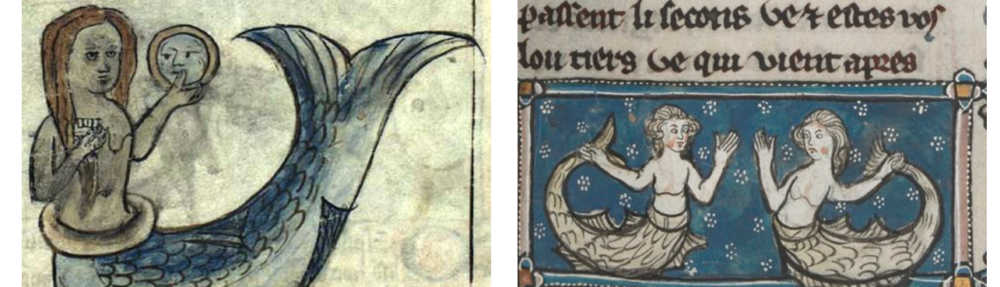
Week 3: Mermaids and The Unknown

After reading both assigned readings I enjoyed how Cristina Bacchilega and Marie Alohalani introduce mermaids as a species that haven’t been completely understood to its full capacity. Fear of the unknown is the best way to describe Merpeople, in this case, mermaids/sirend and the cautious yet curious feeling towards them, predominantly fear.

However, I find it interesting how the feeling of fear towards mermaids/sirens turned into disgust and hatred. As mentioned in The Penguin Book of Mermaids, prostitutes were referenced to as mermaids due to their sex appeal and seductive powers, which is how mermaids/sirens are represented doing to lead men to their deaths. This “likewise attests to how a woman who oversteps the boundaries of gender propriety has, over centuries, risked being defined as monstrous.” (Bacchilega & Alohalani XIII) Not only the unruly women in land were in danger to be classified as monsters but also those of water that didn’t follow the “norm” of pleasing and obeying men. It baffles me how open men were with their hatred towards women and their need to remind them how much they did, “you live here on earth as the world’s most imperfect creature: the scum of nature…” (Scribner 61) It is unfortunate how a feminine mythical creature was used as a mascot for the defamation of women and lasted throughout all those centuries, yet even though still recent mermaids and sirens have now become an image of feminine empowerment to slowly but surely heal that generational wound.

Week 5: Christian Themes and New Interest for Men

For this weeks reading, I found that there were more Christian themes and new interest for men. A lot of the stories we have read previously, where, somewhat putting women as mermaids in which they were sexualized, lusted, dangerous, but in this weeks, reading, we kind of continue that theme of the siren, where women now offer men knowledge. Some of the reading for me was a little bit difficult to understand, but what I picked up on from “The Legend of Melusina” and the other three versions of the same tale was sort of the curiosity of the unknown. This theme almost reminded me of somewhat the Christian sort of wanting the readers to fear this unknown or better yet stay true to their promises and have faith. The stories, in a way, reminded me of Adam and Eve, and not trusting that same serpent symbol. If Eve were to have simply listened to what God said, then there would be no trouble, and in this case, if the king were to have listened and not seen Melusina on Saturday, then all would have been well. It’s as if the church was trying to push the message that you need to have faith and discipline, regardless of your curiosity of the unknown; to essentially not be led into temptation. I just enjoyed how, in this case, the unknown was the sort of knowledge thing rather than the temptation of a woman’s body, or what women might dangerously do. This is the sort of spreading I was used to before coming into this class, rather than putting women into negative light in order to teach them and spread messages.

Week 5: Medieval Melusine

When looking over the reading from this week, the ‘Legend of Melusina’ chapter was quite interesting to read. The depiction of the relationship in between Elinas and Fay was quite interesting. When Elinas first sees her at the fountain, he is dealing with the grief of losing his wife. He is taken by her beauty and she had made him promise to never never see her at the time of her “lying-in”. When he did she left and took her three daughters will her, to a high mountain in Albania. I found it so interesting that when her daughter Melunisa came of age, she asked what her father had did, and then he pledged vengeance against him, which is where the story really begins. Melunisa then proceeds to get her sisters to join her in vengeance and they go to his castle to take him and all of his wealth, and inclose him with a charm. When her mother discovers this, she sentences Melunisa to become a serpent every Saturday for the rest of her being, and could find a husband who wouldn’t see her on Saturdays. In my head, I would have thought that the mother might be glad that Melunisa had done this to the King, but instead she is punished. I feel as this really shows the character of the mother, as she did not want revenge, unlike her daughter Melunisa. When she finds Raymond, he is so taken with her he agrees to these terms, until he breaks them. On page 88 when it says “But it was not the horror that seized him at the sight, it was the infinite anguish at the reflection that through his breach of faith he might lose his lovely wife for ever.” I found this quote to be specially sad and contribute to the story line. Raymond was not disturbed by the sight of his wife with a tail, but he was in pain over the fact that he knew he was going to lose her. This took me by surprise, because so far in all the readings, people have only ever been disturbed by the sight of something like this, something un-human. Raymond was different, he loved his wife so much that even though he might’ve been “un-human” at times, it didn’t matter to him. He knew he breached the trust and the oath between them on Saturdays, and he died. He would’ve rather been dead than without her, and call me crazy but I thought this story was beautifully romantic.

Week 5: Melusina

In this weeks reading of “The Penguin: Book of Mermaids” by Cristina Bacchilega and “The Romance of Faery Melusine”, we read the tragic story about Melusina. Although I did not fully understand it during my first read through, I couldn’t help but notice that this was essentially a cautionary tale about Karma. When her step-father broke his promise to Melusina’s mother and laid eyes on her when he was not supposed to, Melusina opted for revenge. She took her step-fathers money and charm and imprisoned him. This made her mother angry, resulting in Melusina being cursed in a similar way to how Melusina’s mother was originally cursed. Melusina went out, got married to a charming man named Raymond (or Raymondin), but was eventually met with a terrible fate when Raymond saw her in her serpent form when he wasn’t supposed to.

I found a lot of symbolism in the story of Melusina. The most obvious one was the fact that Melusina becomes a serpent from the waist down on Saturdays. I am not sure if this is relevant, but Saturday is the holy day for a lot of religions. In a lot of religions also, serpents are great symbols of evil, deception, and demonic creatures. The idea of Melusina being half serpent is also interesting because she claims she is “as faithful a Christian” (25) as Raymond. Turning into a serpent as a result of her wrongdoings is an excellent example of karma. She eventually had a happy life with the exception of her curse, which ultimately ruined her life in the same way the curse ruined her mothers marriage.

There seemed to be a strong theme regarding beauty and chivalry/masculinity as well. The story of the hunter shows a connection to chivalry and masculinity, which is interesting to read after the story of Melusina. Noble men are drawn to “things that lead them further into unknown… [seeking] in all directions the extension of their physical and spiritual power” (12). It is chivalrous to seek knowledge of the unknown, similar to how Odysseus longed to hear the siren song. Raymond was a chivalrous man who unintentionally committed a horrible act. Karma got him for his actions the same way karma got Melusina. He had a mostly happy life with a beautiful woman after his wrongdoing, but his wife ended up being cursed.

Week 5: Melusine

The importance and significance of beauty, attraction, and femininity are all things I have seen and observed in this class. The Faery at the Fountain engraves this in me even deeper, while these things were of importance in this tale, there were also other obvious aspects that I have not seen in stories before. I would like to say this story reminds me a lot of the damsel in distress trope, but the roles are reversed. Raymondin is on the run and seemingly lost when the faery Melusine comes to what seems to be his rescue. While the roles are reversed from what a typical story usually shares, Melusine did not emasculate Raymondin, at least not in my eyes but I am not exactly sure why. “It was always she, indeed, who led.” (p29). Since it is their first time meeting, it leads me to think that Raymondin is not the first nor last man with whom Melusine shares this type of encounter. In the lens mermaids, they both share this sort of enchanting and hypnotic entity, where the men simply cannot resist their beauty and in return the woman, in this case Melusine gives them some sort of knowledge or information. This is what we have seen in the case of mermaids and sirens, it’s interesting to see that faeries also carry this sort of captivating power. Another thing I noticed was the femininity of Melusine and how much of her hair is emphasized, “Then she began to comb it, and as he admired the fine silky, deep tresses he saw the wooden comb that had ran through them..” This was one of the similarities I noticed between the way both Melusine and mermaids have been depicted.

Reading Response Week 4

When reading more of the Penguin Book of Mermaids, I found it quite intriguing once I got past the introduction. The first story I read was Oannes, which was an interesting perspective from Babylonia where they discussed a Merman. I thought the relationship between the Merman and the people of Babylon was intriguing given it seemed to be such a peaceful relationship between the humans and Merman. He brought them insight into the letters/sciences, and other types of artwork that were unknown to them. It was a dual benefitting relationship. The story describes the merman as conversing with humans in a normal and beneficial way, which is not usually the narrative set in place when talking about the relationships between Mermen/Mermaids and humans. When moving on further into the book The Tuna of Lake Vaihiria, was one of my favorite stories for this weeks reading. When the princess Hina had found out that she was the be engaged to the Eel King, she immediately went to look for help from the Sun God. As the sun god was able to kill the Eel King he told her “He chopped off his great head, which he wrapped in tapa, and presented it to Hina,saying: Hold this and put it not down an instant until you arrive home; then take and plant it in the center of your mare ground. This eels head contains great treasures…” (16) As this continues we realize the significance of the eels head, and when Hina accidentally puts it down to swim, it sprouts the tree and its treasures. As the story goes on an Hina settles in this area, she meets the two sons, one which she marries. It seems is tragedy is connected with Hina, since she lost her first husband, married the other, and then lost a daughter. It was interesting to hear the story with the significance of the eel head, and how it affected the rest of Hina’s life. It also intrigued me because of the difference in stories, and how this one didn’t include a mermaid, but a different kind of “Monster.” Overall, I really enjoyed getting more into this reading and learning about the different cultures and the myths/stories that they share with us.

Week 4: The Tuna (Eel) of Lake Vaihira

From the readings I want to focus on “The Tuna (Eel) of Lake Vaihiria”, the Tuna emerges as a powerful symbol with great cultural importance, adding layers to the story. The Tuna, a creature submerged in the waters of Lake Vaihiria, transcends its aquatic origins to become a powerful symbol within the narrative. Tuna can be interpreted as a metaphor for perseverance and adaptability. The story’s characters face hurdles and endure transformation, similar to the eel’s ability to navigate varied habitats. The Tuna’s elusive and mysterious nature reflects the complexity of life, providing a symbolic lens through which the audience can participate with the story. The Tuna plays a critical role in the story’s complex cultural significance. It serves as a cultural icon, representing the characters’ interconnectedness with their surroundings. The devotion and ceremonies surrounding the Tuna highlight the importance of harmony with nature in the community described in the story. The narrative of the Tuna, reinforces the cultural values of respects for the environment, sustainable living, and the preservation of traditions passed down through generations. The Tuna, as a symbol, enables readers to explore the layers of meaning inside the story. Analyzing its symbolism can reveal insights into the author’s intended themes and messages, providing a more named perspective on the story’s central ideas. The Tuna’s cultural significance provides insight on the community’s values and customs. Understanding its position in rituals and traditions gives readers a glimpse into the cultural tapestry represented in the story, allowing them to understand the richness and authenticity of the setting.

Week 4: Oannes, Yorgos Lathimos’s “Poor Things,” and My Need for More Not-Mermaid Mermaid Movies

Last Friday, I decided to head over to the Fashion Valley Mall right after class to catch a movie as a sort of treat to myself. The movie I ended up watching was Yorgos Lathimos’s “Poor Things,” starring Emma Stone, Willem Dafoe, Marc Ruffalo, and Ramy Youssef. The movie was based on a book by the same name, written by Alasdair Gray, which depicts the adventures of a woman named Bella Baxter, who has the brain of an infant but the body of a woman in her 20s-30s, and her coming-of-age journey of self-discovery.

Initially, I was drawn to the Frankenstein-like premise of the movie because, besides all things mermaid, I also love all things Frankenstein. Of course, the movie delivered on that end–Willem Dafoe playing a doctor named Godwin Baxter, altering and reviving the corpse that would become Bella Baxter and the inevitable parental issues that immediately followed.

What I did not expect was how mermaid-y the movie was, despite not being explicitly about mermaids. Bella, played by the brilliant Emma Stone, is your quintessential mermaid-turned-human–a fish out of water, with long hair and a thirst for knowledge, curiosity in spades, and possessing no desire and making no attempt to blend in with polite society and its arbitrary rules and regulations. Marc Ruffalo’s character, Duncan Wedderburn, is your typical human man in a mermaid story. His presence in the movie irked me to no end because of how presumptuous he was to think that he could handle Bella’s quirks and curiosity, but gladdened me to see his attempts to control Bella and quash her thirst for knowledge did not come to no fruition but instead frustrated him to the hilarious level of absolute loser.

It was Bella’s desire to seek more knowledge and her ability to retain that knowledge that clued me in on the mermaid-y qualities of the movie, as it reminded me of the Babylonian water spirit Oannes. According to The Penguin Book of Mermaids, in Babylonian mythology, “hybrid creatures are associated with the sea are holders of knowledge,” especially in the case of Oannes. (Bacchilega, et. al., 3) Oannes gifted humans “insight into letters, and sciences, and every other art” essentially teaching humans “everything which could tend to soften manners and humanize mankind.” (Bacchilega, et. al., 3) Throughout the movie, Bella’s curiosity is seen as a boon to both the viewers and the characters around her, questioning societal norms and actively seeking ways to improve herself through the acquisition of more knowledge and improving others by sharing said knowledge. The best part is that the movie rewards Bella’s curiosity by allowing characters to exist that accept and encourage her desire for more knowledge and even open themselves up to acquiring more knowledge for themselves.

All in all, it was an incredible movie and I hope it comes out on-demand or on streaming platforms soon so I can watch it over and over again and relish in my newfound love and desire for more not-mermaid mermaid movies.

Week 4: Oannes and Sedna

How were both readings relevant to the course? Well we are learning about Mermaids and what it entails about the environment. In the Readings about Oannes and Sedna we see how their stories play a role in their environments. For Sedna, it’s said she has control over the animals of the sea and the hunters depend on those animals as a source of food. So in this story, Sedna affects the environment because the people believe the sea animals appear when Sedna is happy and disappear when she is upset. This belief leads people to try and make Sedna happy and even feed the animals fresh water before eating them. In comparison, Oannes comes from the water onto earth to help the human environment progress. He helped around with food, infrastructure, and other helpful knowledge for further advancements. So both Sedna and Oannes are sea creatures (merpeople) with human and fish features who affect their environment. 

Week 4: Ancient Origin Myths – Rigo De Leon

In this weeks readings, I couldn’t help but notice how respectful and optimistic myths were towards nature. In the story about Oannes, Oannes is a fish and human hybrid that is well respected by the people of Chaldea. He shares his knowledge with people in order to “soften manners and humanize mankind” (Bacchilega 34), which is interesting because his actions imply that humans are not civil beings, but are animalistic and hostile. People respect Oannes and he respects them back, despite potentially being a fish god. This type of respect is again seen in Kaliya, the Snakes story, which takes place in a completely different part of the world. Despite being an evil snake, Kaliya is given another chance after being defeated. He genuinely reforms, pleading that it is his proper nature as a snake, which he was born into (Bacchilega 39). Meanwhile, Krishna receives love and praise from the cowherders and their wives. I found it really interesting how Krishna was able to unite everybody while giving Kaliya the opportunity to seek redemption.

The story of “The Tuna of Lake Vaihiria” differs from the previous two stories by showing a different side of nature and beasts. The Eel that wants to marry Hina is evil, unlike the two dieties in the other stories. I found it incredibly interesting that the only story with a female protagonist showed the protagonist going through a lot of trauma, such as being forced to marry the evil eel, and accidentally setting down the Eels head. I am not sure if this is intentional to add to mermaids symbolism towards feminism, or if it is just a coincidence. Although she experiences a lot of trauma, she still has a happy ending and grows old with her coconut tree. Overall, these stories were extremely insightful as to how nature and the ocean were tied to Gods and other powerful beings. It is fascinating to see how different cultures respected nature so similarly despite being so different.