Post Human Entanglements in Contemporary Poetry

Dr. Antje Schmidt’s talk on post-human entanglements in contemporary poetry taught me several things. Still, one of the things I felt was most relevant to me and our class was regarding the importance of political and cultural situations occurring at the time certain things are written and published. During her presentation, she focuses on the work of Carla Cerda who is a biologist, poet and author of Loops. Loops is a series of poems all connected and intertwined with one another, where both the author and reader are included in this sort of journey up and down an elevator which seem to represent many different scenarios.

In one instance, Dr. Antje Schmidt pointed out the relevance of one poem and how Cerda took a real life issue that occured regarding lithium mining, and how it affected flamingos. In the poem, there is a line where she talks about the lithium shining on the feathers of flamingos. I felt its important because if I would’ve read this poem it might hav caught me off guard to see her talking about flamingos, but when looking at the context in which the world was in at the time it makes a lot of sense.

In learning this, so far it has helped me think and do some research on other literature I may be consuming, especially in our class. Since a lot of the texts we read, are not modern, i think this was helpful in showing me how important it is to look at the background of literature and see what important events were happening at the time to understand the relevance of said literature.

Week 7: The little Mermaid

This week’s reading focused on Hans Christian Anderson’s “Little Mermaid” folktale. I have never read the original story of the little mermaid and found so many similarities to the Disney adaptation of it. What I found that Disney kept the most similar in the adaptation was the fact that this is sort of a coming of age story. It seems like there’s always a theme to each of these mermaid stories that the mermaid is just a symbol for something larger; they’re always meant to teach us, and that brings me back to the roots of the word monster having meanings of teaching. In this folktale specifically, it seemed like a coming of age story mostly, sprinkled in with Christian values and expected gender roles. The grandmother in the story makes this tradition around the 15th birthday as when “[they] have accomplished your 15th year” (page 109), they were able to go up and see the world above. The 15th birthday held much significance in this story as that was the age the young mermaids were allowed see the entire world for the first time. This tradition reminds me of the Mexican tradition, where on your 15th birthday you’re basically seen as an adult as a young woman, and have a Quinceañera. I can see a lot of history, sort of repeating itself within the stories and everyone as a society having the similar culture just in different fonts. I think that significant because it really shows how similar we are as human beings, regardless of where we come from and when we came from. This notion of you vs the unknown really goes away when you realize our similarities even when it is portrayed through something so different, such as a mermaid.

(posted before 6pm, just edited a typo)

The Little Mermaid

This week, we finally read an all-time classic, “The Little Mermaid” by Hans Christian Anderson. Some of the main themes I wanted to focus on in this blog post are the ideas of pain being normalized in feminism and also the idea of belonging to a group or place.

The little mermaid is told by an older, wiser mermaid that “pain must suffer pride” because she was wearing uncomfortable clothing. The little mermaid, being youngest of her sisters, grew up watching her siblings enter womanhood feeling equally uncomfortable. This is something that I feel a lot of young women see growing up, which in a way could be conditioning them to accept a life of pain because it’s “normal”. But why is it normal? The little mermaid feels immense pain in her legs every time she takes a step. It is almost as if she is being punished for being curious, in the same way Raymondin was. I’ve noticed that in a lot of the stories we have read in class, people who are curious tend to be punished.

Another interesting thing from the reading is the idea that Mermaids do not have souls while humans do, and they are aware of this. Mermaids are only given souls if “a priest lay his right hand” (pg 144) on them in order to officiate a marriage. This idea taps into the subconscious beliefs that Christianity has planted in both men and women that marriage is a necessity to have a completed life. But there is really nothing natural about marriage, it is a man-made concept. I love this idea because if souls exist, they have absolutely nothing to do with man-made concepts, they’d be natural and work in natural ways. Meanwhile, people are reading these popular stories, and while they may not necessarily believe they need matrimony in order to have a soul, they could potentially unintentionally develop the need to find a partner for marriage in order to truly feel complete.

This reading caught me off guard. I did not expect to enjoy this chapter as much as I did, and I feel that the reason for this is because the ideas of feminism and the symbolism are extremely telling of how society was at the time. It’s interesting to see how much yet how little has changed since then.

The Little Mermaid and the parallels of an Immigrant Experience

When reading Chris Hans Anderson’s The Little Mermaid, many things came to mind, including the barriers of humans and nature, and things like sacrifice and selflessness. The little mermaid sisters and family were the one thing I could not stop thinking about when and even after finishing. It is clear that the little mermaid upon leaving was in distress and knew she would miss her sisters, her grandmother, and her family in general,”, now that she was dumb and was about to leave them forever. Her heart seemed ready to burst with anguish.” (pg123, Bacchilega). One of the many glimpses of sacrifice in our story is that she continues to leave her family and home behind, hoping to find love with our human prince.

After reading, I asked myself why I could not stop thinking of the sisters she left behind and how now being a daughter of the air, could not return to see her family. It reminded me of a story all too familiar. Growing up as a first-generation Mexican-American, it was exactly the story of my parents and their siblings. Leaving a country, in this case, the sea, for better opportunities, for the mermaid the chance of “true love,” and never being able to return. The Little Mermaid experience parallels the dreams and aspirations of many immigrants looking to leave their homes. A few other parallels I noticed were the struggle with identity, cultural assimilation, and sacrifice. The main one I would like to expand on is the yearning for belonging. Like the little mermaid, immigrants, and the children go through life feeling the same longing, being caught between two cultures and not feeling fit for either of them. In one sense there is a desire to return home, like the little mermaid longing for her sisters or family, but on the other hand, there is a stronger desire to pursue your opportunities and assimilate to a new culture.

The Little Mermaid to me, served as an allegory for the complexities of the immigrant experience. Which I greatly appreciated, and was definitely caught by surprise.

Week 7 – The Little Mermaid

After reading Hans Christian Andersen’s “The Little Mermaid” I noticed a huge connection between the human world and the unknown world of the environment. There is a common theme of curiosity present in this story that I have found to connect mermaids to people. This is the first story I have found to paint mermaids in a completely positive light. Andersen describes the little mermaid as lovely and delicate. She is very curious about the unknown which to her is the human world. This connects her to humans immediately as we have been learning through past stories, such as the Siren Story and Melusine, that humans have been curious about exploring the unknown world of creatures like mermaids. The Little Mermaid’s curiosity shows the readers that these unknown creatures are not as different from humans as one might think. The Little Mermaid is desperately awaiting the day she gets to go up to shore and experience part of the human world, similar to humans who have hundreds of tales told about their curiosity about mermaids and other creatures.

The Little Mermaid’s curiosity leads her to take control of her own life as she gets older and becomes more independent. She is just turning 15 when she is allowed to go up to shore. She learns to care for the prince, saving him from death, despite their differences. She does not fear going to help him or what the consequences of that could lead to. This part of the story also contributes to this new way of looking at mermaids in a positive light. “His arms and legs began to feel powerless, his beautiful eyes were closed, and he would have died had not the little mermaid come to his assistance” (115). A creature who has so often been looked at as a “monster” is now being shown as the hero. Rather than gaining power from saving his life, as men would typically do in these types of tales, she just becomes more curious. She acts just like a human girl, becoming completely enthralled with the prince whom she loves so dearly. The love for the prince leads her to take her curiosity to the next level and entwine their souls. She takes the risk of listening to the witch to fulfill her desires. The little mermaid is okay with the fact that she will die if it means she has a chance at love with the prince. Her curiosity took her far and she still ended up gaining an immortal soul because she sacrificed herself instead of the prince.

From Demons to…Angels?

After reading the story of Undine, it is abundantly clear that Melusine’s impact on the image of the mermaid in historical literature has turned the once-damned creatures into pious women, desperate to be ever closer to God.

Undine’s sweet nature and her devotion to Huldbrand directly mirrors that of Melusine to Raymond, giving both mermaids an innocent and pure aura about them. This demeanor is of course further emphasized by both mermaid’s decrees of holiness.

Just as Melusine declares to Raymond that she “is as faithful a Christian as [he is]” (The Romance of Melusina, 25), Undine “entreated [the priest] with an agitated tone to pray for the welfare of her soul” (Undine, 101). Undine is also described as “mild and gentle as an angel” (103), which is a stark contrast to the stories of sinful and villainous sirens that were pedaled by the church in it’s past. In this way, it is clear the iconic influence Melusine had on shaping the newfound saintly view of mermaids that were once used as a comparison to debauchery. These mermaids are good Christians, who are concerned with obtaining and protecting their immortal souls, serving as a means for the church to further maintain control of women’s place in society.

Melusine and Undine together promote messages that women are not entitled to their secrets, as Melusine is punished for keeping hers and Undine rushes to reveal her own. They also communicate that to earn the privilege to be loved, a woman must be serving to both God and to her husband.

By twisting and warping the image of the mermaid, and therefore, the image of women as an obscure species, the church maintains control of how women are to exist—what they will be punished for, and what they will be rewarded for. These stories serve as an underscored warning to women about how they must act if they are to be seen as anything but deranged monsters.

Week 6: Undine, Huldbrand, and Christianity

In this weeks reading of “The Penguin Book of Mermaids” by Cristina Baccheliga, I was mainly interested in the idea of Undine, a water goddess, needing to marry a powerless mortal man in order to gain a soul. The reason I was fixated on this idea is because the story seems to create this logic that women are soulless beings that absolutely require a man in order to be complete. I don’t know if I interpreted the reading correctly, but it almost feels like Undine’s significant power was being undermined and overshadowed by the need for a man. This story was written by a man in 1811, and that context tells me that this was a subconscious thought that was shared by men in these decades. True feminist movements wouldn’t begin until about 150 years after this was written.

Despite the unfortunate context of the story, I did appreciate the overall happy ending, as those have not been very common so far. Huldbrand fully “embraced her with the most heartfelt emotion and love” after she revealed that she was not human. Undine was able to keep her new soul but gave up her power as a body of water. While I will admit that the pretext confused me a bit as it seems to contradict the contents of the story, it was an interesting parallel to see how this semi-human entity reacted to a man compared to the sirens with Oddyseus or Melusine with Raymondin. One difference that I found between this story and the others is that Huldbrand seems to be a completely well rounded man, whereas Raymondin was unintentionally a murderer that did not pay the price for his wrongdoings. My theory is that God, or the universe, made an effort for Raymondin to pay for his sins by making him ruin his relationship with Melusine. Huldbrand, on the other hand, has committed no wrongdoings and so he gets to live happily with his wife who shares similar characteristics as Melusine. This would make sense as Christianity was huge in the 1800s and the idea of sinning was taken a lot more seriously than it is today.

Week 6: The Mermaid Craze

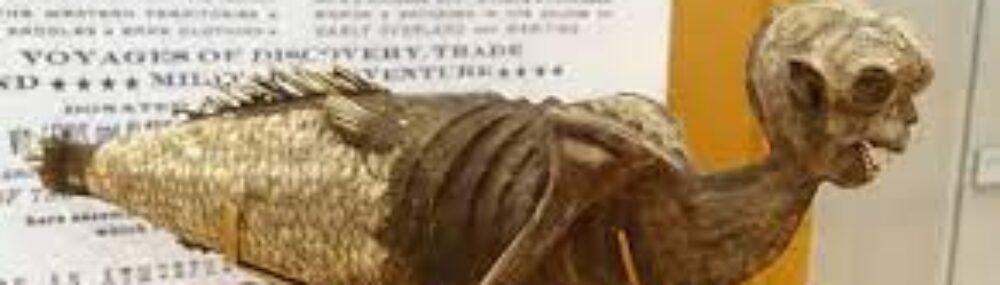
Although I wanted to touch on the idea that this week, at least in the section we read, we finally see a cute love story between a man and mermaid, the overwhelming amount of aha moments I had reading about the mermaid boom essentially warrants its own blog post. The readings pertaining to “The Feejee Mermaid Hoax” (Penguin, 239-244) and “Freakshows and Fantasies” (Vaughn Scribner’s Merpeople) opened my eyes to the answer of why humans are, and have been, so fascinated by mermaids for centuries. As we’ve been reading throughout this class, mermaid tales have been told and recorded for a very long time but I think the Feejee mermaid hoax boosted its popularity for the 1840s. This showman was able to gain a lot of traction on his “discovery” as the Enlightenment was not too far before this time; an era of new thinking and ideas, surely a hybrid human would take the worlds interest with both hands. Although, like we all know, this discovery was a hoax, it did the job on captivating the world once more of this hybrid creature as one of the papers covering the story only discusses the Feejee mermaid in its’ first paragraph while “—the rest is essentially a chronology of mermaid sightings” (Penguin, 240), sparking conversation once again.

Then the transition from learning about this worldwide hoax to reading chapter 4 “Freakshows and Fantasies” you get a clear understanding on how curiosity and curiosities were able to captivate the minds of many people around the world. During this era, 1800-1850s, many Americans were certainly advancing as a nation but still had much to learn as they introduced coal powered engines but weren’t wearing gloves for surgery until a bit later. Therefore with this sort of contradicting, mindset era, playing out the idea of a hybrid beast being out there, but not actually seeing it was somewhat more close to reality than it might be today. Also, the press had a big factor in the culture of this time; there was no Internet, so the newspaper was as bad as real factual information you could receive. Therefore, if the newspaper said there was a mermaid sighting then maybe there actually was. This chapter also mentions how even in the scientific third wave of this mermaid craze people still hoped “—for a brief escape from their hard realities of their daily [lives] more than a peek into mystical wonder.” That quote says it all: essentially we have used this mermaid symbol to teach, to push religious values, to warn, and now for an escape. The mermaid wether it be real or not physically never ceases to legitimize that creative, wondrous spark of hope in our minds and hearts. That’s why myths and legends weather they’re real or not, are able to craft morals and values because of the magical element they hold, and therefore mesmerize a reader.

Week 6: Tricked by the Feejee Mermaid

Good evening, everyone.

This week’s reading took me on a trip through time, back to when I was about 6 years old. In elementary school, I would always listen to The Show on Rock 105.3 – a talk show hosted by younger people talking about things I was far too young to be hearing about – on my way to school every morning. I remember one day, they talked about the Feejee Mermaid – they were trying to figure out whether it was real or not. I think it was a bit, often the cast of the show would poke fun at how gullible and silly Boston Rob (one of the hosts) was – so perhaps they were trying to gaslight him into believing the hoax. But to me, I was sold on the idea that the hideous half-man, half-monkey they would make jokes about existed. When I got home from school I hopped on the family Mac and looked up the hoax for myself. Seeing as I was 6, I expertly ignored all the big words that disproved the Feejee mermaids existence. I was amazed and proceeded to tell everyone I saw and met about it for about a week – and then I forgot about it and moved on with my life until this weeks reading. Even reading the words “Feejee Mermaid Hoax” didn’t connect those dots in my head until I looked it up on google images. It was fun reliving that really small but exciting time of my life.

Discovery Blog: Fortunio and the Siren

For my preparation of next week’s class, I did not read the right/ the assigned tale. Nevertheless, as I found it highly interesting, I thought that I could write my discovery blog and share my findings:

This reading focuses on Fortunio. Fortunio was adopted as an orphan by a loving family, who could not have children on their own. Due to his secret power, he has wished for a sibling, so that his mother got pregnant. Years later, in a fight, Fortunio’s brother Valentino tells Fortunio that he is not the legitimate son of their parents. In his sorrow, Fortunio decides to leave his home, when his mother comes up to him and curses him to be swallowed up by sirens if he ever went on an adventure on the sea. Fortunio ignores his mother’s curse and travels to the west, where he encounters a dispute between a wolf, an ant and an eagle, that were discussing over eating a deer. Fortunio helps them dividing the food properly and they gift him the power to turn into each of the animals whenever he needs to and they part ways. On his adventure, he sees the Princess Doralice of Polonia, who is now promised to a bad looking man called Saracen that won Doralice as a bride. In the following days, he uses his power to transform into the different animals to get to know Doralice better. Doralice and Fortunio thus fall in love with each other and they marry. After they have married, Fortunio decides to travel the sea, where he gets caught by a siren’s song and gets swallowed by the sea, just as he his mother predicted it. After two years of her husband being gone, Doralice and their son decide to look for him to get him out from the siren. Doralice manages to free her husband from the siren’s hostage, when he suddenly uses his power again to turn into an eagle to escape to the ship. Back home, he lastly turns into a wolf to devour his mother and brother. (cf. Penguin, pgs. 89-100).

Reading this tale especially caught my interest, because it made me aware of the deep connection humans and the natural environment have that we now lost. Besides of the fact that the “dangerous” siren caught Fortunio and held him into hostage (and that he was too greedy to accept that he has everything he has ever dreamed of and did not want to stop), I found it even more interesting to see how deeply connected humans and animals can be. Fortunio never, not even a second, thought about the danger of approaching dangerous animals such as a wolf or an eagle. By helping them and approaching them with curiosity, he got to be a part of their world and could understand better, how both humans and animals can coexist together without harming one another. He even cares about a smaller animal such as the ant to get a fair share of the food. It is, as if Fortunio was able to recognize everybody’s existence in this world. Through respect, they become part of one world and there is no us-vs-them society. When I thought about that a little bit more, I got aware that we humans have lost the mutual respect to our nature. If we were a little bit more respectful towards our environment, we would be able to all live in peace together. Instead, humanity’s greed causes severe effects on our natural surroundings. Deforestation which causes the loss of the natural habitats of animals or anthropological natural disasters were only a few of the examples that directly came to my mind. We should all be a little bit like Fortunio and appreciate our coexistence with other living beings on this world.