Week 4: Gender roles slightly reversed

In this week’s readings, “The Penguin Book of Mermaids”, I was really interested to see that in some aspects women figures like sirens were not seen as sexual, where, as we finally are introduced to some male creatures, for lack of better word, and they are on that flipside of being dangerous and predatory. In the chapter regarding “Odysseus and the sirens“ Sirens were more regarded as having “the law and knowledge [they] Held in antiquity, had to do with life and death, or knowing The future beyond human ability— Not so much with sexuality” (Brown, 9). I thought the view of this siren was probably the first time I encountered a perspective where they put A woman like in a positive light. Many of our other readings are to say that women are sexual, deceptive, dangerous, and so on, whereas in this interpretation, they have much to give; Far more than just their outward appearances and pleasure. The same page even goes onto emphasize this perspective by explaining how Odysseus is “subject to erotic temptation more than once— But the sirens law is a different kind”. The next sentence goes onto explain how “Homer’s Sirens sing a song that promises knowledge— A wisdom that bridges world— Instead of pleasure.” As I mentioned, before, if the reader didn’t understand that the sirens were not meant to be put in the box of sexual desire or deception, but that The siren song was putting out more valuable promise. Another way to interpret perhaps, Put men in a better light that they don’t simply crave sex and physicality from women but instead, they crave knowledge and power; creating a new theme of lifting up men without putting down women for once.

Adding onto the Idea of gender swaps, in the chapter regarding “The Tuna (Eel) of Lake Vaihira”, the eel character is said to have raped his beloved, princess bride. In this case, and throughout the whole story, the female character seems to be a respectable character rather than the eel, who could be described as menacing, yet still powerful, but ultimately unfavorably dangerous. Although one may counterclaim and say, the princess is a damsel in distress, following tired gender-norm, I would argue that this is one of those few times in the stories where you can see how the strong desire for women can be harmful; teaching men to be respectable, rather than to paint women as these sex-crazed, dangerous monsters.

Week 4: A Collection of Observations – Kāliya, the Snake

I took some notes during my reading of ‘Kāliya, the Snake’. I don’t know a super coherent way to organize my thoughts here, so I am going to separate them by bullet points.

  • “Serpent worship is among the world’s oldest and most widespread religious practices.” This surprised me. Maybe it’s because I was raised, and the snake is a symbol of the Devil in Christian/Catholic ideologies. It might be because my dad has an ungodly fear of snakes, so I’ve always seen them as something to avoid and not to worship. Maybe I’ve been living under a rock – either way, it’s cool. The only snake-like God or deity I can imagine is Geb from Ancient Egypt.
  • “Then he came upon the river Yamunā, whose waves were tossing about as if she were laughing, throwing patches of foam on the banks.” I really like the use of personification to describe the river Yamunā. I firmly believe one of the fundamental problems with us as a species is how we stopped looking at the natural world as its own being. I don’t know if that makes any sense. To most people words like ‘lake’, ‘river’, ‘tree’, ‘mountain’, etc. are just that – words. They are void of personality and I’d be willing to bet for a lot of people, placing humanlike behaviors on these words would be considered weird or hippy-esque. As a species, it almost seems like we stopped trying to understand the natural world – we replaced that connection with the hellbent desire to conquer it. We stopped adapting to Earth, now Earth has to adapt to us. Unfortunately I think its too late to turn the tides on humanity (singular) we view our planet.
  • “How can I, a mere woman, describe you? . . . Since silly women and miserable creatures are to be pitied by the virtuous, please forgive this wretched creature, you who are eminent among the forgiving!” Once again, gross gross GROSS. It’s so crazy to write a story and have a woman just blatantly say this. I’m assuming this story was passed down orally in Hindu for centuries, so for centuries these ideals were fed to young boys and girls. I know that this note isn’t very constructive as its saying somethings thats already been said and will probably be said for the rest of our course from time to time – but golly, this undisguised degradation of women as an entirety is so baffling and strange.

Week 1: Introduction

Hello everyone, my name is Daniella Sanchez and I’m a transfer English student from Imperial Valley College. My plan is to apply to the teaching credential program once I acquire my B.A next year. I commute everyday from Calexico to SDSU, it’s tough work but I manage. I was intrigued with this class when I first read the reviews in “rate my professor” on how there is a huge focus on mermaids and it’s effect on society, I was hooked. This feeling of curiosity grew once I stepped foot in class. Mermaids had always been a fairytale for me, however, after hearing everyone’s take on mermaids throughout different points of history my gears began to turn. I’m eager to be in this class and learn more about mermaids/mermen and their position/purpose in society.

Week 2/3 Reading Anaylsis

When I walked out of the first day of class I was left wondering how I got myself signed up for a college course centered on mermaids and thought to myself I was either going to love it or hate it. After our initial discussion on Thursday and reading through the first few chapters of Vaughn Scribner’s “Merpeople” I have already begun to take an increased interest in the variety of lenses with which we can approach the subject of mermaids to explore what they symbolize and the importance of their persistence throughout generations of many different human societies and cultures. The in-class analysis of the etymology of certain words such as environment, nature, and monster sparked some ideas in my head about the way humans have defined themselves in relation to the “natural world.” I found it incredibly interesting that nature was first defined in terms of human nature as a description of people and later amended the definition to what is commonly known today. This sequencing of these definitions leads me to believe that people initially considered themselves to be separate from the natural world and later realized that the relationship is much more complex.

The word that has stuck in my head the most throughout our first classes and readings, as it pertains to mermaids, is hybrid. The mermaid, being a hybrid mix of human and animal is the perfect symbol to represent how human beings are a part of nature while also separate. The fact the upper half of the mermaid is human is also symbolic in a sense that the familiar human characteristics that supposedly set humans apart from animals such as the potential for conscience thoughts and the ability to use our hands in contrast with the lower half which binds the mermaid to the ocean and natural world. The way humans defined nature creates a hybrid situation similar to that of the mermaid, as much as our human qualities separate us and make us different there is no way to separate ourselves from nature, we are a part of it regardless of our greater potential to alter the natural world.

My parting question for the week pertaining to etymology that I am interested to explore more throughout the semester is: “How we define what it means to be human?” People have mimicked animals in their creations, and we have witnessed certain animals mimicking human behaviors. For example, we designed airplanes with birds flight as a model and we have taught chimpanzees and gorillas to communicate in human sign language, which in my mind leaves a lot of grey areas for defining how we could possibly be 100% separate from nature. A final note in regard to my “man-made” comment in class on Thursday, I thought a lot about this since that class and one thing that initially I thought of as a defining difference was the way we build structures and homes, however this is evident for animals as well in bird nests, beaver dams, burrowing communities, etc.

Week 1 Introduction

Hello everybody! My name is Richie, and this is my first year attending San Diego State after transferring from community college in the area. I was born and raised in North County near Encinitas and Carlsbad, and I spent most of my time as a kid outdoors playing baseball or at the beach, which has led me to my passion for environmental sciences and my major, sustainability, because I would like to preserve our resources in order to allow future generations to have the same sorts of experiences that I was able to growing up. I recently adopted a kitten, my first pet, her name is Rosie and she is 5 months old and spending time with her has been my number one hobby lately. I was a little skeptical about the whole mermaid thing after the first day, however I loved the first classes and readings and I’m looking forward to a great semester with everyone and excited to have a passionate professor to teach the subject matter. Ya’ll can reach out whenever I’m always happy to meet new people!
-Richie

Week 2 – Reading Post

In this weeks reading of “Merpeople: A Human History” by Vaughn Scribner, I was completely fascinated by the Catholic Church’s involvement in the use of mermaids to manipulate the general public. When I began reading, I mostly expected the reading material to mainly feature the evolution of mermaids throughout different cultures. I had no idea that mermaids were instruments of manipulation for the Catholic Church, which intended to use mermaid imagery to “dethrone femininity” (Scribner 12). Painting mermaids in an overly sexual light, the church used mermaids to symbolize seductive beings that made men fall into their lustful desires. Ultimately, the Church was using these creatures to spread their propaganda about sinning.

The Catholic Church benefited from the globalization of mermaids in Western, Eastern, and African folklore, because it further pushed their agendas. Sailors across the world would make claims about interacting with mermaids, and their “encounters resonated with the Christian Church’s imagery” and further pushed the Church’s “efforts to denigrate the feminine” (Scribner 56). My focus on the Catholic Church with these chapters comes from the idea that mermaids could not possibly be the only things that the Catholic Church used to manipulate people. By studying how effective the use of mermaids was, it gives me the ambition to look into what else the Church has used to maintain relevancy. Science has only been a generally accepted concept for a couple centuries, yet society has existed for thousands of years. Even in modern media that I can recall, mermaids are still commonly sexualized, which could still subconsciously push the old agendas of the Church.

I grew up going to Catholic Church, and I cannot recall ever seeing any mermaids, or any mythical creatures besides angels and demons in paintings inside of the church. It is extremely fascinating to me to see how the same Church I grew up attending used manipulation tactics to push their agenda. It is also interesting to me to see what the church’s agendas were as the church was developing. It makes me wonder if this type of behavior is still happening in the Church, but with more modern methods.

Week 2 Merpeople: A Human History

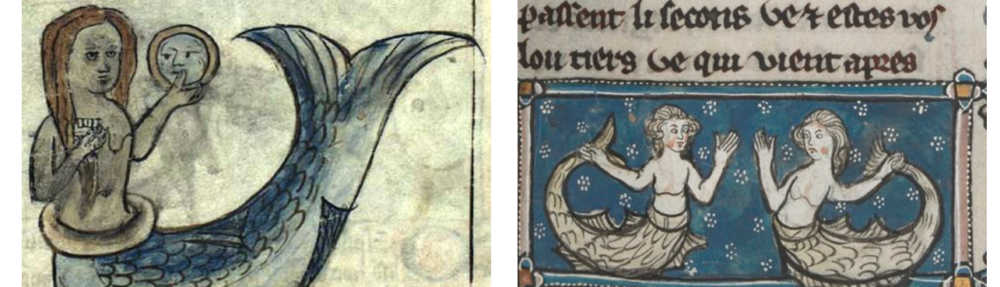
After reading Chapter 1, I was intrigued by the growth of mermaid mythology, which revealed that these enigmatic beings underwent a tremendous shift over the medieval and Renaissance periods. These mythical creatures were diverse, representing both beauty and danger across cultures. As the story evolved into the medieval era, I became interested in how the Church Christianized mermaids. The deliberate use of mermaids in Christian imagery shows a complicated interplay between church power and society narratives. Christianity merged with old pagan ideas, ushering in a new era of mermaid symbolism. The Church’s use of mermaids to communicate ideas about masculinity, femininity, wonder, and danger became an intriguing component of medieval art and sculpture. Moving on to the medieval interpretation, Pliny the Elder’s “Natural History” and later bestiaries depicted tritons and nereids vividly. It was fascinating to see how medieval historians, influenced by Pliny’s descriptions, regarded these beings as half-human, half-fish. The following sexualization of mermaids in illuminated manuscripts was a fascinating look at the junction of religious symbolism and artistic freedom. The contrasted images of mermen, frequently dressed in monk’s robes, emphasized the Church’s emphasis on piety and self-discipline. The recorded encounters with merpeople during medieval times helped to bridge the gap between myth and reality, supporting the Church’s vision. Folktales depicting mermaids as terrible sirens capable of causing men to suffer and die added another layer to the unfolding storyline. The journey through the evolution of mermaid mythology was more than just a chronological progression; it was also an engrossing investigation of the relationship between mythology, religion, and societal attitudes. From ancient myths to Christianized emblems, the mermaid’s transformation reflected larger transformations in cultural perceptions and religious power relations, finally ingraining these mythical figures profoundly into Western folklore and society.

Week 2 or three reading: Mermaids in different cultures

After this weeks reading, in the Penguin Book of mermaids, I noticed the different types of representation of Mermaids in different cultures. I noticed this when reading about sirens versus mermaids, and how they used to be two different distinct creatures that now are sometimes meshed as one. Specifically I can see this difference when they were talking about how the British saw mermaids, and were compared sometimes to prostitutes and sexual symbols instead of monsters. Mermaids had anew definition of what it was to be feminine or sexual, instead of a monster, which what other cultures had seen them as. We can see this with the Greek, who saw them more as Sirens and monsters, who lured men to their death and demise with their song. When contrasting how these two different cultures saw Mermaids/Sirens, I can clearly see the distinction between monsters and humans. Mermaids innately are human-like, human upper body and fish tail, which is why they are seen as creatures. A lot of different cultures have different representations, but most of them are sexualized and objectified in some way. This was quite interesting to read about, and how Mermaids/Sirens are the same and different all at once. There are stories about Mermaids being tamed, mainly in British culture, where they have been more objectified as sex symbols than other cultures. They have been seen as monstrous and sexual at the same time. I found these different cultural representations of the Mermaid to be quite interesting, since I had only really seen the girlish version of the Mermaid, like in Emily Windsnap, which I read as a child, so seeing these more monstrous and sexual representations was quite a different perspective. This view on mermaids and how gender and sexuality comes into the perspective also was an interesting take, and how in different cultures some tired to “tame” mermaids, while some could not. Humans have always had a fascination with mermaids, but different cultures have different takes on this.

Kiersten Brown

Week 3: Penguin Book of Mermaids

The The Penguin Book of Mermaids begins by discussing the history of mermaids from various perspectives. I found this information to be necessary as a precursor to our studies, especially for us who have a lack of knowledge on the subject. I thought it was interesting that we discussed the human views of nonhuman and monstrous beings in class, and that it was demonstrated again in the idea that “There is something deeply unsettling about a being whose form merges the human with the nonhuman”(p. xi). This made me wonder what direction the stories in this book will lead towards, whether they will admire the nonhuman or not. What is so unsettling? Is this just human opinion or do these creatures have evil traits? I am curious to uncover the truth from each culture.

Another point I find fascinating, is the course of a story and how “stories move about in the world in ways that are comparable to ocean currents, following a course as they move”(xv). First off, I think this is a fantastic metaphor to describe the constant evolution of story telling and it brings up a great point. How do we know what began in these stories and what has shifted through storytelling? I am eager to keep reading to uncover these mysteries.

Merpeople

In Merpeople “A Human History” the historical background of mermaids is discussed and has brought a great amount of new perspectives. Prior to this my understanding of mermaids was slim to none, sure I have enjoyed fictional works with mermaids, but I have never questioned the history behind these creatures. After studying this I am fascinated but also not surprised as the traditional views of women remain similar to the historic understanding mermaids. The way that mermaids are perceived as sexual and objective is similar to the way that women were, and still are, viewed in life and various fictions. Similarly, stereotypes between mermen and man linger simultaneously. The idea that they are with “lust for sex and power”( Scribner,11) does not fall short of how they are perceived in a non-mermaid world. With that being said, there are ways were I can connect the two and reiterate that merpeople are used “to gain a deeper understanding of one of the mysterious, capricious and dangerous creatures on Earth: humans( Scribner, 7).

On the contrary, there are surely some ideas that have come to my surprise. Specifically, the fact that religion plays great a role in the history of mermaids. What specifically caught my attention is how the Christian Church typically encourages a modest, more reserved lifestyle yet the mermaid was deemed such a sexual creature. Considering my lack of previous study on this topic, I am interested to see how mermaids are perceived and understood in different religions apart from the Disney films I have seen. I guess my knowledge also comes from a very specific type of mermaid film, and one thats audience is much younger. I am excited to broaden my understanding and learn more about this character.