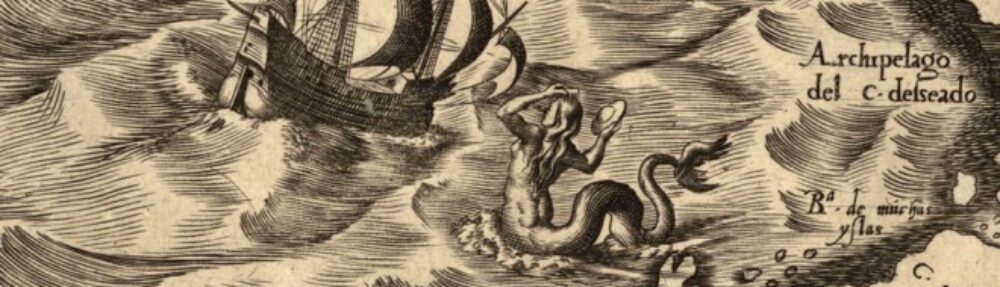
The Article “The Blue Humanities” by John R. Gillis takes the point made in last week’s reading of “The Trouble With Wilderness” by William Cronon a step further—narrowing the human-made idea of “wilderness” to one specific aspect of the environment: The Ocean. In what we observed from Cronon, we learned about how humanity constructed the idea of the untouched “wilderness” in order to blind ourselves to not only our misdeeds (pollution, loss of biodiversity, overconsumption) but our presence in every area of the world. There is no where to hide from ourselves and our wrongdoings, and we comfort ourselves through delusion. Gillis teaches us about the history of human’s perception of the ocean, once being overlooked, to being feared, to being a new place of solace—a new place to hide. Since the ocean, having been believed to be an empty abyss, was vastly unexplored, humanity was able to project their dreams onto and escape into the deep. He states, “Pristine nature, now in short supply in industrialized heartlands, found refuge in the oceans, while the mystery once associated with terra incognita relocated to the deeps.”, explaining the need to escape that affected a vast majority of people, specifically in urbanized environments, who were immediate witnesses to humanity’s destruction of the natural world. As industrialization became more developed, the world as people knew it began to shrink: in cities, as large buildings were raised and city limits expanded, there was less and less world to be found in the common space, and even in nature, as temperate forests were clear-cut to construct these buildings, life that was not polluted by industrial values disappeared. The only piece of the natural world that was left for people to grasp onto was the ocean, so much so “they want about them talismans of nature on their walls, their shelves, their keyrings.” (Paterson-Hamilton), to be kept as reminders of what life is still out there, life beyond the smog and concrete. But even those talismans are part of the grand constructed delusion, as the ecosystems that were reaped in order collect those talismans were forever tainted. In the hands of collectors desperate for comfort that there is still pure life out there, or in the lungs of swimmers desperate to be part of it, or in the literature of Atlantis that plays in the dreams of people who can no longer see the stars, there is hope that not all has been lost to consumption. But it is already too late, and unless those hopes turn into reparations, and we stop running from the reality of our impact, the problem will only worsen with ignorance.
“Early modern science knew much more about the heavens than about the oceans; and more attention was paid to extracting the wealth of the seas, namely fish, than to the waters themselves. All that lay beneath the surface—The Deep—was thought to be an unfathomable abyss, impenetrable and unknowable, a dark dead zone that trapped all that sank below the surface, never revealing its secrets.”
Reading Blue Humanities this week reaffirmed the idea that we really don’t know anything about the ocean. Most of what we know is either what we have explored (which is so minor compared to the percentage of the ocean that is undiscovered), or what we have created through our imagination. Similar to last week’s reading, we created an “aesthetic” of the ocean. What was once considered a scary unknown, is now an element of nature that brings serenity and peace to people. This shift in mindset and attitude towards the ocean and the wilderness in a way is kind of refreshing because I think it encourages us to be more protective over earth. Although preservation tactics and human consumption have been an ailment to nature, viewing natural elements in a humanly-beneficial way can motivate politicians and people in general to shift towards saving the planet.
The Emergence of Environmental Humanities was not eye-opening because it was their first time reading about our environmental crisis, nor will it be the last time. What did catch my attention was a point made towards the middle of the text. We have all been experiencing this concept in this class, the idea and question of whether or not we are apart or a part of nature. “Human beings are not independent of the natural world but are part of it.” (p9). There is an interaction between the environment and humans, which leads me to lean towards humans being apart and dependent on nature, in accordance with what the text says. Others of course can feel differently, and there’s no right or wrong answer but it is important, at least I think so to see where certain beliefs come from and how they have developed, or not developed.
Another point in the text is “Human beings are animals and are mortal.” (p10). My first reaction to this line was confusion, mainly because of all our in-class discussions on the line between human and animal, or human and monster. So when I initially read this I was caught a little off guard. When continuing the reading I realized the text was referring to evolution, but I think it plays a bigger role than just that.
The last thing I would like to touch on is the use of the word “interconnectedness,” throughout the reading. The use of it reminds me a lot of the discourse on whether we are or are not a part of the natural world. In a way, it reassures me or leans me even forward to the idea that we are, especially today because of how our actions can and have heavily impacted our environment.
In “The Trouble with Wilderness; or, Getting Back to the Wrong Nature” by William Cronon, WIlliam Cronon argues that argues that preserving wilderness doesn’t necessarily mean that people are respecting it. People are natural beings, and although humanity has evolved to the point of manipulating nature, preserving wilderness takes away from the history of indigenous people that lived harmoniously with nature. Cronon believes that the concept of wilderness “had to become sacred” (9) in order to be idolized. Cronon also repeatedly mentions satan and God when discussing wilderness. The idea that the wilderness is sacred is a very interesting thought to me. At what point do humans exceed nature and are too advanced to partake in it? There is no clear line, and I think that Cronon does an excellent job at pointing out the flaws in the logic by proposing that indigenous history should be studied and celebrated through nature.
Although I do agree with Cronin overall, I disagree that the wilderness is “profoundly a human creation” (2). The wilderness existed long before humanity and although humans came around and altered it, I believe that the wilderness has been shaped based off of what it has been able to provide. What it can provide has shaped how humanity has altered it, which I think proves that nature is ultimately more powerful. Nature could exist without humanity but humanity would stand no chance against nature. It is important to consider indigenous influence on nature and allow humanity to be considered a part of it, but to propose that humanity has power over nature can and has been disproven easily.
Despite my disagreement, Cronon does an excellent job at proposing why nature being sacred does not mean that humanity cannot be a part of it. Humanity was able to survive based on the resources that the wilderness has provided, and evolving into intelligent creatures should not be enough reason to cut the tie between nature and humanity. Despite what may be a controversial take, if I have interpreted it correctly, Cronon’s idea should be discussed in order to have a better idea as to how people should treat their relationship with nature.
When doing this weeks reading, The Trouble with Wilderness was quite interesting. It discussed not only the human impact on our environment today, but also how the wilderness connects to our relationships with the non-human world. On page 8 it says “Remember the feelings of such moments, and you will know as well as I do that you were in the presence of something irreducibly nonhuman, something profoundly Other than yourself. Wilderness is made of that too.” This comparison between the Wilderness and us is distinct here, as we get a description of a feeling we get when we are in nature, something non-human. This is what connects us to nature and the wilderness, our awe of it, the feelings we get when we are in beautiful scenery. I thought this really helped the articles voice of the importance of Nature, and why we need to protect it. Where would we get these feelings of awe if not for the natural beauty around us? I am not sure, and this felt like a reminder of that.
Not only is this feeling of awe surrounded by the idea of Wilderness, but also the feeling of terror. This article uses examples of 18th century English literature, and its descriptions of the Wilderness or the Wild. It states “To be a wilderness then was to be ‘deserted’, ‘savage’, ‘desolate’, ‘barren’ – In short, a ‘waste’, the word’s nearest synonym. Its connotations were anything but positive, and the emotion one was most likely to feel in its presence was ‘bewilderment’ or terror.” This is one of the many examples in this article used to describe past connotations of the Wilderness, that it was something to be afraid of. As the wilderness is still something people are wary of, it is less looked at in that way now, or at least for some people. For me, I would like to say I am not afraid of the Wilderness, sure when I think of it I usually think of it as Nature or something beautiful. The unknown is scary, which is why these connotations for the Wilderness are still used today. People hate the unknown, they hate the undiscovered. I think this article really painted the picture of that fear, and how we should try to celebrate and protect it, not destroy it our of fear and greed.
I am an environmental science major, and one of the first things we learn about the ecosystems we seek to protect are the “services” they can provide us––because how can we make non-environmentalists care about the planet without coaxing them with what the planet can give them in return? These categories of services include provisioning services, regulating services, supporting services, and cultural services. Cultural services are, as defined by the National Wildlife Federation, a “non-material benefit that contributes to the development and cultural advancement of people…the building of knowledge and the spreading of ideas; creativity born from interactions with nature (music, art, architecture); and recreation.” (nwf.org, N.D). The “recreation” they reference is tourism. “Cultural services” are exactly what William Colton is addressing in his paper, “The Trouble with Wilderness”. The sublime beauty and innate inhumanity early explorers like Thoreau and Wordsworth described in the texts they made public is what the National Wildlife Foundation is referencing now as a “service”. Something “serving” of us, not untamed and terrifying like what Thoreau and Wordsworth described. The foundation is actively encouraging more human presence in the natural world as a way of furthering our intellectual discoveries and creativities, while also making the income they rely on to maintain the preserve with the influx of tourism to these places, as people seek out this “service” they are promised. Colton mentions this attitude at its birth, as following these popular works by explorers featuring The Sublime, “more and more tourists sought out the wilderness as a spectacle to be looked at and enjoyed for its great beauty, [and] the sublime in effect became domesticated.” (12). Just like some best-selling new book on the shelf at Barnes and Nobles or blockbuster movie everyone is talking about, the “wilderness” became a commodity to come get a look at for yourself, diminishing it’s obscurity and turning it into an anthropocentric novelty. Who wouldn’t want to get a taste of the novel Unknown (or rather, freshly broken in “Unknown”)? And in this mentality of everyone wanting to be an explorer, the unknown becomes known and we take hold of it. It is there where we claim nature but label it “other”, label it “wilderness”, though, since our invasion, it is anything but. It now exists in the maps made from clear-cut trees bunched up tightly in the fists of visitors that will inevitably end up on the ground of the trails they claim this “service” from. It exists in our hands, yet we comfort ourselves by naming it “wild” and clutching onto the idea that it is our escape. But there is no escape now; we are everywhere.
Rigo De Leon
ECL 305
Professor Pressman
March 3rd, 2024
For many people, writing is an outlet to convey emotions and gives writers the opportunity to combine their subconscious thoughts with their creativity. Reading stories that were written centuries ago gives readers the opportunity to see what the writer was going through at the time through the wording of their sentences, the imagery they choose to provide, and messages they leave for readers. By studying “Odysseus and the Sirens” which is a chapter in Homer’s “Odyssey”, Odysseus becomes infatuated with the siren song, and professes that he will tie himself to his ship, and be the only one in his crew to refrain from protecting his ears. Odysseus speaks in the form of a poem, which gives the reader a much better understanding of what he is going through, and also gives the reader the opportunity to relate to him by the way he conveys his feelings. As he is facing death, this passage hints at the idea that Odysseus is overcome with existential wonder that he shares with humanity as he enters the opening moments of the experience he has been longing for for years. The demonic imagery induces fear in Odysseus, but this is counteracted by the calming personification of the ocean, which leaves Odysseus with a relatable feeling of acceptance to whatever his fate may be.
The conflicting imagery in this passage is extremely important because it gives an idea as to how unsure Odysseus is made to feel in that moment. His initial reaction to meeting the Sirens makes him recall how the “waves below, at once forgot to move. Some demon calm’d the air and smooth’d the deep, Hush’d the loud winds, and charm’d the waves to sleep.” (43). The text makes it clear that through all the impending chaos, he is able to take in the nature around him as a natural coping mechanism. In reality, this may have only induced more fear in him. Such calmness caused by what he believes to be evil creatures juxtaposes what humans are conditioned to believe should happen when faced with danger. Did Odysseus see massive waves that threatened the safety of the boat? Did he see large, brainless brutes that could rip him apart? No. He experienced tranquility in his environment. The passage breaks down an experience that most people can relate to, that being the moment where people lose all power, and can do absolutely nothing but accept whatever fate is in store.
Odysseus has lived his life believing that these beautiful creatures are ultimately demonic and deadly, yet he is still willing to try to outsmart them in order to hear their song, which could prove to be fatal to not only him but his entire crew. By asking for only he “alone, with fetters firmly bound, The gods allow to hear the dangerous sound” (41). Odysseus emits a natural human response by sacrificing safety for the sake of honoring his desire of knowledge. Sacrifice is a very normal aspect to humanity, especially when curiosity consumes people. Odysseus proclaims that the gods will let him hear what he desires to hear. This is important to the rest of the story because it shows that Odysseus believes in a higher power. Given that this was written before the beginning of Christianity, it not only predicts how people behave once Christianity is brought to life, but it also proves that fate and a belief in a higher power is a principle that has existed throughout the existence of humanity. People find themselves closest to a higher power when experiencing a life threatening event. By mentioning the fetters, which are essentially chains that are restraining him, he is displaying a sense of hope that he will survive this encounter with the Sirens. Odysseus portrays a longing for wisdom and excitement, yet he is granted the knowledge that is needed for a chance to survive. People act similarly in the modern age in forms such as adrenaline rushes. There are people who risk their lives jumping out of planes, surviving in the woods alone, or deep sea diving who search for enticing experiences for the sake of pleasure. Similarly to Odysseus, the people that crave adrenaline accept their fates in order to slightly scratch the large itch that is meant to satisfy existential wonder.
As Odysseus prepares to encounter the Sirens, he further shows his animalistic wonder by making an effort to cover the ears of his crew. With “every sail [they] furl, each oar [they] ply; Lash’d by the stroke, the frothy waters fly. The ductile wax, with busy hands” Odysseus molds. The effort that is put into preparation for their encounter is treated like a space mission: Both require a lot of thought and knowledge, both are extremely dangerous, and both are not completely necessary. The world is big enough to provide those with the necessities they need. Despite people being programmed to value their lives, they have beat the natural world by being conscious enough to fight their primal instincts of survival for the sake of desire. Through his writings, Homer unintentionally shows us that human instincts have not changed from how they were thousands of years ago.
When Odysseus finally encounters the Sirens, they make an effort to make him succumb to his temptations. The Sirens sing their beautiful song, but instead of providing direct knowledge and wisdom, they use their voices to “instruct the soul, and charm the ear.” If Odysseus chooses to “Approach, [his] soul will shall into raptures rise” (43). Resisting temptation is a completely unnatural human response to a situation. Temptation is a concept that was constructed along with religion and society. Fighting temptation is what separates humans from animals, as humans are able to come together and think not only for themselves, but for those around them as well. Odysseus uses all of his strength to resist the urge to join the Sirens.
One of the most impactful aspects of this story is the fact that the readers do not get to find out how Odysseus felt about the Siren song. The story ends abruptly after they simply sail past the Sirens. The readers should see this and rethink what the point of the entire text was. Homer leads people to believe that there will be a rewarding payoff to all of Odysseus’ work and desire. Instead, readers spend time learning about Odysseus’s battle against temptation. One could look at this and relate it to an experience they could have where the struggle of completing a task completely overshadows the feeling of success or satisfaction that they expected. Through Odysseus’ poem, he provides a relatable experience that can be related to universally, where he honors desire beyond what he knows is right, despite being at the hands of death.
At first glance, “ The Legend of Sedna the Sea Goddess” appears to be a cautionary tale which warns about the consequences of deviating from the traditional norms of marriage. Sedna didn’t want to marry and when she finally does she is betrayed and ends up with the “ head and torso of a woman and the tail of a fish.” Yet, upon deeper analysis, the story allows for the exploration of Inuit culture through the hybrid body of Sedna in order to explore what this story entails about Inuits’ relationship to sacrifice, spirituality, and nature.
To start, Sedna allows for the exploration of sacrifice in Inuits culture. Fearing the unsteady nature of their kayak during a storm, Sedna’s father makes the choice to sever her fingers, joint by joint. On one hand, it symbolizes the sacrifice made to restore equilibrium to the kayak, emphasizing the immediate need for balance in the face of danger. However, the story takes a turn as each severed finger transforms into sea creatures like “fish, seals, walruses, and whales,” Sedna’s sacrifice ultimately becomes a resource for the entire Inuit community and she beholds the power over them. The emergence of varied sea creatures therefore shows that sacrifices, no matter how painful, contribute to the balance of nature and the prosperity of the community.
In addition, Spirituality is a crucial part of Inuit culture that is further explored through Sedna. After being thrown from the kayak, Sedna is described as having transformed into a spirit, “Sedna sank to the bottom of the ocean and there became a powerful spirit.” In this sense, spirits transcend life and are depicted as something eternal. They believe this spirit has power over the animals in the sea which is an important resource to them. This goes to show how strong their belief in spiritual powers are. Their belief in this spirit is so deep that they even have taboos they follow to show their respect for her, like “when a seal is killed it must be given a drink of fresh water, not salt water” giving the seal fresh water adds to this respect and the appreciation of the sacrifice of the seals life. To add onto this, it is said that “ If the hunters do not catch anything for a long time, the Shaman will transform himself into a fish” and “appease Sedna.” The idea that the Shaman can transform themselves to meet Sedna in the case she becomes upset and their access to sea creatures becomes threatened, strengthens the belief that having a good spirit and following taboos and rituals are crucial and can affect the balance of nature.
Furthermore, the harmonious relationship that the Inuit have with Sedna serves as a reflection of the relationship they have with nature, specifically with the sea. As detailed in the story, “The Inuit who rely on these animals want to maintain a good relationship with Sedna, so that she will continue to allow her animals to make themselves available to the hunters.” Since Sedna is what stands in between the Inuits and their access to the sea creatures, a harmonious relationship is important. The sea creatures Sedna controls is a crucial resource to Inuit hunters as it provides them with “food, clothes, and shelter.” As mentioned in the previous paragraph, the Shaman transforms themselves to make Sedna happy which is interesting and adds to the relationship between the Inuit and nature, “ The Shaman will comb the tangles out of Sedna’s hair and put it into braids.” Rather than approaching Sedna with fear, the Inuit have respect, nurturing, and care for her. On the same note, this also depicts the Inuits relationship to the sea and how they don’t exploit it for its resources but instead appreciate it and have gratitude.
Overall, “ The Legend of Sedna the Sea Goddess” transcends its initial appearance as a cautionary tale and becomes an in-depth examination of Inuit culture, particularly when it comes to sacrifice, spirituality, and nature. Sednas sacrifice reinforces the Inuits belief that sacrifice can contribute to the greater good, spirituality shows how a good spirit can have an influence towards the natural world, and the Inuits harmonic relationship with Sedna embodies their relationship with nature.
Works Cited
Lindeman, Lenore. “The Legend of Sedna the Sea Goddess.” Sedna or Sanna the Sea Goddess of the Inuit, www.palomar.edu/users/scrouthamel/ais100/sedna.htm. Accessed 1 Mar. 2024.
Naomi Mireles
ECL 305
Professor Pressman
3 March 2024
Julnar the Mermaid and Her Son Badar Basim of Persia are first seen in The Thousand and One Nights, also known as The Arabian Nights. This story is deeply rooted in Middle Eastern folklore and contains Indian, Persian, Arabic, and Jewish Traditions (Bacchilega, 171). Our narrator, Shahrazad, tells the story of a seaborn princess who goes by the name of Julnar who flees her home in the sea after a falling out with her brother and although she misses them greatly, she forbids herself from returning. Julnar is sold to King Shahriman in Khorasan. Before Julnar, King Shahriman was known to own many women, though he was sad because none of them would bear him children, and he feared there would be no one to inherit his kingdom. Instantly, the King is infatuated with Julnar and perceives her to be the most beautiful woman, so much so that he gives up his many concubines. The assertion of control is symbolic of the unequal power dynamic between the two, where Julnar finds herself subject to the King’s ownership and authority despite her autonomy as a powerful sea princess. This is perceived from their first encounter when the King purchases Julnar where possession is asserted. Although later in the story, a year after Julnar is silent, she develops genuine care for the King, their relationship is founded on control and limitations imposed upon her by the king, which in turn emphasizes the coercive nature of the relationship, which prompts the reader to rethink conventional and individual understandings of love and relationships.
At the story’s beginning, the king’s power is evident from the moment Julnar appears at his door as a slave. The king immediately takes possession of Julnar and claims her as his own. The unequal power dynamics between the two are reflected in the king’s assertion of control over Julnar and are continuously reinforced by his position of power as king. Despite Julnar being of a relatively high class in her realm, this is disregarded as this information is unknown to the king, while outside of her natural environment, she does not hold much power or authority, not even over herself. The king’s desire to dominate and control Julnar is evident in the early stages of her arrival, “When everyone was gone, he took off his clothes and disrobed her with his own hand..So he lay down next to her and began making love.” (Bacchilega,175). The language used to describe this encounter is seemingly one-sided, it does not say “they” made love, it is evident that this was taken, not given, especially since Julnar did not speak until a year into their relationship. Throughout the narrative, the king’s possessiveness reflects entitlement, where love becomes synonymous with ownership and control.
The romanticization of control and manipulation is depicted in Julnars willingness to sacrifice her agency for the King and his affection. With his desire to have a child, Julnar puts his desires over her own of returning to the sea to be with her brother and mother. Simultaneously, Julnar relinquishes her independence and power as a mermaid princess to comply with the king’s demands, which perpetuates a narrative where love becomes synonymous with submission. Julnar’s silent asset normalizes the manipulative tactics seen by the king. Despite her initial hesitation, she eventually succumbs to the king’s advances and desires under the pretext of love. The forms of manipulation and use of power as a king and higher social status depict harmful ideals of love where coercion is romanticized as an expression of affection.
Over and above that, the king’s manipulation of Julnar is seen through his exploitation of her vulnerability. He takes advantage of Julnar’s desire for acceptance and belonging, milking his emotions to manipulate her into fulfilling his desires. This manipulation reinforces the narrative’s underlying themes of power imbalance and control within their relationship.
Julnar the Mermaid shares a narrative in which themes of power, control, and manipulation are unveiled. The king’s dominance over Julnar is symbolic of the unequal power dynamics within romantic relationships. Through the king’s tactics, a normalization of coercion and manipulation is perpetrated which reflects harmful ideals of love where manipulation overshadows love and respect. For example, the king’s initial reaction to assert ownership of Julnar reflects societal norms where women were viewed as nothing more than possessions to be owned and controlled by men. The idea of love as possession is further imposed on the reader as the king confines Julnar to his environment which strips Julnar of her agency in the search and longing for external love and affection. On top of this, the story shines a light on the timeless expectation of women to prioritize the desires and wishes of men over their own. Julnar’s satisfaction with the king despite her hesitation highlights the societal pressures upon women to prioritize the needs and wishes of their partners even at their own expense.
The romanticization of control and manipulation within Julnar’s relationship with the king reflects broader modern and cultural attitudes and ideas of love and relationships. Julnar the Mermaid, while a fascinating and captivating story, also challenges the nature of love and power in our society. In delving deeper into our story, the layers of coercion and manipulation from the king allow us to gain insight into the complexities of human emotion and the journey for connection and romantic love.
Citations
Bacchilega, Cristina. Penguin Book of Mermaids. Penguin Publishing Group, 2019.
Kiersten Brown
ECL 305
Professor Pressman
3/3/24
Close Reading:Undine
Undine’s story is still important today because of how it shows the impact of the patriarchy on women’s lives and the depiction of women in our society. When closely reading Undine’s story, not only do I observe the effects of the partiracy on her life, but also how being a woman affected the outcome of her storyline. This story brings up many ideas and questions to mind, but the relevance of a man-made society is prevalent here.
Undine’s tale is quite interesting, as it discusses the storyline of a young woman/mermaid, who is looking for the love of a human man. My first observation of this: Why is Undine so set on finding a Human man to love her, to make her complete? Well, first of all this can be answered quite easily: A patriarchal society and its norms. This applies to when the first tale of Undine was written and even now in our society. Women have always been expected to marry a man, reproduce, and look over the home. Although this has quite changed in the 21st century, those societal norms are still prevalent today. We still see those traditional norms pushed on women, and whether or not we have progressed as a society some people still see the world this way. Undine’s tale is one of the many like this, where a woman is expected to find pure happiness with a man. In this folklore I can see how this affects the course of her life, and her overall demise/loss of happiness.
Undine is a half woman-half mermaid (or water princess) and her story portrays these ideals of a patriarchal society. When Undine is first introduced, I learned about how mermaids have no souls, and they only move through the elements. This is a big aspect as to why Undine “needed” her Knight Huldbrand, in order for her to have a soul. She needed a human man to have a soul, it was not enough for her to exist on her own, but she had to co-exist in order to be whole. This concept was not only because she is a mermaid, but also because she is a woman. On page 105 it says “Thus my father, who is a powerful water-prince in the Mediterranean Sea, desired that his only daughter should become possessed of a soul, even though she must endure many of the sufferings of those thus endowed.” This quote stood out to me because of the significance of a soul, not necessarily to her, but to her father. It was her father who desired her to obtain a soul. A man desired her to find a soul, no matter the sufferings, when Undine could have probably found another mermaid or water creature that would fulfill her just as much, or even then no one. In order to obtain a soul her human lover would have to accept her for what she is. This comes to show how the course of Undine’s life was changed because of the patriarchal wishes of her father, his desires for her life, not her own. If she had not followed his wishes and searched long and hard for a human husband, she could have done a lot more with her life. The social structure of status then (and even now) were men above women, and the opinions of the men around Undine in her life significantly affected her. Not only do the men in Undine’s life have a say in her future, but it was not her own wish to obtain a soul.
This brings out the questions as to why she needed one in the first place. In the depiction of her story, and many other mermaid-like folklores we have read, they all desire the same thing. The Human experience. They are all described as longing to have legs, be on land, love a human, and be able to do human things. We can see this in Undine’s tale, as all she desires is to be accepted by her husband and his people. She wants to have the human experience, and the book states “If you do not make my whole life miserable. For what is to become of me, if you avoid and reject me?” (page 106) Undine is speaking here as she beares herself and her true form to Huldbrand. She quite literally says she doesn’t know what she will do if he rejects her, she’d go home and wallow in her sadness. This is not her fault that she feels this way, it is the patriarchal society she grew up in and how she was molded to act and feel. Her life was not really ever her own, and her husband ended up betraying her for another human woman. The society she was born into, back when this was written in the 1800s, was even more patriarchal than now. Undine definitely had to follow her fathers wishes and desires for her life, for her to find a soul, which led to her later heartbreak and betrayal from her husband. Her life was viewed as basically worthless, without a soul or husband. To me, Undine’s marriage to Huldbrand, her human husband, felt more like a business deal. This is what the basis of marriage was built upon, it was built upon a business transaction and deal between families and wealth. In Undine’s case she was gaining a soul from this “business transaction.” Even though she claims to love him, at the end of the day their relationship was built on a business deal and the obsession or lust Huldbrand felt for her. He was under her spell, entranced by her beauty that she radiated, an otherworldly beauty. Was he even in love with her? Did he desire her or love her? I believe that it was lust, for her beauty and his obsession with her. When thinking about how Undine’s story connected to the effects of the patriarchy on her life, we see this with the downfall of her marriage when he later betrays her. She relied all her happiness on him, because that’s what women were expected to do, rely on other men for their happiness. They were not allowed to hold jobs, worth, or hobbies really outside of the marriage and the family.
Not only is the patriarchal society what affected Undines life, but it is still prevalent today in other folklore stories and real life. In our society today we can still see how women do not have the same opportunities as men, there is still that traditional stigma there, as we see in Undine’s story. The idea of needing a partner to be full, is still an idea we see in the media today, not only mermaid stories or depictions. Every Disney princess movie, romantic comedies, the Little Mermaid, are all examples of this patriarchal society. Even if it is not the intent, we can see how the stereotypes of women and their happiness are still depicted as needing a man, even in the 21at century. People will argue this is not true, and yes we have really made changes and women have lots of opportunities, more than before. But we cannot ignore that these stereotypes still exist and still affect women and their lives. It’s what happened to Undine. Overall, when close- reading this text, not only do I see this depiction of Undines worth being connected to a man, but also the affect the patriarchal society held on her life.
Works Cited
Bacchilega and Brown, The Penguin Book of Mermaids, Penguin books, 2019
Friedrich de la Motte Fouqué, Undine, 1811