week fifteen: the Deep Again

So our girl Yetu was rescued by humans, which I find an interesting take on the mermaid mythos because usually its the mermaid who does the rescuing? Like how in the Little Mermaid, the mermaid in there rescued the prince from drowning, but in The Deep, Yetu’s being fed and looked after.

Also her relationship to Oori is interesting to me, because its this book’s instance of the two worlds meeting in the middle- both grapple with companionship as well as the past. I think Oori continuing to ensure that her homeland stays up despite being the last of her entire group/kin is important because in a way, it ties into the whole “ocean is an archive” thing- she’s ensuring that her history stays up, and that there IS a homeland that exists out there for her to return to. In way, Oori represents the idea that it is one’s duty to ensure that their history stays remembered. Yetu is a sort of a parallel because her entire culture is based on the idea that only ONE person should remember so everyone else can forget, and like… The way they contrast each other in this aspect is interesting.

Both were essentially forced into being the upholders, the historians, and yet they have such different approaches to how they do this. This is such a refreshing take on the mermaid tale and I’m really enjoying it so far.

week thirteen: african water spirits

we had two different cultures- african and then Afro-caribbean water spirits. while they had their differences, it was very interesting to see how similar they were to one another. Both of the main water spirits were mothers, which I felt could be connected to how water itself is a source of life, and how mothers / the feminine is also connected to life because birth.

and then that leads into a segway about Yemaja being a mother and then giving birth (after being raped) to all sorts of bodies of water, among other things like gods of diseases and iron and war, but also vegetables and lightning. But you could argue that water is necessary for all of these things to thrive (war im not so sure about)… water is necessary for life. water had to be created out of somewhere, much like how women bear children (which one could argue is like making something out of nothing), so there’s that parallel. to be honest (and sorry another tangent) there’s something kinda fucked up about how “woman suffers at the hands of a man and gives birth to a bunch of interesting demigods” because we see a similar parallel with medusa being decapitated and giving birth to pegasus and someone else.

weird how mermaid stories are so quick to go to women suffering for the sake of others… then again i think that’s more tied to how femininity is viewed in the lens of the patriarchy? its a little different because you have maman dlo, who seems to thrive in spite of her femininity (but then also takes pretty young women to become pretty mermaids…) interesting bits of folklore this week.

week 11? Sirenomelia

professor where did you even find this

anyways it was really uncanny, with all of those shots from under the surface of the water. And then the mermaid(?) swimming amongst the human structures, and then later in the middle of the ocean… it felt so out of place and yet so natural..

I think it speaks to how humans are somewhat out of place in nature, just as the mermaid was out of place amongst the structures. All of the shots of the quiet stillness in the ocean and in that tundra area sort of spoke to how nature sort of coexists with itself. That mermaids are a sort of extension of nature in a way, because we see the mermaid in the water almost all the time (naturally).
the film kind of implies that mermaids are indeed the link between humans and the ocean because the mermaid interacts with bare, isolated nature and the equally empty human structures. There’s also a bit of curiosity as the mermaid explores the structures, it could be a nod to how humans are curious about the ocean and explore it slowly.

Midterm Close Reading Assignment

Ashley Rubin 

3 March, 2024

Pressman 

Midterm 

The chapter “Freak Shows and Fantasies” from “Merpeople: A Human History” by Vaughn Scribner proves that the media has always greatly influenced the public’s opinions of those different than them. This chapter tells how stories of merpeople were spread through newspapers in the 19th century, providing sightings and hoaxes, and how that compares to public opinion of marginalized groups. People based their beliefs off of what the newspapers had to say just as how the media still plays a big role in the beliefs people hold on those different from them today. 

“Freak Shows and Fantasies” focuses on the nineteenth-century Western world, specifically in Britain and America. This era was characterized by significant urbanization, economic growth, scientific advancements, technological innovations, and shifts in demographics. Such transformations contributed to a rapidly changing society, where people were increasingly interconnected and exposed to new ideas and experiences. Newspapers were gaining popularity, featuring an increasing number of stories focused on mermaid sightings. With their rising numbers, newspapers became integral to shaping the media and its effect on the public.  “This chapter’s analytical arc is largely reliant on the boom in popular press in the nineteenth-century West. By the early nineteenth century, newspapers and periodicals became the most efficient means through which to transmit information to the broadest portion of the populace” (Scribner, 127). Scribner describes here the pivotal role of the popular press in shaping public perception during this time. Media is a means of communication that can reach a large audience and take an influence on that audience. By the year 1860, the United States was giving its citizens access to over 3,000 newspapers. The Western world was not a time where everyone was accepted no matter what they looked like, believed in, or where they were from. Societal norms and prejudices often dictated who was deemed acceptable or desirable, and individuals who deviated from these norms faced marginalization and discrimination. This can be proved especially true through the increase of stories being told about mermaids and how the public perceived this based on what newspapers had been reporting.

While the argument over whether or not mermaids were real might seem far-fetched in comparison to the discrimination of marginalized groups, its role during this period proved how unaccepting the world can be. Between 1810 and 1845 mermaid sightings were being reported in the paper at least four times a year. As mentioned before, most civilians of this time were getting their news from these newspapers and these newspapers only. “Periodicals were, as one nineteenth-century writer exclaimed, ‘the owners and stars’ of heaven and Earth. Therefore, everyone from greedy hucksters to erudite academics carved out space in this popular medium, for nowhere else could they spread their message so broadly and proficiently. This makes them ideal vehicles through which to delve into Westerners’ investigations of merpeople between 1800 and 1900” (Scribner, 128). The belief of whether or not mermaids were real was high during this period. As the fascination with mermaid sightings began, many people believed that they could be real. This is because newspapers were publishing stories that favored verified mermaid sightings rather than hoaxes and mistrusting sources. The papers also emphasized stories that highlighted human interactions with merpeople along with cultural poems and songs. The choices of these papers ignited the public’s interest and acceptance of merpeople. In doing so, newspapers not only reflected societal attitudes but also played an influential role in shaping beliefs about the existence of mermaids during this era of curiosity and exploration. 

Following the year 1845 the view on mermaids and other mythical creatures began to shift. “With the humbuggery of Eades and Barnum so publicized over the past thirty years, newspapers primarily printed pieces that concentrated on the hoaxes and frauds surrounding mermaids and tritons. These articles usually employed a mocking – if not deriding – tone, and sometimes even targeted certain political groups or people” (Scribner, 128). The influence of P.T. Barnum increased the curiosity and talk about mermaids and other unique creatures. Barnum was well known for his display and fascination with unconventional people and creatures. His knack for showmanship not only entertained but also shaped popular perceptions and discussions around these subjects. When Barnum’s Feejee Mermaid was proven to be fake, the journalistic view on mermaids shifted along with the public’s opinion. This shift happened quickly and proved how much of an influence newspapers, or the media, had on those who were consuming it. People went from completely believing in the idea that merpeople could be real to immediately taking detest on that idea. This transformation showed the power of the media to shape and influence societal norms. It revealed how quickly public opinion could be swayed by journalistic narratives, highlighting the balance between belief and skepticism. The evolution of attitudes towards mermaids serves as an example of the dynamic between media, perception, and cultural discourse in shaping societal beliefs and values.

This can easily be compared to the acceptance and unacceptance of marginalized groups. When the media is highlighting positive stories of mermaids, the public has interest and acceptance. As the media started to shift its reporting, it became clear that the public no longer accepted the idea that mermaids could be real. This chapter takes place during the nineteenth-century Western world, a time when groups such as women, racial minorities, lower socioeconomic groups, and religious minorities were not accepted by the rest of the world. Similar to the beliefs about mermaids, the opinion of the majority on these groups was due to news coverage. Newspapers had the power to cover these groups in both a positive and negative light. They had the power to release coverage that was either supportive or hostile. Whichever way the papers would cover these groups is how the majority of people would think of them and in return treat them. A specific example of this during this period is the treatment and coverage of women. Due to the patriarchal attitudes of the time, newspapers had the choice to either support women’s rights or oppose them. Depending on which paper audiences were reading affected their opinions on women and their rights. If a paper was supporting women’s rights and publishing stories that painted the movement in a positive light, its readers were likely to support the marginalized group. If a paper was opposing women’s rights and talking about them in a negative light, its readers most likely did not support the group or the movement. The influence of newspapers on public opinion was high, as readers often relied on them as primary sources of information and as guides for societal norms. The framing of stories and editorials by newspapers had huge effects on how marginalized groups were perceived and treated by society as a whole. The comparison between these groups and mermaids highlights the power dynamics apparent in media representation and its impact on social attitudes and behaviors. By diving deeper into the comparison between the perception of mermaids and the treatment of marginalized groups, insight is given into the ideas and views of identity, representation, and power in nineteenth-century Western society.

The ideas presented in this chapter are significant because they are still relevant in today’s modern society. The media plays an important role in our society and has an extreme amount of power when it comes to influencing public opinion. In today’s world, the media serves as a primary source of information and a crucial platform for news, entertainment, and cultural narratives. With the large presence of digital media and social networking platforms, the reach and impact of the media have expanded, furthering its influence on public opinion and perception. Through selective reporting, editorial decisions, and the use of persuasion, the media can sway public opinion, reinforce existing beliefs, or challenge established ones. A modern-day example that can be compared to both the belief of merpeople and opinions on women’s rights in the nineteenth century is the treatment of LGBTQ+ individuals. The LGBTQ+ community has been fighting for years to be fully accepted and treated as equals in society. This is a group that has had a continuous struggle with acceptance and is still being impacted by the media. The media still varies in its coverage of the LGBTQ+ community, oftentimes painting the group in a negative light. Society seems to go back and forth with its acceptance of the community quite often in recent years. When the media highlights positive stories people become more accepting but the rise of social media has made it even more difficult for the group to be accepted. Social media has offered both opportunities for visibility and acceptance but has also opened up spaces for harassment, bullying, and hate speech. This can make it challenging for LGBTQ+ individuals to find acceptance and support in online spaces and can increase harmful stereotypes and misinformation, proving how much of a role the media plays in acceptance. Just as the media played a pivotal role in shaping public perceptions and attitudes towards issues similar to this in the nineteenth century, it continues to have significant influence over the acceptance and treatment of marginalized communities like the LGBTQ+ community today.

In conclusion, the chapter “Freak Shows and Fantasies” from “Merpeople: A Human History” by Vaughn Scribner offers profound insights into the influence of the media on shaping public perceptions and attitudes towards marginalized groups both in the nineteenth-century and modern-day society. By examining the role of newspapers and their impact on the beliefs of both marginalized groups and mermaids in nineteenth-century Western society, the chapter underscores the pivotal role of media in disseminating information, framing narratives, and influencing societal norms and how that idea is still apparent today.

Works Cited

Scribner, Vaughn. Merpeople: A Human History. Reaktion Books Ltd, 2020.
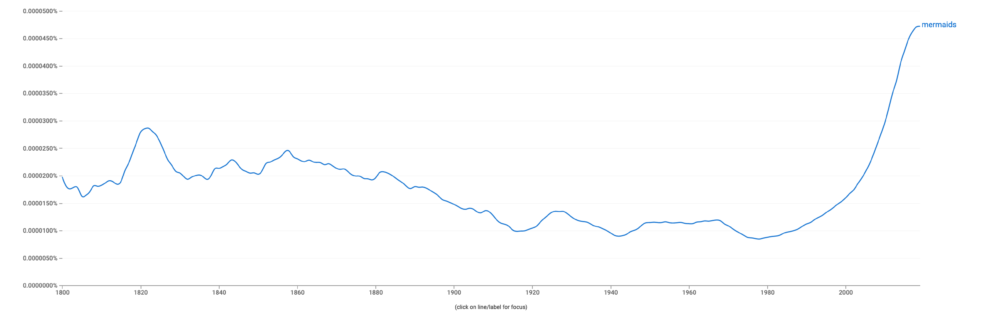
Week 7: Little Mermaid

So I read “The Little Mermaid” for the first time, and I was blown away from all of the imagery, to be honest. The way that things get described, like the ocean kingdom, it was very breathtaking. “The soil produces the most curious trees and flowers, whose leaves and stems are so flexible that the slightest motion of the water seems to fluster them as if they were living creatures. Fishes, great and small, glide through the branches as birds fly through the trees here upon earth.”(page one hundred and eight)*

This was what intrigued me, as well, because here we see the connection between human and nature. We can establish here that, at this point, we would imagine merpeople to have a similar sort of world as our own, given how the merpeople have things such as trees and flowers. We see the comparison between them and us, drawing similarities and parallels. Some things are done differently, of course, but when we imagined the merpeople, we imagined them similar to us. Granted, you can say that maybe the trees are different, but we don’t GET any of that. What this is giving is that its giving “they’re more like us”.

Ok then I want to talk about the last bit, where the little mermaid goes to Heaven(?)/ascends after her death. First of all, she’s way better than me. Second of all, the ending felt really weird to me. So she’s told, “You have suffered and endured, and have raised yourself into an aerial spirit, and now your own good works may obtain you an immortal soul after the lapse of three hundred years.” (page one hundred thirty). and THEN she’s also told that her 300 years is contingent on children???? Is this supposed to be like religious propaganda or something? Does this mean that nothing matters???

*my number one key on my laptop is sticky so I had to use the actual word for the numbers.

Week 6: Freakshows and Fantasies

“The Feejee Mermaid Hoax” and “Freakshows and Fantasies” both demonstrate the Western obsession with mermaids and the efforts at “ordering the natural world and its creatures” that continued from the Enlightenment period (Scribner, 129). In Barnum’s autobiography from 1854, he discusses the Feejee Mermaid Hoax, but also outlines a historical account of mermaid sightings and displays. Barnum describes the mermaid as a “fabulous animal”, and yet, continually applies Western beauty standards to the mermaid sightings and displays. He views the mermaid as animal or other, but not enough for them to be free of our judgment.

While almost every recorded mermaid sighting occurred in the British Isles or America, both readings pointed at “the ‘Oriental’ allure of Asia (that) still held sway of the Western masses” (Scribner, 126). In 1758 a mermaid exhibited at the fair of St. Germaine’s in France was described as “female, with ugly negro features. The skin was harsh, the ears very large…” (Penguin, 243). Here, Western beauty standards, and clear racism, is being applied to the mermaid, even though they are viewed as animal or other. However, in London in 1775, a mermaid exhibited was determined to be an “Asiastic mermaid… young female- its eyes a fine light blue- its nose small and handsome- its mouth small- its lips thin- its chin well shaped- its breasts are fair and fall… the belly is round and swelling, but there is no navel…” (Penguin, 243). The mermaid that was suspected to come from the Archipelago seems to meet the Western standard of human beauty.

Also, the detail of the rounded belly lacking a navel points out the ongoing question of how mermaids reproduce. If there is no navel, it must widely differ from the human birthing process. I find it interesting that this detail was included in the 1775 exhibit.

In mermaid sighting and captures from earlier in 1187 and 1430, they both appeared close to human, but were said to not be able to speak, Barnum states “that nothing seem wanting to it (the mermaid) but speech” (Penguin, 242). The mermaids lack of speech seems to be another separating factor between us or other, as well as if the mermaid was even deemed satisfactory.

Week 6: Freakshows and Fantasies – The Confirmation of Merpeople

I found great interest in this week’s reading in “Merpeople: A Human History”, Freakshows and Fantasies. I was very intrigued by how the belief of merpeople spread throughout the United States and London. Most of the stories we have covered so far take place on different continents, such as France (Melusine) and Tamriel (sirens), which has led me to believe that the merpeople did not have an origin in a place like the United States. The ideas and beliefs of merpeople were spread widely through newspapers. Cities such as New York and London used newspapers as the primary way to spread news throughout their area. This intrigues me because most people during this time were learning about mermaids through the news. This led these people to believe in mermaids before they were even given any proof of their existence. Newspapers were publishing many hoaxes when it came to mermaids but also featured sightings. I am wondering how readers distinguished what they believed with such contradictory stories coming out at the same time. This has also brought me to connect this time with the period we are currently living in. The media has always had a large effect on people and what they believe.

I have also found great interest in P.T. Barnum’s influence on mermaid confirmation. Barnum was known for taking “freaks”, or non-conventional people, and putting them in a show. I find it interesting that he “imploded belief in merpeople” (128) when he was such a believer in the unknown. I would like to do further research on Barnum’s belief and interest in mermaids and learn about the effects that had on people during the time.

Week 2: Merpeople

My first reaction to the reading is surprise; by the unexpected ubiquity of the presence of mermaids across popular culture and religious texts. I think it’s also interesting to see that The Church attempted to manipulate the perception of mermaids and use it as a sort of symbol for their interests.

I think it’s fascinating that we can use mermaids and merpeople to learn about the hybridization of humans, and how it can be a metaphor for some of our own characteristics. I also think it’s interesting how something that was manipulated to degrade the feminine can be warped and changed over time to hold a completely different message.

Week 2/3 Reading Anaylsis

When I walked out of the first day of class I was left wondering how I got myself signed up for a college course centered on mermaids and thought to myself I was either going to love it or hate it. After our initial discussion on Thursday and reading through the first few chapters of Vaughn Scribner’s “Merpeople” I have already begun to take an increased interest in the variety of lenses with which we can approach the subject of mermaids to explore what they symbolize and the importance of their persistence throughout generations of many different human societies and cultures. The in-class analysis of the etymology of certain words such as environment, nature, and monster sparked some ideas in my head about the way humans have defined themselves in relation to the “natural world.” I found it incredibly interesting that nature was first defined in terms of human nature as a description of people and later amended the definition to what is commonly known today. This sequencing of these definitions leads me to believe that people initially considered themselves to be separate from the natural world and later realized that the relationship is much more complex.

The word that has stuck in my head the most throughout our first classes and readings, as it pertains to mermaids, is hybrid. The mermaid, being a hybrid mix of human and animal is the perfect symbol to represent how human beings are a part of nature while also separate. The fact the upper half of the mermaid is human is also symbolic in a sense that the familiar human characteristics that supposedly set humans apart from animals such as the potential for conscience thoughts and the ability to use our hands in contrast with the lower half which binds the mermaid to the ocean and natural world. The way humans defined nature creates a hybrid situation similar to that of the mermaid, as much as our human qualities separate us and make us different there is no way to separate ourselves from nature, we are a part of it regardless of our greater potential to alter the natural world.

My parting question for the week pertaining to etymology that I am interested to explore more throughout the semester is: “How we define what it means to be human?” People have mimicked animals in their creations, and we have witnessed certain animals mimicking human behaviors. For example, we designed airplanes with birds flight as a model and we have taught chimpanzees and gorillas to communicate in human sign language, which in my mind leaves a lot of grey areas for defining how we could possibly be 100% separate from nature. A final note in regard to my “man-made” comment in class on Thursday, I thought a lot about this since that class and one thing that initially I thought of as a defining difference was the way we build structures and homes, however this is evident for animals as well in bird nests, beaver dams, burrowing communities, etc.

Week Two: Merpeople: A Human History

Chapters one through two of Vaughn Scribner’s Merpeople: A Human History discuss the origins of mermaids and how these creatures became a cultural phenomenon. As someone unfamiliar with the history behind mermaids, I found it fascinating to learn how Christianity impacted their perception.

Initially, churches used images and sculptures of mermaids to “remind followers of the infinite power of God” and force onlookers to confront their “relationship with their faith” and “sinful nature” (Scribner 43). From a modern perspective, I found this particularly interesting as I never considered mermaids to be overtly monstrous. However, as I consider the era in which these images were created, I can understand how these creatures may be jarring. In the medieval ages, women were demonized and expected to be subservient to men. Early depictions of mermaids reflect this as they describe these women as “a monstrosity” and “suggestive reminder of the dangers of feminity” (Scribner 51). Essentially, mermaids were thought to be destructive, “vengeful creatures” who would lead men “to their misfortune” (Scribner 55).

Growing up, I only ever thought of mermaids as strong, independent women navigating the difficult nature of the ocean. I looked up to mermaids and would often daydream about a life where I was one. So, upon reading this week’s chapters, I was shocked to learn that this perspective was entirely different from those in the medieval ages. I can only imagine what it would be like to be a woman at a time when these stories were believed to be fact. To men, women were purely figures of fear and desire. I am curious to see if the book discusses how the perception of mermaids evolved to become the symbol of female empowerment I associate them with today.