Week 10: When is the ocean’s birthday?

Helen M. Rodzakowski’s Vast Oceans made me think and rethink my perception of so much more than the ocean. It also made me rethink the things considered just as timeless as the ocean–for example, Barbie. Barbie dolls and Barbie movies were a personal childhood staple. There wasn’t a day that went by in the first six or seven years of my life that I didn’t watch Barbie’s “Rapunzel” or sing the songs from Barbie’s “The Princess and the Pauper” or happily receive a new Barbie doll from my aunt. Barbie’s presence in my life was a constant, so it didn’t occur until later in life that Barbie wasn’t always a constant in every kid’s life. We can trace Barbie’s beginnings back to the 50s, down to the name of her creator and why she was named Barbie in the first place. Barbie has history, but in the eyes of time, Barbie is barely a twinkle in it.

One of the quotes that stood out to me in Rodzakowski’s Vast Oceans is: ““…the connections between people and oceans, though ancient, have tightened over time and multiplied with industrialization and globalization. Although we think of it as being starkly different, in this sense the ocean resembles the land. This trajectory runs counter to wide-spread cultural assumptions of the ocean as a place remote from and immune to human activity.” (9) The ocean has seen all of human history, existing long before humans even became humans. If the ocean were a person, it would know more of our history than we know of it. Even though our knowledge of the ocean’s history is limited, it doesn’t mean it doesn’t exist.

The Ocean Reader

The opening paragraph of this reading caught my attention. Because it’s impossible to cut trees or mine the surface of the ocean, it seems “impervious to the onslaught of the harvesters.” I had never before considered terracentrism.

I’m not sure how relevant this is to the reading, but I can somewhat relate on a personal level to the concept of terracentrism. A few years ago, I watched a documentary called Cowspiracy. As a result of that film and Michael Pollan’s The Omnivore’s Dilemma, I became a pescetarian. For 2 years, I didn’t even consider the ocean or the beings affected by my consumption of fish. It wasn’t until I learned more about overfishing and the exploitation of dolphin populations in places like Japan that I even considered cutting out fish from my diet. Although I don’t believe it is up to the individual to change the environmental destruction on a large scale, I somewhat disregarded the ocean as a productive ecosystem.

The concept of the Ocean being one interconnected system without boundaries fascinates me. By naming different parts of the ocean as their own ocean, we have artificially separated a singular connected ecosystem into different parts. By doing so, we forget that species like birds and whales travel across these permeable “borders” for their migrating patterns. We also forget that there are countries that are disproportionately affected by the overconsumption of goods in wealthy countries. For example, the trash that the US sends to China and subsequently the Philippines affects the populations of people and animals all over the Pacific. A plastic bottle I throw into the Pacific won’t magically stop at the edge of the next ocean over.

Ocean Lingo

I found the reading, “Deterritorializing Preface” interesting as it tries to shift our perspective of life by changing commonly used “ground” words and metaphors in to ocean related vocabulary. I was surprised to see that the seven words Steve Mentz provided were quite similar to the words he replaced them with and how he managed to relate them to modern day events. For example, he replaced the word “state” with “ship” and explaining how both can be related to the political environment as ship-to-ship encounters comprise of trading, fighting, hailing, and sighting similar to the activities “state” governments conduct (xvi). I think the idea behind changing our vocabulary from land to sea terminology is neat given that it is something we don’t use as often. Even though we will most likely spend our life on land and are fortunate enough to live on the coast, we or at least I sometimes forget that the ocean takes up the majority of the surface area on Earth. What I think Mentz was trying to say was we should be more considerate towards the ocean and can start with simple changes like tweaking our vocabulary.

Week 10: A Continuance of Attempting to Link Human and Ocean

I felt as though that the readings this week was another spoonful of humans trying to redefine the ocean to the humans who crafted its definitions and boundaries prior. Each text attempts to combine oceanic history with human history; supposing that there should be no distinction between the two. In my pessimistic view on this situation remains the same: to solve the problem of humans intrinsically destroying our own environment, we must convince people that they should care. In order for this to happen any producer of literature should aim to romanticize the ocean or anthropomorphize it. Many people care about things other than themselves like animals, but the world isn’t 100% vegetarian, though some are, and that niche population helps more than not. The only way people will do anything is if it immediately, or in a short amount of time, gives them a reward in return. The world faces so many environmental issues created by humans, but the average person living their daily life will not concern themselves with what happens to the planet when they drive their car to work, what happens to the trash when they throw it in the bin, what happens to the single use plastics they use after going out for a bite to eat, because why would they? If the effects of these decisions seem harmless then why bother to make sure? In my opinion there is one introduction that I felt missed the mark in terms of successfully pulling in the reader to ultimately make them care about the ocean.

The intro for The Ocean Reader had a strong first page as it directly spoke to the reader and dramatically challenged preconceived notions. One being that, “—the Ocean [has] also seemed unchangeable, inexhaustible, and impervious to the onslaught of the harvesters. But such is not the case.” (Duke UP, 1). I feel as though many people, including myself, have seen the ocean to be this huge, mighty force, that couldn’t possibly be affected by tiny little humans. Therefore, by debunking this perception of the ocean, the author shifts the perception to the idea that we are hurting, for lack of better words, the ocean by the things we do in our daily lives ie: pollution, CO2 admissions, overfishing, etc. This take is very effective in my opinion, but where he lost me as a reader, and in effectiveness, is when he goes on a spiel of numbers on the depths and reach the ocean has. As a reader, I cannot even fathom such numbers and if I can’t imagine it, then it’s not real, in tern not having an effect on me. Therefore, the direct approach to make me rethink my own ideas or to make me see the ocean in a new light is much more effective in terms of making me want to get up and save the ocean.

Week 10: Deterreiorializing Preface

In ‘Deterritorializing Preface,’ the text reveals how descriptors and common word associations with the land are a conscious act that centers land over the ocean. This reading offers precise language to recenter the ocean as a place with its own merit and agency outside of its proximity to land. Even before presenting these alternative definitions, the author states that ‘moving offshore reshapes our vocabulary (xv),’ which allows for the structure of the text itself to also deterritorialize as it provides a mental shift that moves the reader’s focus from the land to the ocean. In all seven alternative vocabularies, the author places the word ‘formerly’ next to the terrestrial-based vocabulary and is enclosed within a parenthesis. This confined position within the parenthesis minimizes the presence of the terrestrial vocabulary and highlights the aquatic/ocean-based vocabulary. This visual focus on the oceanic word continues to shift the gaze of the reader toward the ocean and further pushes them into the open waters of a new way of interacting with language. In the last section of the text, the author states that they nearly wrote down the phrase ‘change the world’ instead of ‘change the ocean.’ The phrase ‘change the world’ has been used as a call to action to inspire individuals to try to fix injustices or problems that Earth faces. However, the ‘world’ usually calls to mind images of land and solid ground and largely excludes the 70% world that’s covered in water. By changing this common phrase to ‘change the ocean,’ the text once again centers on the ocean as a physical place where an active change can occur, especially one that involves connotations that certain vocabularies can bring.  

Steve MentzOcean (Bloomsbury, 2020): “Deterritorializing Preface” (pgs. xv-xviii)

Deterritorializing Preface

It is interesting that for so long the ocean has been considered a place where change does not take place even though it’s literally a place that is constantly undergoing movement. This week’s reading show that to believe the ocean to be ahistorical and un-dynamic says more about the way we as humans have shaped our beliefs and how the very language we create reinforces this “offshore” way of thinking. I am interested in comparing and contrasting our western relationship with the ocean with the relationship that other coastal cultures have with the ocean. It would be particularly interesting to analyze how language differs based on the geographical proximity to the ocean. Based on the readings we have been assigned these past couple of weeks it’s clear that in the environmental humanities it is crucial to listen and learn from people of all backgrounds, who have differing relationships with the natural world. It is a collective labor that will help re-examine ever sifting relationship with the environment. The Deterritorializing preface excerpt further examines how our language shapes the reality in which we live in. The examination of these aquatic terms helped me understand how more terrestrial terms can often limit our thinking. For example, the term current as opposed to field; It is clear that the usage of field connotes an understanding of safety in the reliable but it does not prepare us for when the reliable fails the way that the word current does. In such a rapidly changing world and one in which humans are in constant movement, I’m thinking particularly of immigration, is it not easier to accept change and difference with a word like current? It allows us to view the world as one of constant ebbs and flows and therefore something that we can all move in rhythm to rather than resistance. It seems like now more than ever, we can benefit from moving from terrestrial thinking, into a more “liquid” manner of thinking. I am getting a better understanding of the blue humanities and what it seeks to explore. After all, I believe it was last week’s readings that mention that the solution to our environmental crisis does not rely on technological innovation but rather in reshaping how we relate and think of the environment and that includes even the language we use.

Week 10: Thoughts on Vast Expanses

I found the discussion of ocean history extremely interesting in this week’s readings. In the Introduction of Vast Expanses, Rodzadowski mentions that we must pay attention “to questions of how, by whom and why knowledge about the ocean was created and used” (Rodzadowski, p. 9). When discussing ocean history, there is a need to understand what information came from which culture because that plays large in role in understanding the relationship to the ocean at the time. As we have discussed in class, some cultures view the ocean as something to work with and others view it as an object to use. Additionally, this quote makes me question the knowledge that we have of the ocean. When I think of how we gain knowledge, I think of books, and while I know that information can also be passed orally, what information was published about the ocean, and what cultures’ knowledge was included? That shapes and influences our views of the ocean’s history and our history with the ocean. 

Since technology has evolved and humans have expanded their impact on the environment, it’s interesting to read about the different stages of human relationships with the ocean. I was fascinated with the idea of the modern relationship with the ocean. Rodzadowski describes how in the 1970s there was “concern for the great whales and about the dangers posed by major oil spills..but [this concern] did not translate into worry about the ocean itself, only its coasts and a handful of its more charismatic inhabitants” (p.11). Using sea animals that appeal to the masses to protest certain actions or policies is something that we still do today. 50 years ago people used their concern for the whales to protest oil spills and four years ago people used turtles to bring awareness to the amount of plastic being dumped in the ocean. This idea of concern for certain animals rather than the ocean as a whole is so fascinating because the state of the ocean directly impacts these animals but we had not acknowledged that until recently. I wonder how our relationship with the ocean will change in the coming years and if there will be any major changes culturally that will shift our outlook on the ocean. 

Earth’s Second World and The Right to Understand

Good evening Class,

Did anybody else get goosebumps reading the introduction to The Ocean Reader? Because those measurements made a shiver run down my spine.

It wasn’t until very recently that I’ve been able to better accurately visualize distances and lengths mentally – because of this newfound ability, I had to do double take after double take when reading the introduction to The Ocean Reader. I do all of my mental measurements in yards because its easy for me to visualize the length of a football field in my head than a kilometer. So if one kilometer is 1,093, and some change, yards long – or a little less than 11 football fields – then that means the Mariana Trench is about 27,887 football fields deep… please, somebody tell me I’m not the only one freaked out by that idea.

To think that a majority of the Earth’s crust is underwater is baffling. This means a majority of OUR planet is not easily accessible by any means. I’m personally conflicted by this. I see myself as a part of Earth – I believe that just because I can ask questions about how the world operates and what life means doesn’t necessarily mean I’m entitled an explanation. I do not want to meddle with the natural order of the planet just to scratch any philosophical itch I may conjure up. I WAS content with living in a world full of mystery and I DO enjoy looking at the sky and day dreaming about the universe and its plethora of mysteries. But seeing just how much of the world is underwater (and really being able to visualize it) has made me a little more curious than I was before. The ocean is truly another world existing within our own, and this realization is becoming more and more apparent to me the more we read in this course.

EDIT: I think I might have gotten my calculations wrong. My bad, everyone.

Week 10: Terracentrism and Mermaids

Eric Paul Roorda’s introduction to The Ocean Reader advocates for a more holistic understanding of the ocean, challenging the notion of “separate bodies of water named as different Oceans” (2). Roorda continues our discussion of the Blue Humanities by arguing that the challenges facing the ocean can be addressed with an interdisciplinary approach–incorporating history and culture into marine science. A major reason why most of our ocean has gone unexplored is due to “terracentrism,” a term referring to “people’s tendency to consider the world and human activity mainly in the context of land and events that take place on land” (1). Terracentrism has deep roots in our history and has heavily influenced how knowledge is constructed and perceived. This bias limits our understanding of interconnected ecosystems and marginalizes the study of the ocean.

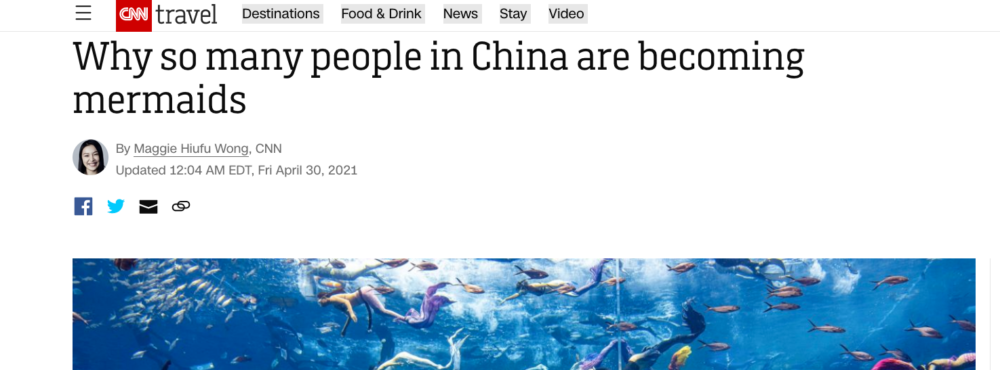
Terracentrism influences how humans interact and perceive marine environments, including the creatures that inhabit them. This skewed understanding of ocean life can be seen in our study of mermaids. Most of the mermaid stories we have discussed thus far have portrayed mermaids as half-human. These depictions accentuate a deeper bias ingrained in Western culture. By portraying mermaids as half-human, these stories inherently suggest that only beings with human-like features can possess intelligence, emotions, and agency. This perspective not only reflects a limited understanding of marine life, but also perpetuates a hierarchical view of the natural world. Additionally, half-human mermaids reflect the tendency to project human traits and experiences on non-human entities. This lens reinforces terracentrism, which creates the risk of overlooking the complex and diverse ocean habitats.

Overall, I found Roorda’s introduction powerful as it highlights the “natural bias” (1) humans have when discussing the ocean. As Roorda says, “we all depend on the ocean” (4), and actively recognizing this bias may lead to a deeper and more empathetic understanding of aquatic life.

Week 10: Deterritorialization

For far too long, humans have regarded the ocean as “other”, as “terra incognita”, as a void, obscuring the mas that covers 71% of Earth’s surface from ourselves and shirking the responsibilities of it’s abuse and pillaging off of ourselves as it is not ours to own and therefore not ours to care for. Terracentrism dominates our collective psyche through our language, commonly held beliefs, and areas of scientific study. Steve Mentz’s piece, “Deterritorializing Preface” offers an interesting new shift in our vocabulary, as a means of centering the ocean, which has previously been left wholly ignored, in our research, discussion, and understanding of the world. In this way, we can broaden our perspective that shapes our action in response to environmental crisis from just land occupied by humans to the vast ocean as well. As an environmental science major, I find this criticism of research’s common tongue to be very compelling. This piece not only directs my attention to the common use of terracentric words like “Field” in my natural vocabulary, but also has me question my own motivations and understandings in entering this *current* of study. I had come to understand from William Cronon’s piece “The Trouble With Wilderness” that my pursuit of a degree in environmental science with the intention to serve the environment stemmed from an anthropocentric savior complex; how could I say I want to to save the environment if I am part of the larger issue? Becoming aware of that was a first step to readjusting my view on environmental conservation from “saving” to “making reparations”—to approaching the environment with a deep sense of regret and respect, as to avoid asserting the same control over it that led to it’s deterioration and to give it the space and support to thrive and repair itself. Now, Mentz’s piece offers me seven new ocean-centric words to broaden my understanding even further, as I’ve come to understand that not only was I entering into my career with a damaging anthropocentric outlook, but a terracentric outlook as well. Thanks to these works, I can construct a new paradigm for my approach to environmental sciences that is predominantly structured around respect and understanding, rather than control and self-gratification.