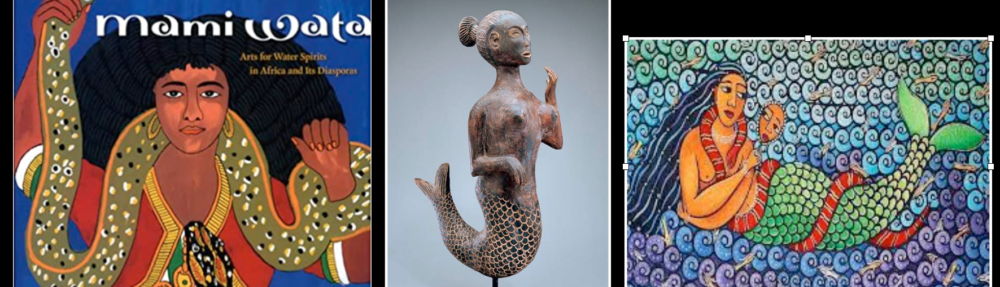
One thing I found particularly interesting after completing the first couple weeks of reading was the different interpretations of the mermaid’s hybrid body and how each depiction dehumanizes women. Vaughn Scribner’s Merpeople: A Human History discusses the Western perception of the maiden’s “part woman, part fish, part animal” figure (Scribner 76). The alluring bodies of these women are explained to be “strange” but “wonderful”— emphasizing the mystery surrounding mermaids (Scribner 76). As we have discussed in class, the Catholic Church used the appeal of mermaids to emphasize the dangers of femininity. The church made it clear that when men encounter a mermaid, they must not fall victim to their intrigue because it will bring “personal grief” and “humans to horrible ends” (Scribner 55).
The Penguin Book of Mermaids by Cristiana Bacchilega and Marie Alogalani Brown also considers the Western interpretation of the hybridity of mermaids. They explain that the “single fishtail [marks mermaids] as having some control over their bodies” while the “bare-breasted top” suggests her “duplicitous nature” (Bacchilega, Brown xiii). However, Bacchilega and Brown also discuss the Rene Magritte painting “The Collective Invention.” In Magritte’s depiction of the mermaid’s hybrid body, the top and bottom are switched. So, the woman is pictured with a “fish head” while the lower body is “human and naked” (Bacchilega, Brown xiii). There is nothing sensual about “The Collection Invention.” This painting takes away the beauty surrounding mermaids and makes them look frightening. Magritte’s painting dehumanizes these creatures and, I believe, shows the misogyny present in early tales and depictions of mermaids. Men took women’s bodies and made them something to be afraid of. This further shows how demonized women were at this time and the imbalance of power between women and men.
I am curious to see if other cultures’ stories regarding mermaids are as misogynistic as the Western’s. Colonialism has impacted many cultures around the world, so I wonder if the Western influence has impacted mermaid myths and legends more than we think.