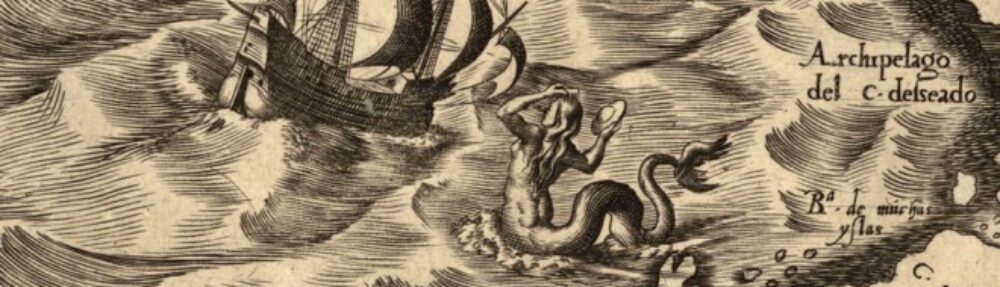
“The Feejee Mermaid Hoax” and “Freakshows and Fantasies” both demonstrate the Western obsession with mermaids and the efforts at “ordering the natural world and its creatures” that continued from the Enlightenment period (Scribner, 129). In Barnum’s autobiography from 1854, he discusses the Feejee Mermaid Hoax, but also outlines a historical account of mermaid sightings and displays. Barnum describes the mermaid as a “fabulous animal”, and yet, continually applies Western beauty standards to the mermaid sightings and displays. He views the mermaid as animal or other, but not enough for them to be free of our judgment.
While almost every recorded mermaid sighting occurred in the British Isles or America, both readings pointed at “the ‘Oriental’ allure of Asia (that) still held sway of the Western masses” (Scribner, 126). In 1758 a mermaid exhibited at the fair of St. Germaine’s in France was described as “female, with ugly negro features. The skin was harsh, the ears very large…” (Penguin, 243). Here, Western beauty standards, and clear racism, is being applied to the mermaid, even though they are viewed as animal or other. However, in London in 1775, a mermaid exhibited was determined to be an “Asiastic mermaid… young female- its eyes a fine light blue- its nose small and handsome- its mouth small- its lips thin- its chin well shaped- its breasts are fair and fall… the belly is round and swelling, but there is no navel…” (Penguin, 243). The mermaid that was suspected to come from the Archipelago seems to meet the Western standard of human beauty.
Also, the detail of the rounded belly lacking a navel points out the ongoing question of how mermaids reproduce. If there is no navel, it must widely differ from the human birthing process. I find it interesting that this detail was included in the 1775 exhibit.
In mermaid sighting and captures from earlier in 1187 and 1430, they both appeared close to human, but were said to not be able to speak, Barnum states “that nothing seem wanting to it (the mermaid) but speech” (Penguin, 242). The mermaids lack of speech seems to be another separating factor between us or other, as well as if the mermaid was even deemed satisfactory.
Great blog post that shows you developing arguments and interpretations from the reading, citing and explicating quotes to develop your point. You cite the text and then make the point, “The mermaid that was suspected to come from the Archipelago seems to meet the Western standard of human beauty.” You can push further here on why this matters– So What. But, this is good work!
Your analysis of Undine’s “The Day After the Wedding” was both insightful and thought-provoking. Your exploration of Undine’s depiction and relationship with Huldbrand effectively emphasizes the text’s themes of love, nature, and human connection. Your insight about Undine and Huldbrand’s enduring loyalty, despite their disagreements, is extremely striking. It emphasizes the potential for harmony between humans and the natural environment, implying a need for greater understanding and acceptance. Furthermore, your interpretation of Undine’s phrase about all beings striving for betterment resonates strongly. It stimulates us to reevaluate our relationship with environment and promotes a more cooperative attitude.