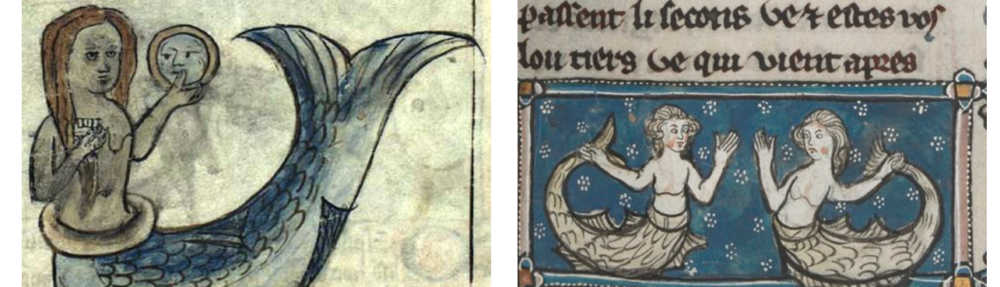
What I found most interesting this week was the difference between the Melusine origin story in the Penguin book versus the story told in the Romance of the Faery Melusine. In the Penguin Book of Mermaids, it states that Melusine (called Melusina in this book), has a serpent tale and does not appear as a mermaid. However, as we see in the Romance of the Faery Melusine, she is represented as a mermaid. In fact, the entire room that she hides in on Saturdays is made up for a mermaid–containing sand, water, shells, and coral. I think that this is because of the Christian Church. As we learned in the first chapter of the Merpeople book, the Christian Church chose the image of the mermaid for their own deviant needs (to belittle women and bring more followers to the church). This book, at least from the chapters we read, seems to have big Christian themes and God/Jesus is constantly mentioned. For instance, on page 12: “In those days men identified with things that could lead them further into the unknown; they sought in all directions the extension of their physical and spiritual power. So they believed and so they lived, sure of themselves and strong at one moment, at the next deflated and weak, falling to their knees for restoration from another source, the Lord Jesus Christ. And things, animals or people, trees or weapons, were more themselves… And the law of God prevailed over all.” These not so subtle mentions of Christian ideology are important because they give us context to who may have written this text, and where this text may have originated from. Clearly, it was written during a time where many were religious and believed in God. These men mentioned in this quote rely on Jesus Christ, and believe God is almighty. There are many mentions of God in this text–I will not list them all as it would be boring and extended–-but some important ones are “I am as faithful a Christian as you are” (p. 25), “before God and in the face of ourselves, and will marry you as soon as you wish in a church” (p. 26), “Could it be the Devil?” (p. 121), and “Pray devotedly to Our Lord to relieve my sufferings and shorten the time of my ordeal” (p. 144). These quotes further reveal the Christian beliefs of the time. In addition, Melusine is depicted combing her hair and using a mirror–which are associated with vanity (which I believe came from the Christian Church). She is also sexualized, as the Christian Church did with their mermaids: “flawless figure of a woman, forever young… her bent back magnificent in profile, her breasts raised… the exquisite flesh” (p.125). While the Penguin Book says that Christian framework makes her a more positive character aligned with water, I am not sure this is so true. I feel like this story was adopted to further demonize women, as liars and deceivers (as she was not truthful about what happened on Saturdays). Not only this, but Raymondin accuses Melusine of having damned children, and that she is a phantom and her children are as well, which could maybe imply that women can bear devilish fruit (but it could not be the man’s fault).
Literature and the Environment: Mermaids
Professor Jessica Pressman. Spring 2024