Week 5 – The Faery at the Fountain

Chapter 3 of The Romance of the Faery Melusine (Gareth Knight, translated by Andre Lebey, 19th C) I thought was interesting to read about since in the back of my head all I was thinking about was that they were hinting about mermaids or sirens the entire time. Reading the Legend of Melusina (The Penguin Book of Mermaids, 85-87) and it stating that her mother “condemned Melusina to become every Saturday a serpent, from the waist downwards” (page 86), which stuck with me because as I read Chapter 3 of The Romance of the Faery Melusine I unnoticed how stories were worded differently. In summary on page 25 it was almost as if Melusina was mind reading Raymondin which to me gives the idea off that she might be a siren, since in last weeks class one of the main discussions of a siren was that they have been somewhat presented as mystical beings that hold all the knowledge in the world which can include the thoughts of others. It was interesting that no where in this chapter it was clearly stated what mythical being Melusina could’ve been, but they made it a point to mention the beauty and knowledge she held that left Raymondin wondering “if he were still alive” (24). 

One of the biggest points I found interesting that was made within chapter 3 is the idea of blinded trust due to feminine beauty. Before even knowing Melusina’s name, Raymondin was able to fully confide in Melusina and the contract of marriage she has set up for the both of them which made me wonder how beautiful Melusina could have been that it left Raymondin unable to comprehend what is being said and the contract he is signing himself up for. It isn’t such a surprise that he was able to trust Melusina because of how differently things were done and said in the past, but it’s strange that Raymondin himself didn’t stop to question if she was even a mythical being since sirens were existent in that period of time. The idea of feminine beauty through this story has had an emphasis on me in that now I can only imagine the power that mermaids, sirens and so many other feminine mythical beings would have over the male population.

Week 5: Legend of Melusina

“The Legend of Melusina” seems to be the first tale we have studied this far where a hybrid only takes its shape one a week, in this case on Saturday’s. Not only did that surprise me, but so did Raymond’s reaction when uncovered Melusina’s secret. I honestly expected a more negative reaction because of her ability to shape shift into various forms. It is said that “It was not horror that seized him at the sight, it as infinite anguish at the reflection that through his breach of faith he might lose his lovely wife forever”(p. 88). This story is the first time a mermaid has been seen for her true self by a man, and it seems as if the relationship between them is more genuine than in what we have studied in the past. I bring this up based on my original curiosity surrounding the idea of gender roles and femininity. I am interested to see how dynamics change through different works of literature and what this has to do with the type of hybrid creature, or the fact that she is mostly human? By that I mean if it was more than just Saturday that she became hybrid, would that change the way the story goes?

Week 5: Melusine

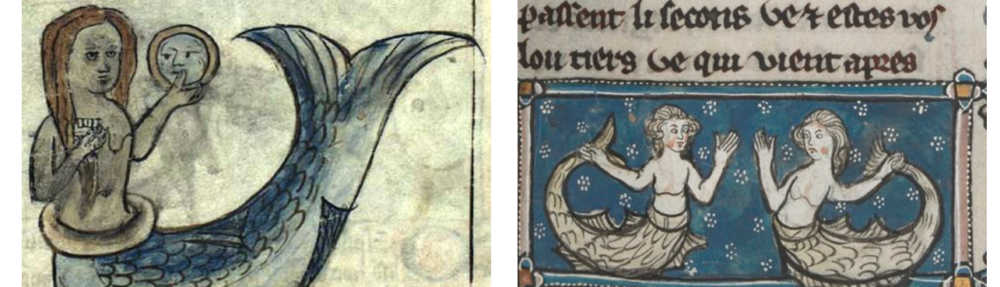
The importance and significance of beauty, attraction, and femininity are all things I have seen and observed in this class. The Faery at the Fountain engraves this in me even deeper, while these things were of importance in this tale, there were also other obvious aspects that I have not seen in stories before. I would like to say this story reminds me a lot of the damsel in distress trope, but the roles are reversed. Raymondin is on the run and seemingly lost when the faery Melusine comes to what seems to be his rescue. While the roles are reversed from what a typical story usually shares, Melusine did not emasculate Raymondin, at least not in my eyes but I am not exactly sure why. “It was always she, indeed, who led.” (p29). Since it is their first time meeting, it leads me to think that Raymondin is not the first nor last man with whom Melusine shares this type of encounter. In the lens mermaids, they both share this sort of enchanting and hypnotic entity, where the men simply cannot resist their beauty and in return the woman, in this case Melusine gives them some sort of knowledge or information. This is what we have seen in the case of mermaids and sirens, it’s interesting to see that faeries also carry this sort of captivating power. Another thing I noticed was the femininity of Melusine and how much of her hair is emphasized, “Then she began to comb it, and as he admired the fine silky, deep tresses he saw the wooden comb that had ran through them..” This was one of the similarities I noticed between the way both Melusine and mermaids have been depicted.