Week 9: The Thing about “The Thing in Itself”

Our reading for this week references philosopher Immanuel Kant’s “das Ding an sich”–or “the thing in itself.” “The thing in itself” refers to an individual’s difficulty to truly comprehend an object because of the meanings and definitions attached to the object. Those meanings and definitions, which differ from person to person, cloud the “prior truth” attached to the object.

It’s an interesting way of viewing the world as this school of thought asks its student to examine their personal biases, but it’s also an incredibly removed and admittedly-Western way of viewing the world. The text states: “…every object and being is defined by its relationships. It is part of networks and only has meaning in relation to its surroundings. Scientists studying nature had sought to know the “thing in itself” and to isolate an organism in a cage or a glass container. Yet to grasp fully any form of life requires studying it in its habitat, where its existence is defined by relations with others of the same species, and by the plants, animals, insects, and microscopic organisms that share its environment. As the analysis becomes more detailed, it must include more and more about the environment, including the climate, food sources, predators, competitors, procreation, and so on.” (9)

In essence, this means that no object exists in a vacuum and its meaning comes from the things that surround it. A spool of thread and a shirt aren’t just two separate objects that happen to be in proximity; there’s a story that can be created around these two objects. One could say the spool of thread was used to fix a hole in the shirt or that the thread was used to sew together the parts of the shirt. We could even go as far as to say that the spool of thread might be embroidery floss and could be used to embroider a pattern on the shirt. The individual meanings of a shirt as a garment and canvas for creation and a spool of thread as a tool for creativity and creation are only created because of each object’s relation to each other.

This relational existence is what makes the conversation about humans, anthropocentrism, and the environmental humanities’ denouncement of said anthropocentrism so interesting. While we as a species have created a lot of problems for nature by distancing ourselves from it, we have also still made ourselves a part of it through our interference. Have you ever seen what a banana or watermelon looked like before humans came up with GMOs, natural or otherwise? Nature shapes us just as much as we shape nature and human interference, in a way, becomes a part of nature.

The Emergence of the Environmental Humanities

“We have not searched for straw men to demolish; rather, we
have focused on what seems the most intriguing and potentially productive
approaches.” The closing statement of the introduction suggests that the authors would like to provide an observation of some environmental humanities approaches in the past. One early criticism that I have is that it was claimed very early on that environmental humanities as a field has only been around for the last one hundred years. Although the article does discuss the exploitation of indigenous/native people in the US (including the creation of national parks), it fails to give much context to the Western creation of science. I think it would be useful for readers to understand some of the practices that indigenous peoples have passed down to preserve their local communities. For us to see the whole picture, we need to realize why the concept of environmental humanities was even created. Last time I checked, Native Americans weren’t given much credit for their ability to exist symbiotically with their surrounding environment. This concept of Environmental Humanities seems to cover the scale of the whole Earth because we now have a globe that is connected not only physically by roads but a vast network of communication creating a place with little isolation. Because of this, it creates the assumption that the Environment includes everything on Earth. Now more than ever, actions that affect the environment on a local scale may cause some environmental damage on a large scale.

I like the dilemma of conservation brought up by the authors. It’s a difficult question to answer sometimes. Do we conserve this so-called pristine wilderness and kick out those who have been living symbiotically in that area? In Africa, there have been issues of gorilla conservation which requires locals to be removed from the land they’ve always lived on. Do we value the gorillas more than the livelihood of our own kind? Where do we draw the line of morality when it comes to conservation? I’d like to see what happens in the future of conservation and preservation, the balance has proven difficult.

Week Nine Reading Response

It occurs to me, after this week’s reading, that I knew nothing about what the environmental humanities were. I am thinking that the environmental humanities seem like a response to some of the important points of our reading of Cronon last week. Reading “The Emergence of Environmental Humanities” further solidifies some of our discussion point from last week. Western views of our relationship with nature are deeply narrow and do not allow for the communication and open mindedness required to provide solutions to our ecological problems. It’s no coincidence that the study of environmental humanities grew through the contributions of different fields of study like gender and indigenous studies both being intersectional studies that try to de-centralize the western narratives. On discussing what topics are covered by the study of humanities the text says, “a new range of concepts emerged that provide a framework for environmental humanities, such as ecoracism, environmental justice, ‘naturecultures,’ the environmentalism of the poor and the posthuman.” It never occurred to me how important these topics are when considering environmentalism and that new technology is not always the only answer or even the answer to our environmental crisis. I like how the text mentions that science does not always consider the knowledge that is readily available to us. I remember discussing early in the semester how indigenous peoples have so much knowledge of the land that has been dismissed by science as nothing but folklore without actually considering what knowledge they have to offer. It is how we learn that controlled fires in a forest are necessary to bring about new life.

 I have recently read Greg Grandin’s book “The end of the Myth” and in it he re-contextualizes the conditions that led to the dustbowl famine during the great depression. A big part of the reason for the famine was the destroying of land by unsustainable farming practices used for the production of cotton. The book explores the idea that plantation owners were not interested in sustainability of farming because the myth of the frontier gave them a false sense of confidence that when the land was spent they could just extend further west. Pairing this book with the topics being discussed in this class helps reinforce why environmental humanities are necessary.

Humanity is Nature’s Greatest Parasite

In this weeks reading of “The Emergence of the Environmental Humanities” by David Nye, I found the breakdown of humanities treatment of nature to be extremely interesting. I had never considered how much information about societal constructs could be told from analyzing humanities poor treatment of nature. From the very beginning, we are coerced into realizing that environmental humanities is a relatively new thing, which I had never considered. Its creation shows a lot about how people are realizing their mistakes with their treatment of nature. Society has unintentionally made the poor treatment of nature the standard for nations to thrive since the Industrial Revolution. While there are now people trying to fight back against this unsustainable way of survival, many nations and industries will not dare to accept a change because it could mess with profits or disrupt the flow of a lot of populations.

What interested me the most is idea of ecoracism. Ecoracism is the concept that wealthy nations will “outsource their pollution” (p18) to poor countries in order to maintain a clean and healthy country. While one nation will benefit, the other country will see the build up of an unsustainable ecosystem. For a superpower to create an unhealthy environment for a less fortunate country shows that we are blatantly allowing modern day imperialism. This is a huge problem in itself because it paints the average person as either ignorant, an enabler, or too lazy to do something about the issue. The lack of unity against the issue matters because solving the environment crisis is not an attainable goal without unity. Even if people choose to ignore the issue, eventually everybody is going to feel the effects. Nature does not know any borders. Natural resources are being depleted from the planet that is shared by all of humanity. Eventually, superpower nations will not be able to throw their pollution in other countries.

It is incredibly alarming that people have access to this information and do nothing about the impending issues that will be impossible to ignore. Humanity is derived by nature, and I personally believe humanity could thrive with the natural resources we have access to if greed and comfortability were not an issue. While there are some true efforts to fix the environment, if people are not unified it will not be able to be fixed.

Understanding the Ocean: Art vs. Science

While reading The Blue Humanities, by John R. Gillis, I kept thinking about the relationship between art and science.

I believe that both art and science are ultimately trying to accomplish the same goal – albeit by taking different steps. To me, the goal of art is to spread awareness and an overall understanding of any specific issue or topic by creating something an audience can observe and explore with their imagination. Whether its a movie, song, painting, etc. it is my understanding that art is to be carefully crafted in order to raise a question in the viewers mind that they are supposed to answer for themselves. Science, seems to be the opposite. Where art aims to ask questions, science wants to provide an answer. Science produces theories that are meant to be tested and experimented with to get the greatest understanding of the subject as possible.

So where does the Ocean come in with all of this? Well, with the ocean being so vast and mysterious – it is no question why so many works of art have been produced with the ocean being the main character. It’s unpredictable and violent while also being calm and serene. It is the perfect canvas to paint upon the fears, desires, and wonders of the human mind. But how does writing a book affect the ocean? Making a movie? Writing a song? The biggest influence art has on the ocean is how we view this integral part of our world. Could it lead us to wanting to investigate it.

Where we observe the ocean through art, we could disrupt it with science. While we can learn a lot about the ocean through research, there’s a difference between observing it as it currently exists and observing it with a plethora of variables. Human beings have an impact on everything they decide to get themselves involved with. I am not against science in the slightest, but I do tend to associate the urge we have to “understand” the world around us with the tendancy to try and control it. I think that we cant fathom the perfectly chaotic synergy of the Natural World. We require structure in our lives to make the world go ’round, so we intend to implement that structure on a world that would be better off without it. The way I see it, we are product of the Natural World, but we are in no way a part of it. I dont think we can return to it, so ultimately this debate on whether understanding the world through art is better than doing so through science or vice versa is rather moot.

Sorry for the downer post, I’ve just been chasing this idea around in my head and reading The Blue Humanities somehow made the idea click into place.

Reflection on “The Blue Humanities” by John R. Gillis

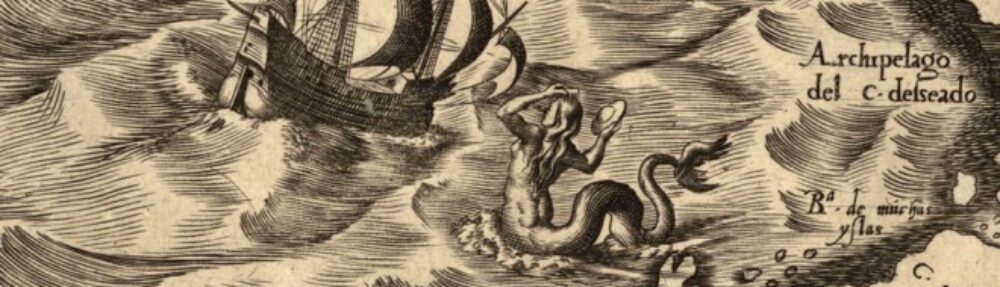
The article discusses many aspects of humans’ understanding about the ocean. It begins by stating that humans know more about the moon than the depth of the ocean, which is amusing considering we live alongside it. Because of it being unknown, the article explains the ocean was feared before the 19th century. It was perceived as “dangerous and repellant, ugly and unfit for literary or artistic representation” (Gillis). However, in the 19th century it was through literary and artistic representation that humans began to connect with the ocean and use it to reflect their own lives. I thought this was fascinating because it became a sort of trend for people and even those who didn’t associate with the ocean, still represented traces of it in their daily lives, the article quotes, “the ocean entered the minds, homes, dreams, and conversation of ordinary people.” It was in the 19th and 20th century that the sea was finally associated with life rather than death as a “three-dimensional living thing with a history, geography, and a life of its own.” In relation, Writers and painters turned their attention to the ocean when nations turned away and allowed for the ocean to be a place for metaphors. Another big part of this cultural shift is archeology and anthropology because it brought us more knowledge about the history of the ocean through scientific studies. The ocean began to shift from a lifeless place to a place filled with life. Today, we are able to explore the history of the ocean and its characteristics, “ocean currents, tides, and waves.” Overall, blue humanities, as mentioned in the article, “recognizes the close relationship between modern western culture and the sea” which highlights the cultural shift humans have had and continue to have with the sea.

Week 9: The Human in Humanities Environmental Issues

For this weeks’ blog I wanted to focus on the key point made in The Emergence of the Environmental Humanities: that humans are the cause and answer to environmental issues that plague the world. Humans are, and have always been, and invasive species to the planet; we drive cars that produce lots of CO2 emissions, we overfish the sea, we destroy land to create homes, and so on. The article, early on, states how, “—[the] current consumption of the earth’s resources is not sustainable” (MIT, 1) and that this issue is not fixable by scientists alone. The writers of this essay essentially say that in order to fix this issue we need to convince humans to go along with a solution by catering to them and highlighting the profitability. This leads me to my underlying point that in a capitalistic world, one where you will not show up to your next shift if you receive nothing but knowing you are contributing to the betterment of society, the globally impacting environmental issues will never be resolved in a world full of narrow minded individuals. For example, as an average citizen it is hard to grasp the idea that I alone can do anything about the carbon emissions cars produce every day because even with the invention of new electrically powered cars, it doesn’t mean that me or the next person will have the money to buy one. Therefore the writers then touch on the idea that in order for an environmentally forward shift in any aspect of every day life to have an effect, the new shift must take note of “— adequate insight into the historical and cultural context of a proposed solution” (MIT, 2). This problem is a human made problem that will take everyone’s opinions, outlooks, and ideas to be contributed if we ever want to make any sort of real, positive, change in our environment. Humans are very emotionally wired beings, so if we can get people to care about this issue AND make it make the most practical sense, only then will change have the potential to occur; without those two qualities, humans cannot be bothered and we will ride the Earth until it’s’ wheels fall off.

Week 9 — AI Modeling an Eco-Friendly World

This week’s reading was super interesting to me and I found that I enjoyed the author’s approach in that they basically say here are the ways that we think are best to view/treat the environment and here are their drawbacks. They clearly stated in the beginning too that they are not out to destroy or dissect any bad ideas, it’s really just pooling what they believe are some of the best approaches. For my blog post, I want to talk about something that my roommate sent me off of reddit the other day and how it relates to this reading. I liked their introduction to explaining how environmental humanities will become a prevalent study in the near future. It reads, “Carolyn Merchant has argued that “a partnership ethic would bring humans and non-human nature into a dynamically balanced, more nearly equal relationship.” Such a new ethic requires a new narrative. This new story “would not accept the idea of sub-duing the earth, or even dressing and keeping the garden, since both entail total domestication and control by human beings. Instead, each earthly place would be a home, or community, to be shared with other living and non-living things” (Emerret, page 6). The other day my roommate sent me this link where someone asked Chat-GPT to “describe a world where the power structures are reversed. Add descriptions for images to accompany the text”. If you click on the link I would hope you are as baffled and interested as I am. It’s interesting to see in this world that we cohabit the environment with nature, opposed to the typical western approach of conquering the environment. Seeing cities and houses that look equally modern as they do ‘nature-ish’ is a wild sight, and in my opinion would be a sick world to live in. My only contingencies in this world is that for starters, I think it would be nearly impossible to get each and every person on earth on this same level of understanding and appreciation towards the environment, especially losing the emphasis on monetary growth in large corporations. Secondly, and what scares me the most, is a world that is predominantly run by AI. I think the concept of AI having no biases is super cool and could be extremely powerful, but in a nutshell someone has to create and train that AI model, and if fed with some level of bias it will inevitably surface in its decision making. But who knows, AI will continue to develop, peoples opinions around: money, positions of power, and environmental relationship could also be subject to change allowing room for this type of society in our world at some point in our future. If anyone checks out the link, let me know what you think! Is it a world you would want to live in? Is it a realistic future? 

Week 9: Humanities

so this time it was a reading and not quite from the penguin book or the other one which is an interesting change of pace. It talks about how environmental humanities have been in the works for awhile, which I believe: we’ve been aware of climate change since the 60s at the earliest (if I recall correctly). But reading it really reaffirmed a theme that we touch upon in class which is that of humanity’s role within nature.

”human beings are not merely observers they are an active part of nature”. (Page 8) We have shaped nature all throughout history physically and figuratively (through stuff like folklore and mythology). Even today we’re still trying to understand nature more and more (especially since we have a profound effect on it)In a way, it makes sense why environmental humanities became more and more relevant (with understanding comes widespread knowledge, and more awareness). At the same time, though, I hope we aren’t too late with it. Maybe being so divorced from nature has made us care less? Not to say that the developed world is horrible and we should revert back to a simpler life, but the more we move forward, the less we seem concerned with our planet

I had to type this on my iPhone. .

Week 9: The Ocean—Where There is Mystery, There is a Place to Hide From Ourselves

The Article “The Blue Humanities” by John R. Gillis takes the point made in last week’s reading of “The Trouble With Wilderness” by William Cronon a step further—narrowing the human-made idea of “wilderness” to one specific aspect of the environment: The Ocean. In what we observed from Cronon, we learned about how humanity constructed the idea of the untouched “wilderness” in order to blind ourselves to not only our misdeeds (pollution, loss of biodiversity, overconsumption) but our presence in every area of the world. There is no where to hide from ourselves and our wrongdoings, and we comfort ourselves through delusion. Gillis teaches us about the history of human’s perception of the ocean, once being overlooked, to being feared, to being a new place of solace—a new place to hide. Since the ocean, having been believed to be an empty abyss, was vastly unexplored, humanity was able to project their dreams onto and escape into the deep. He states, “Pristine nature, now in short supply in industrialized heartlands, found refuge in the oceans, while the mystery once associated with terra incognita relocated to the deeps.”, explaining the need to escape that affected a vast majority of people, specifically in urbanized environments, who were immediate witnesses to humanity’s destruction of the natural world. As industrialization became more developed, the world as people knew it began to shrink: in cities, as large buildings were raised and city limits expanded, there was less and less world to be found in the common space, and even in nature, as temperate forests were clear-cut to construct these buildings, life that was not polluted by industrial values disappeared. The only piece of the natural world that was left for people to grasp onto was the ocean, so much so “they want about them talismans of nature on their walls, their shelves, their keyrings.” (Paterson-Hamilton), to be kept as reminders of what life is still out there, life beyond the smog and concrete. But even those talismans are part of the grand constructed delusion, as the ecosystems that were reaped in order collect those talismans were forever tainted. In the hands of collectors desperate for comfort that there is still pure life out there, or in the lungs of swimmers desperate to be part of it, or in the literature of Atlantis that plays in the dreams of people who can no longer see the stars, there is hope that not all has been lost to consumption. But it is already too late, and unless those hopes turn into reparations, and we stop running from the reality of our impact, the problem will only worsen with ignorance.