The reading for this week was the first reading to really pinpoint and dissect the notion that perhaps humans and nature are one and if so why is it that we feel separate from it. It seems no matter what text you read in this class, a Christian value can be spotted somewhere in its interpretation. In this particular case, I felt the religious aspect added to not only the awe and beauty of nature, but also the fear and otherness it gives off. Cronin pointed out that in “—early Christian saints and mystics had often emulated Christ’s desert retreat as they sought to experience for themselves the visions and spiritual testing He had endured. (Cronin, 10)” I think this urge to go into the unknown and truly immerse yourself into something natural. Like the desert, to experience something supernatural or unnatural, pulls on the idea that we as a human race knew very little of the natural world around us during this Romantic period, but it was this era of curiosity that gave these natural environments a sort of mysterious personification. It was no longer supposed that nature was simply a desolate plot of land, but when given meaning by the Bible, nature began to warrant respect from its human counterparts. I also thought this idea showed through in the quote “[God] would most often be found in those vast, powerful landscapes where one could not help feeling insignificant and being reminded of one’s own mortality. (Cronon, 10)” It would seem that in order for humans to respect nature and view/understand its value, a hierarchical mindset must be employed. Since God was above all, of course he would chose places that remind you, you are but one single human he has created in this vast world he has crafted. It would seem that for humans to give value to anything, they must see themselves below it, which may warrant the question why humans respect things they feel powerless to? I’m not sure exactly what it all means but I thought these ideas were striking in the reading so hopefully one of my fellow classmates can further elaborate my thoughts.
Tag Archives: week 8
The Concept of Sacred Wilderness
In “The Trouble with Wilderness; or, Getting Back to the Wrong Nature” by William Cronon, WIlliam Cronon argues that argues that preserving wilderness doesn’t necessarily mean that people are respecting it. People are natural beings, and although humanity has evolved to the point of manipulating nature, preserving wilderness takes away from the history of indigenous people that lived harmoniously with nature. Cronon believes that the concept of wilderness “had to become sacred” (9) in order to be idolized. Cronon also repeatedly mentions satan and God when discussing wilderness. The idea that the wilderness is sacred is a very interesting thought to me. At what point do humans exceed nature and are too advanced to partake in it? There is no clear line, and I think that Cronon does an excellent job at pointing out the flaws in the logic by proposing that indigenous history should be studied and celebrated through nature.
Although I do agree with Cronin overall, I disagree that the wilderness is “profoundly a human creation” (2). The wilderness existed long before humanity and although humans came around and altered it, I believe that the wilderness has been shaped based off of what it has been able to provide. What it can provide has shaped how humanity has altered it, which I think proves that nature is ultimately more powerful. Nature could exist without humanity but humanity would stand no chance against nature. It is important to consider indigenous influence on nature and allow humanity to be considered a part of it, but to propose that humanity has power over nature can and has been disproven easily.
Despite my disagreement, Cronon does an excellent job at proposing why nature being sacred does not mean that humanity cannot be a part of it. Humanity was able to survive based on the resources that the wilderness has provided, and evolving into intelligent creatures should not be enough reason to cut the tie between nature and humanity. Despite what may be a controversial take, if I have interpreted it correctly, Cronon’s idea should be discussed in order to have a better idea as to how people should treat their relationship with nature.
Week Eight Reading Response
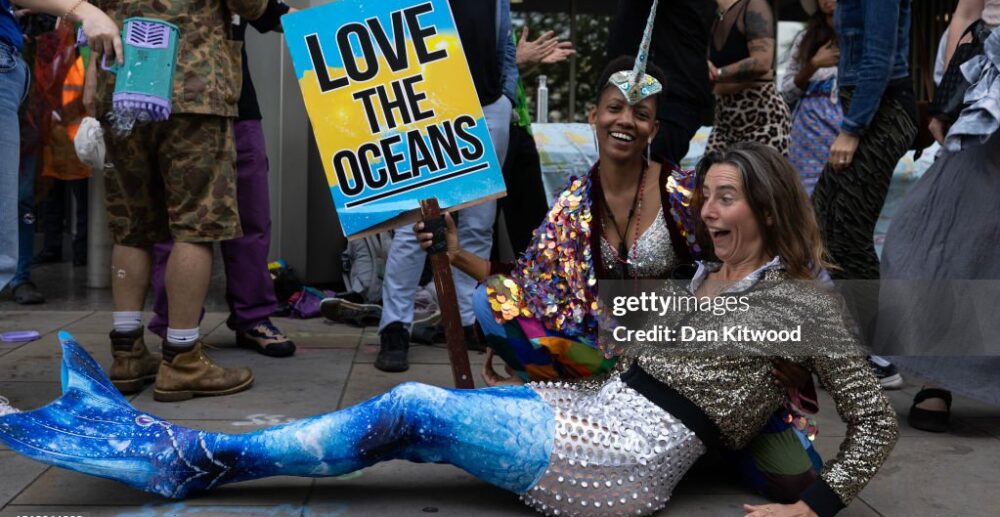
I appreciate how this reading defines wilderness and the environment. It helped to enrich my understanding of these concepts when considering them in conversation with mermaid mythology. The idea of wilderness had always seemed to be a naturally occurring thing. Something that simply existed and humans affected. To realize that wilderness is but a human construct and a rather narrow and exclusionary point of view is fascinating.
Whilst reading, it was interesting to notice the how the ideas of wilderness and mermaids shift over time. By this I mean that as the wilderness becomes less and less a place of evil and more a place to consume recreationally, so too do the attitudes about Mermaids shift. She becomes less of an evil monster and is commercialized in the 19th century. This also gives me a better understanding of why she is often used as a representation of nature and wilderness. On page 17 Cronon describes wilderness as a “siren song of escape.” I find this particularly interesting because we are learning that wilderness in many ways is a social construct that is a product of myth. The idea that nature and civilization operate on separate spheres is likewise a myth. We see this even in the story of Melusine. The beginning of the story describes that nature is in many ways a man’s domain, it is for a man to find adventure and prove their bravery by conquering it. Constantly humans infringe upon nature but so many stories show the mermaid as being the invader. Many years later we see these same sentiments still being echoed in the figurehead of The Virginian. I appreciated that the text also does away with the Christian idea of wilderness as untouched and “virgin” first because it denies the presence of natives that were forcibly removed from their homes; Second because to say that wilderness is virginal and that it is the environment in which the individual man can enforce their freedom and masculinity is deeply troublesome. When gender is considered as these elements of power, it is not difficult to understand how we end up with so much history of misogyny. It further reinforces the texts claim that to think of the wilderness through such a narrow scope also influences who we view as human and worthier of protection. If the point is to save the environment by keeping it pristine and untouched then what of the people that live in constant relation to the land and see themselves also affected by the same environmental issues affecting the natural world. Does that mean that these humans are not worth protecting? Again, we are put into the conversation of defining who is human who is not and what and who is worth saving.
Week 8: The Trouble with Wilderness
What stood out to me was Cronon’s return to his main argument, “there is nothing natural about the concept of wilderness. It is entirely a creation of the culture that holds it dear, a product of the very history it seeks to deny.” (16) Cronon challenges the widely believed perception of wilderness as a natural, undisturbed state. He begins by claiming that the concept of wilderness is not natural or innate, but rather a product of human society. He challenges the notion that wilderness exists irrespective of human impact. He contends that wildness is a product of the society that values it, highlighting the importance of cultural values and views in creating our understanding of nature. Furthermore, Cronon emphasizes the contradictory character of wildness, claiming that it is “a product of the very history it seeks to deny.” He contends that the romantic idealization of wilderness as a clean and unspoiled landscape ignores the rich human history associated with these locations. By recognizing the historical context in which wilderness ideals developed, Cronon encourages readers to critically evaluate the cultural structures that impact our impressions of nature.
However, I am in partial agreement with his argument. I value Cronon’s critique, but I also believe that preserving select wilderness regions is beneficial to biodiversity conservation and ecosystem health. I agree that the distinction between wilderness and civilization is arbitrary, and that humans have influenced ecosystems throughout history. However, I appreciate the value of designated wilderness regions for conservation. Also recognizing both the cultural creation of wilderness and the significance of preserving specific landscapes for their biological value. But I believe it is critical to prioritize the preservation of wilderness regions as a means of conserving biodiversity and ecological health. I believe that wilderness is valuable in and of itself, regardless of human impact, and that rigorous protection measures should be implemented to keep these areas clean. I would argue that Cronon’s critique hinders efforts to protect wilderness and natural places from further degradation. What concerns me is that stressing human influence on wilderness may lead to complacency or a reduction in conservation efforts.
Week 8 — Modern Day Frontiersmen
Although I have only read half of the reading thus far, I found the large portion of the text to be rather interesting. I have read a handful of Muir’s, Thoreau’s, and Roosevelt’s works from this time and it was cool to see a piece that incorporated all of their works together. I have found that I personally struggle to support both the industrial movements to attempt to overrule the land and the religious ideologies that came into place to protect our national parks/wilderness landmarks. I think it is great that through romanticism and religious ideologies that we were able to develop this appreciation for nature; it makes sense that the religious appeals were what worked for the people in this time period. However today, we still have these issues going on with large corporations attempting to tap into the resources of beautiful environmental landscapes but religious ideologies will not suffice in halting their activities (especially in other countries with different religious beliefs). On top of that, we have many US companies that are intentionally going to other countries to exploit labor and natural resources because it’s cheaper and not deemed illegal the way it is in the US. This plays on the concept of NIMBY (not in my backyard), which is nice to know that the states are protected, but doesn’t stop Americans from going elsewhere for resources, still prompting the question about how much we really care for our earth.
One part that spoke to me was when the author mentioned views and actions towards the wilderness. It states, “[f]or them, wild land was not a site for productive labor and not a permanent home; rather, it was a place of recreation. One went to the wilderness not as a producer but as a consumer, hiring guides and other backcountry residents who could serve as romantic surrogates for the rough riders and hunters of the frontier if one was willing to overlook their new status as employees and servants of the rich” (Cronon, page 15). This speaks to me as I led ocean tours along the Palos Verdes Peninsula for many years. What frustrates me is that in this context, I would be deemed a guide for the hunters of the frontier, which is a humorous joke. I know those waters, landscapes, animals, and everything there is to know about that area. The people that I take out are not frontiersmen, they are typically wealthy people that have no appreciation for the ocean nor any understanding of the powers it has (until they take my tour). In this regard, I think it is ironic to say that the tourists flocking in with money are rough-riders. However, to play devil’s advocate, without wealthy individuals coming and paying for guides and tours, we wouldn’t have the money to protect and serve the environment the way we do. At the end of the day, I think I have a heightened sense of appreciation for the environment because I have watched some of my favorite places on earth get destroyed by anthropogenic activities. I struggle to understand another perspective that might attempt to destroy what I find has innate beauty simply because it wasn’t manmade.
Week 8: The Trouble with Wilderness
Reading William Cronon’s “The Trouble with Wilderness” made me realize that our era of “aesthetics” has always existed. He describes the wilderness as “not a pristine sanctuary where the last remnant of an untouched, endangered, but still transcendent nature can for at least a little while longer be encountered without the contaminating taint of civilization.” I thought this was really funny and so accurate to refer to human civilization as a “taint” contaminant because anything we touch and access we ultimately destroy. Our idea of wilderness is a fragment that we created. Cronon continues by noting that “As we gaze into the mirror it holds up for us, we too easily imagine that what we behold is Nature when in fact we see the reflection of our own unexamined longings and desires.” Our perception is flawed because we only see through the lens of our own cultural experiences and desires. Cronon highlights this by pointing out that “what brought each of us to the places where such memories became possible is entirely a cultural invention.” I found this to be interesting because at one point in time, the idea of wilderness was cultivated around a biblical meaning, and it was associated with terror and fear. As society progressed and people and politics became more secular, the idea of wilderness followed that secular path.
Week 8: The Environment and The Wilderness
In the reading this week, I think the author touched on a lot of important topics that I don’t really tend to think about. There was a quote that really stuck out to me that reads, “The removal of Indians to create an “uninhabited wilderness”-uninhabited as never before in the human history of the place-reminds us just how invented, just how constructed, the American wilderness really is” (pp 15). The idea that the American wilderness was viewed as “unhabited” is inaccurate because Indigenous people had created and built their lives in these areas long before the Europeans even arrived. The assumption of an untouched wilderness erases the history and presence of the Indigenous people who lived there for centuries. The concept of wilderness itself is socially constructed. It has made us view of nature as something separate from human influence or habitation. Western viewpoints were focused on the fact that nature existed for their own use and benefit. On the contrary, many Indigenous cultures have a strong connection with nature, spiritually and physically. They tend to view nature and humans as interconnected and they have the want to protect and preserve the land for their future generations. They often have more sustainable practices and a balanced relationship with nature, which could not be said the same for the Western world.
I hadn’t really thought a lot about how our relationship with nature has been constructed by the ideals our country was built on. The idea that we “dominate” the natural world has been passed on for generations and is the building blocks of how we have treated the nature around us. In many religious contexts, there are connections described between humans and nature, where humans are depicted as having been given dominion over the Earth. This can be interpreted as exploiting nature for human benefit and prioritizing human activities over nature. It makes me rethink how I view nature and how much we rely on it in our day to day lives without even realizing it. I think our society as a whole needs to appreciate our surroundings more and not take what nature has given us and continues to give for us for granted.
Touring the Wilderness and Claiming our Services from The Wild
I am an environmental science major, and one of the first things we learn about the ecosystems we seek to protect are the “services” they can provide us––because how can we make non-environmentalists care about the planet without coaxing them with what the planet can give them in return? These categories of services include provisioning services, regulating services, supporting services, and cultural services. Cultural services are, as defined by the National Wildlife Federation, a “non-material benefit that contributes to the development and cultural advancement of people…the building of knowledge and the spreading of ideas; creativity born from interactions with nature (music, art, architecture); and recreation.” (nwf.org, N.D). The “recreation” they reference is tourism. “Cultural services” are exactly what William Colton is addressing in his paper, “The Trouble with Wilderness”. The sublime beauty and innate inhumanity early explorers like Thoreau and Wordsworth described in the texts they made public is what the National Wildlife Foundation is referencing now as a “service”. Something “serving” of us, not untamed and terrifying like what Thoreau and Wordsworth described. The foundation is actively encouraging more human presence in the natural world as a way of furthering our intellectual discoveries and creativities, while also making the income they rely on to maintain the preserve with the influx of tourism to these places, as people seek out this “service” they are promised. Colton mentions this attitude at its birth, as following these popular works by explorers featuring The Sublime, “more and more tourists sought out the wilderness as a spectacle to be looked at and enjoyed for its great beauty, [and] the sublime in effect became domesticated.” (12). Just like some best-selling new book on the shelf at Barnes and Nobles or blockbuster movie everyone is talking about, the “wilderness” became a commodity to come get a look at for yourself, diminishing it’s obscurity and turning it into an anthropocentric novelty. Who wouldn’t want to get a taste of the novel Unknown (or rather, freshly broken in “Unknown”)? And in this mentality of everyone wanting to be an explorer, the unknown becomes known and we take hold of it. It is there where we claim nature but label it “other”, label it “wilderness”, though, since our invasion, it is anything but. It now exists in the maps made from clear-cut trees bunched up tightly in the fists of visitors that will inevitably end up on the ground of the trails they claim this “service” from. It exists in our hands, yet we comfort ourselves by naming it “wild” and clutching onto the idea that it is our escape. But there is no escape now; we are everywhere.
Week 8: The Trouble With Wilderness
I have noticed a common theme with the association of nature and the environment to the Christian religion. In past weeks we have read stories that have told the Christian belief and role in stories surrounding mythical creatures and the environment. It is clear to me now how much of an impact nature had on the Christian religion, causing those followers to tell such tales. Going back 250 years in history, the wilderness was seen as a scary, savage, and deserted place. “The wilderness was where Christ had struggled with the devil and endured his temptations” (Cronon, 8). The wilderness was seen as a place where people, or Christ, would go fight in a way because of its dangerous nature. This can be connected to mermaid depictions by the Christian religion near this time. At a time when the wilderness was an unknown place that was filled with risks and temptations, it makes sense that stories about merpeople or sirens trying to tempt humans to come to them were being told.
As time went on, the views and ideas of the wilderness and nature changed. Nature was beginning to be appreciated as one of God’s creations. The wilderness shifted from an undiscovered mysterious land to a land of freedom. “It is a place of freedom in which we can recover the true selves we have lost to the corrupting influences of our artificial lives. Most of all, it is the ultimate landscape of authenticity. Combining the sacred grandeur of the sublime with
the primitive simplicity of the frontier, it is the place where we can see the world as it
really is, and so know ourselves as we really are-or ought to be” (Cronon, 16). This change of heart about the wilderness can be correlated with the change of heart about merpeople in the Christian religion. Christians began to depict mermaids through beautiful artwork and texts, showing them in a more positive light. It is interesting to me how much nature contributes to the beliefs and ideals of a religion.