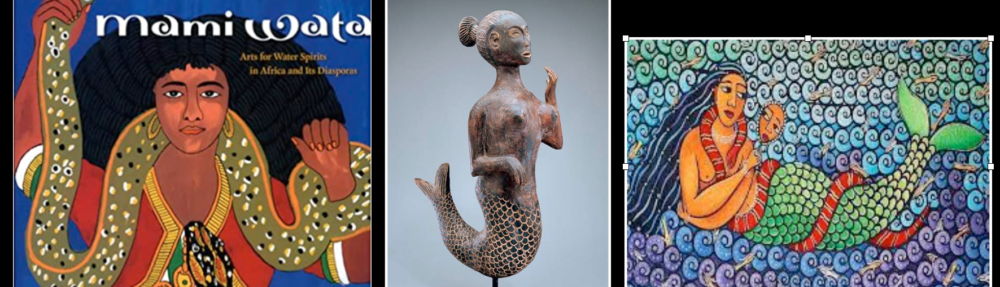
Week 3: Mermaids and The Unknown

After reading both assigned readings I enjoyed how Cristina Bacchilega and Marie Alohalani introduce mermaids as a species that haven’t been completely understood to its full capacity. Fear of the unknown is the best way to describe Merpeople, in this case, mermaids/sirend and the cautious yet curious feeling towards them, predominantly fear.

However, I find it interesting how the feeling of fear towards mermaids/sirens turned into disgust and hatred. As mentioned in The Penguin Book of Mermaids, prostitutes were referenced to as mermaids due to their sex appeal and seductive powers, which is how mermaids/sirens are represented doing to lead men to their deaths. This “likewise attests to how a woman who oversteps the boundaries of gender propriety has, over centuries, risked being defined as monstrous.” (Bacchilega & Alohalani XIII) Not only the unruly women in land were in danger to be classified as monsters but also those of water that didn’t follow the “norm” of pleasing and obeying men. It baffles me how open men were with their hatred towards women and their need to remind them how much they did, “you live here on earth as the world’s most imperfect creature: the scum of nature…” (Scribner 61) It is unfortunate how a feminine mythical creature was used as a mascot for the defamation of women and lasted throughout all those centuries, yet even though still recent mermaids and sirens have now become an image of feminine empowerment to slowly but surely heal that generational wound.

Week 3: The Mer-Wife Plot and How Women Are Perceived

It was interesting to see the difference between Western European and precolonial societies’ attitudes and beliefs towards women. It was equally interesting to see those attitudes reflected in how they viewed mermaids. The patriarchal ideas held within European Christian doctrine stand stark against the more egalitarian precolonial views of gender, reflected in how European mer-wife plots tended to be tales about female infidelity or served as implicit calls to action for their male audience to control the women in their lives, (Bacchilega, et. al., xix) whereas precolonial societies like precolonial Hawaiian myths of human men and their mer-wives (mo’o) found no need to control their otherworldly spouses. (Bacchilega, et. al., xx) 

In my personal and cultural experience, we also have a mermaid equivalent called the sirena, but the name itself and its associating facts are borrowed from the Spanish. The sirena has a reputation for using their beauty and their enchanting voices to lure sailors to watery deaths, similar to the way Europeans paint mermaids as temptresses. However, in precolonial Philippine myths, sirenas are seen as protectors of the waters, sea life and the gods themselves. In one myth, a sirena stayed loyal to their human lover, who earned the sirena’s trust and loyalty after performing multiple feats, till they died and spent the rest of their immortal life still very much in love with their lover.

Week 3: Merpeople and Penguin

After completing both readings, I have a much better understanding of the origins of mermaids and the application of studying mermaids to our course. The first thing that stood out to me in “Merpeople: a human history” by Vaughn Scribner was on page 62 when it stated that people of the new world were fearful of female opossums. I think it is crazy that the discovery of an opossum was considered to be a ‘hybridized’ blend of Old World animals and humans… I would’ve thought that about bears or some bigger, top-of-the-food-chain, type of animal. After that thought however, I tried to take the perspective of the first person to encounter a new animal species without the internet and I could see how an opossum would come across that way. What would your thoughts be if you were the first person to encounter an opossum in the 1500s? Would you think it is simply another animal? Or would you consider it to be a monster? I think this same concept/question reflects the difference in thought between the 1500s and present day in that in an older time period, people sought a religious, spiritual, or monstrous answer to their questions, whereas today people turn to science (or the internet) for something they don’t understand/can’t explain. 

In the second reading, “The Penguin Book of Mermaids” by Cristiana Bacchilega and Marie Alogalani Brown, the first thing that stood out to me was the description and explanation of the concept of vanity demonstrated through the mirror that we discussed in class on Thursday. The next thing that stood out to me was on page XIII when the authors reference gender propriety being overstepped and linked that with being ‘monstrous’. This would explain the overuse of mermaids in religious ideologies in that mermaids are a tempting beast that would lead to someone committing a sin. I find this interesting because it also later states Odysseus’s story with the sirens. His ability not to succumb to their temptations was deemed “manly” and “heroic”, both of which are words I would not use to describe their encounter. With this said, I am curious as to what the double-standard will be when we start discussing mermen. Will they be sexualized as heavily and possess similar symbolic meanings? Or will it be another patriarchal interpretation and reflect male dominance? The main merman that comes to mind is Poseidon, who is a god and is depicted as a dominant protector of the ocean. Without much background or understanding, mermen seem to have different symbolic meanings than that of their female counterparts, but I guess we will find out when as we get further into the course!

Week 2 or 3: Noah as a Merperson

I had a very Catholic/Christian upbringing, so the name Noah and terms like “the Great Deluge” ring a bell or two. I know the gist; God gets angry and wants to essentially factory reset the world. He makes an exception for Noah and his family. He bestows upon him the responsibility of gathering two of every living animal and putting them on a big boat to survive the flood. I’ve seen movies and countless illustrations showing that big boat and the grumpy old man of God who built it – but I’ve never seen or witnessed Noah portrayed as a Merperson.

In Chapter 1 of Merpeople: A Human History, Scribner mentions Noah being depicted as half-man, half-fish. He also mentions that Early Christians saw Noah as “The second father of the human race, and the preserver and teacher of the arts and sciences as they existed before the Great Deluge” (third page of Chapter One). This is super interesting because while mermen symbolize knowledge and religion, Mermaids weren’t held in such high regard by Early Christian leaders. According to Scribner’s book, women were symbols of “lust, weakness, and man’s fall from grace.” But with Mother Mary being a symbol of purity and faith, they had to get creative – and thus, they borrowed the mermaid to make it clear that there’s no correlation between Mary and all the other evil women in the world. While this drastic generalization of women is, on all accounts, silly – nobody can deny that both the mermaid and the merman share a trait -power. Mermens’ power inspires Early Christian men. It almost seems like they are a representation of what man should strive to be—master of men and sea. The power mermaids hold is meant to be interpreted as something to be cautious of. Women tempt men on land; mermaids tempt men at sea? I don’t want to speak too confidently about this, as I am still learning, but I find this line of thought fascinating.

Luckily, my Catholic/Christian upbringing was very loose, and I’m able to freely think for myself. That being said, I read the first chapter out loud to myself and thought the Early Christian interpretations of women and mermaids were wild.

Week 3: Merpeople Reflecton

While reading through the assigned chapters in Merpeople, I was continuously making connections with last class discussion about the image that was presented. A few things I remember that were brought up about the image were the comb and mirror the mermaid was holding and the vegetation the mermaid was surrounded in. In the book Merpeople, it states, “A mermaid’s accessories also revealed deeper symbolism, with her mirror and comb representing vanity…” (pg 13). As for the surrounding vegetation, it wasn’t uncommon for Pagan artwork to include foliage (pg 33, 42), I remember the image was pulled from a religious text so I assess that the religious text had some Pagan background.

Another topic I found interesting were the difference of views between mermaid/merman.  “Westerners, from their very origins, have looked to mermen as arbiters of knowledge, civilization and religion.” (pg 30) While mermaids were viewed as “…hideous beasts who only intended to bring man to destruction through his own lust for sex and power” (pg 11). I was curious as to why they kept denigrating mermaids even though the mermen were of the same species, at least have the mermen possess their own negative traits. Obviously, this was a jab towards the feminine population. I found it funny how in one illustration they even depicted a merman as a monk where instead of having an exposed upperbody, he was wearing a monks robe, “demonstrating men’s proclivity for piety and religious self-control” (pg 51).

One thing I find interesting was how something so prominent that was included in Church’s decor, bestiaries, folklore all around the world, and even charts used for navigation is rarely spoke about today. Sure there are films being made like The Little Mermaid, but I feel like now it has just become a childhood fantasy. It will be interesting to learn at what time in history did the “hype” around merpeople begin to dissolve and why.

Week 2/3: Merpeople: A Human History

In Merpeople: A Human History, Chapter 1, Medieval Monsters, discusses how the mermaid evolved throughout the Medieval period. During this period, the mermaid defined and reflected Western ideas of religion, sex, and power. This chapter specifically focuses on the Christian churches use of the mermaid. The Christian church and its symbols adapted from the ones of pagan, including mermaids. Similarly, the representation and appearance of Jesus was as well. Because many pagan Gods were both male and female “many early Christian images of Jesus appeared androgynous, with Jesus boasting feminine hips, suggestions of breasts and a beautiful face” (36). The image of a male Jesus we recognize today was created in the Middle Ages as the church tried to distance itself from pagan pasts. 

Mermaids became a symbol of the church and evolved from a more hideous creature to an enticing and female creature. Mermaids became overly feminine, for the church women representing lust, weakness, and mens falling from grace, and now so did mermaids. But why would illustrations of mermaids be present in a church? As the book says “What better way to demonstrate the titillations of the flesh than to display an enticing image in the holiest of spaces?” (39). The beautiful, female mermaid served as a warning against flesh and desire in the church, which derived greatly from some of the oldest images of mermaids as sirens or half birds. Still, both were made to remind men “of her ability to steal their souls” (41). Like many symbols, the representation and meaning of them changes depending on who controls them, or obtains the “power”. 

Before reading, I was unaware of the history behind how mermaids were represented, and how we’ve come to know them today. I was even shocked at how the image of Jesus was changed and used, similar to the mermaid. 

Week 3: The Penguin Book of Mermaids Introduction

After reading “The Penguin Book of Mermaids” introduction, I got a deeper understanding of the topics we spoke about in class on Thursday. The introduction dives into the idea of mermaids being monsters and what that really means. The introduction also speaks on the feminity of mermaids and how that was perceived differently by different groups throughout time.

This reading intrigued me greatly because it explains beauty as a dangerous or even monstrous trait. Mermaids are typically depicted as gorgeous women on the top half of their bodies. This beauty is something that has been said to allow them to lure men in and take power over them, which in return makes them dangerous. The reading refers to the definition of a monster as “a portent or prodigious being that defies what is commonly found in nature and thus elicits both fear and awe” (Bacchilega and Brown, xii). This definition derives from the Latin language and sparked a personal interest for me. Monsters are typically thought of as something that is only scary and insights fear. This definition helps explain that a monster, such as a mermaid, can also be looked at in awe.

The reading elaborated on the idea of the fear of mermaids through their environment. Mermaids are creatures of the ocean, an environment humans don’t know much about. While one might think we know a lot about the ocean, only 5% of it has been discovered. Humans tend to fear the unknown, making a creature who is part human and inhabits an environment we don’t know much about scary. I find this extremely interesting and it is a topic I hope to dive deeper into. It intrigues me how we do not know if these creatures are real or what is real about them because we truly know so little about where they reside.

Week 2 or three reading: Mermaids in different cultures

After this weeks reading, in the Penguin Book of mermaids, I noticed the different types of representation of Mermaids in different cultures. I noticed this when reading about sirens versus mermaids, and how they used to be two different distinct creatures that now are sometimes meshed as one. Specifically I can see this difference when they were talking about how the British saw mermaids, and were compared sometimes to prostitutes and sexual symbols instead of monsters. Mermaids had anew definition of what it was to be feminine or sexual, instead of a monster, which what other cultures had seen them as. We can see this with the Greek, who saw them more as Sirens and monsters, who lured men to their death and demise with their song. When contrasting how these two different cultures saw Mermaids/Sirens, I can clearly see the distinction between monsters and humans. Mermaids innately are human-like, human upper body and fish tail, which is why they are seen as creatures. A lot of different cultures have different representations, but most of them are sexualized and objectified in some way. This was quite interesting to read about, and how Mermaids/Sirens are the same and different all at once. There are stories about Mermaids being tamed, mainly in British culture, where they have been more objectified as sex symbols than other cultures. They have been seen as monstrous and sexual at the same time. I found these different cultural representations of the Mermaid to be quite interesting, since I had only really seen the girlish version of the Mermaid, like in Emily Windsnap, which I read as a child, so seeing these more monstrous and sexual representations was quite a different perspective. This view on mermaids and how gender and sexuality comes into the perspective also was an interesting take, and how in different cultures some tired to “tame” mermaids, while some could not. Humans have always had a fascination with mermaids, but different cultures have different takes on this.

Kiersten Brown

Week 3: Penguin Book of Mermaids

The The Penguin Book of Mermaids begins by discussing the history of mermaids from various perspectives. I found this information to be necessary as a precursor to our studies, especially for us who have a lack of knowledge on the subject. I thought it was interesting that we discussed the human views of nonhuman and monstrous beings in class, and that it was demonstrated again in the idea that “There is something deeply unsettling about a being whose form merges the human with the nonhuman”(p. xi). This made me wonder what direction the stories in this book will lead towards, whether they will admire the nonhuman or not. What is so unsettling? Is this just human opinion or do these creatures have evil traits? I am curious to uncover the truth from each culture.

Another point I find fascinating, is the course of a story and how “stories move about in the world in ways that are comparable to ocean currents, following a course as they move”(xv). First off, I think this is a fantastic metaphor to describe the constant evolution of story telling and it brings up a great point. How do we know what began in these stories and what has shifted through storytelling? I am eager to keep reading to uncover these mysteries.

Week 3: Cultural Differences in Representations of Mermaids

What I found interesting in the reading this week was some of the ideas presented in the Penguin Book of Mermaids. This introduction discussed some of the differences in cultural representations of mermaids. For instance, the Romans and Greeks had Sirens, who were seen as harlots. In Britain, mermaids were compared to prostitutes: “…the appellation of prostitutes as ‘mermaids’ in early modern British culture likewise attests to how a woman who oversteps the boundaries of gender propriety has, over centuries, risked being defined as monstrous” (p. xiii). Both these cultures clearly look down upon these ideas of mermaids, and the feminine. This has an interesting contrast when compared to Hawaiian ideas of mermaids, which is also discussed briefly in this introductory chapter. The author states: “Significantly, there are no tales of men who try to tame their mo’o partners, because the mo’o, like the features of the water they embody, cannot be contained or domesticated” (p. xx). This representation of mermaids in Hawaiian culture allows them to be independent beings, who are not being objectified, or ‘tamed’, like other stories. Meanwhile, European culture is more focused on the idea of ‘taming’ a woman, and the struggle for power between a man and woman who are romantically involved. When discussing European cultural views of mermaids, the author states: “These tales speak to the discrepancy between men’s longing for a woman unfettered by social mores and their attempt to control her by domesticating her” (p.xviii). Not only can these ideas of taming a mermaid be seen in these tales, but this can be seen in modern day relationships, where some men have the mindset of ‘taming’ a woman and expecting submission. 

I found these cultural examinations of perception of mermaids to be interesting as the other reading from Merpeople  was more focused on the Christian Church and how Europeans viewed mermaids. I am interested in learning more about how Hawaiian culture viewed merpeople, and how other cultures may have viewed mermaids with respect and as equals, as opposed to mythical creatures that are both intriguing and dangerous. I do wonder if Indigenous culture plays a role in how mermaids may be viewed. In the introduction to Penguin Book of Mermaids, the author briefly mentions that “mermaids and other water spirits raised issues of gender, voice, and sexuality, as well as knowledge, ecology, and spirituality–especially but not only in Indigenous contexts” (p. x). I don’t want to speak on something I do not know much about, but it is my understanding that some Indigenous cultures, especially in the US, believe that animals have spirits and often represent significant things in these cultures. So, I wonder if Indigenous Hawaiian culture, if possessing similar beliefs, may have had more respect for merpeople because of this–having previous respect for non-human forms leads to respect for half human half animal forms.