Week 2 – Merpeople : A Human History

After reading this week’s chapter of “Merpeople: A Human History” I learned a lot of new information I had never known before. I don’t have a large background on the history of mermaids and how they were involved in human history, so I did not know that they correlated to Christianity or any religion at all. I found it interesting how the church learned, appreciated, and believed in mermaids through art, sculpture, and myriad texts after such a long time of the Christian church and churchgoers in Europe overly sexualizing mermaids. While I do have the knowledge that mermaids have been sexualized over time, I did not know how the true belief and appreciation of them started.

As Scribner elaborated on the involvement of mermaids in the Christian Church, I was also intrigued by the fact that the Christian Church bridged “the gap between the supposedly ‘savage’ and the civilized,” (Scribner, 16). It is surprising to me that mermaids were accepted because of how the Christian Church portrayed them after it contributed to such extreme sexualization of them. Stories about mermaids today, that I have personally read or seen myself, typically do not have a religious belief tied to their background. The history of mermaids is much different than what is depicted in some popular media today.

While the beliefs and depictions of mermaids have been different throughout history, the Christian Church belief is one that intrigued me most. Comparing how mermaids were seen in different periods gives us a good idea of how we got to where we are today. It helps explain how mermaids are seen now in literature, media, and real-life beliefs. I am excited to expand on this topic through more research and discussion in class.

Week 2

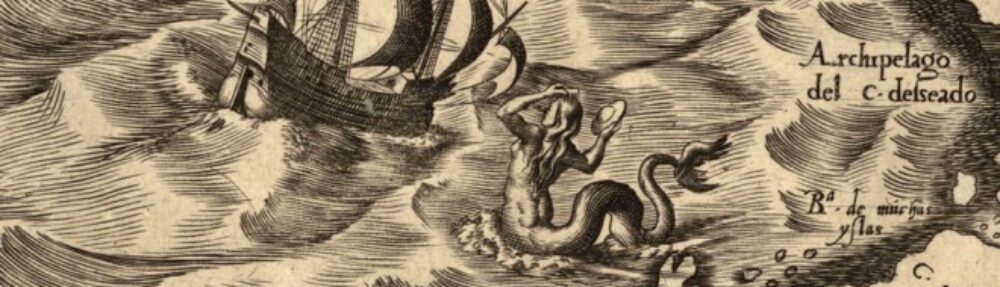
While reading this week’s chapters, I found it very interesting how the discovery of the Americas relates to mermaids. Because the concept of mermaids had already been well established in the Medieval period, when explorers ventured west, they brought their beliefs along with them. Those beliefs led to “mermaid sightings” that then led to images of mermaids being physically distributed more and more through maps. The interaction between the images on those maps and the motivation to explore the world is fascinating. The author explains that “representations [of mermaids] only further primed explorers to find mermaids” (Scribner, p. 19) which encouraged cartographers to keep including mermaids. It makes me wonder how many discoveries that we discussed in school were made because the person initially wanted to find mermaids. 

At the same time, it is intriguing to me that putting mermaids on these maps also indicated a new environment filled with unknown animals, people, etc. In this way, it seems to me that mermaids had an important and impactful role in the colonization of the Americas. There were more motivators during this time than just seeing mermaids, however to the public, it was probably something that made a difference in whether or not they supported these ventures. Mermaids in this sense represent exploration and new opportunities. They were a physical manifestation of the new environments that the Western countries were uncovering.

I also found it interesting that Scribner mentions that the way that each country understood mermaids was a representation of the way that they tried to understand the new worlds that they were discovering. It shows how culture plays an important role in a person’s relationship with the environment. I question if the way that different cultures viewed the mermaid impacted the way they interacted with the ocean. For instance, if a culture feared the mermaid, did they see the ocean as something to conquer?  

Islam and Mermaids

Reading the introduction to “Merpeople” was so insightful because it contained a lot of information and history on the perception of Merpeople, especially from a Christian point of view. First and foremost, I thought it was interesting to read about human fascination with these creatures because when you think about it, mermaids are everywhere! They exist in books, movies, shows, and even toys for children; they also exist in many mediums for adults as well. In my opinion, human fascination with merpeople has a lot to do with animalistic urges that humans have that may not all be understood and/or celebrated. Merpeople are a reflection of a half-human and half-animal creature, but they are depicted in beautiful forms for the most part. Even when they are vicious creatures, they are depicted as beautiful.

Moving forward, the Christian depiction of mermaids was used to “depreciate the feminine” and correlate women with the idea of vanity (pgs. 11-13). As time progressed, eventually mermaids were used almost as a tactic to attract religious acceptance. Reading this was interesting to me because it made me think of what the Islamic perception of mermaids is (I am Muslim). I remember when I was younger, I was told that mermaids exist in heaven, and when men live a “pious” life on earth, they are rewarded with mermaids in heaven. Now, this isn’t a legitimate Islamic belief, but the idea is that it shows how mermaids were used as an incentive for the afterlife, illustrating hope in the form of reward. In Islam, it is also said that creatures that exist on land also exist in different forms in the sea, suggesting the possible belief of the existence of merpeople. This topic is very fun to dive into because it is encouraging me to research deeper into the Islamic perception of mermaids.

My thoughts on part of the Reading (week 2?)

While I was reading the introductory part of the reading, all I could think was “dang, there are a LOT of different interpretations about mermaids”. And thats not really the half of it- there seemed to be a different definition, a different vision of what a mermaid was, what they looked like, and what they did. I liked that. I liked seeing how different cultures took different ideas about the mermaid, even though some of them I definitely did not agree with. It’s interesting to consider how many people used the mermaid as a symbol, even when different groups and cultures had clashing ideas.

Seems to me that growing up in certain areas or growing up with certain ideas colors the symbolism of the mermaid. While the ideas can change over decades or centuries, some things still remain- positive or negative connotations with the mythical creature. And it’s so fun to see the change. Going from monstrous, to beautiful, and from different flavors of dangerous. Like how some mermaids were almost completely monsters, like Scylla and Charbydis, but then much later in other cultures they became more and more human. I think that speaks to how more modern audiences begin to view the mermaid itself.

Week 2: Merpeople

Reading this text, I was able to see and decipher many new meanings of the symbolization of a mermaid that I had never seen or thought of before. While some and most ideas I read about were fascinating, there was one mentioned around the beginning of the introduction that caught my attention. “Humanity maintains a tenuous balance between wonder and order,civilization and savagery.” (Vaughn,9). While the text goes on to explain and share the origin of mermaids and merpeople, this concept stayed with me throughout. It made me question a couple of things, along with humanity and just what it means to be a “human.” Since this was mentioned, it made me think of the fine line between human and monster, or animal, when it comes to a mermaid. What this might mean for humans, and made me think that maybe there is also a fine line for humans between humanity, empathy and monstrosity (whatever that may mean for everyone individually). While I wasn’t surprised by the sexualization of mermaids, I was disappointed. The fact that even as mythical creatures, women can’t seem to catch a break from men, is overwhelming. Mermaids we’re seen as derivatives of beasts, and we’re to blame for men’s lust, which was another thing that was upsetting. While learning of these origins might’ve not been the ones expected, it was interesting to learn how mermaids can hold so much symbolization and significance, when I had never thought of it before.

Week 2 – Merpeople: A Human History

After reading this week’s chapter of “Merpeople: A Human History” I discovered a significant amount of information that I didn’t know about the origins of mermaids. Finding out that mermaids come from a religious background overall was the most surprising fact I read since I have always believed that they originated from mythologically stories such as Greek Gods. It is strange to read about their evolution as how they were first being portrayed to finally how they are now being portrayed.

Throughout the introduction chapter Scribner was able to give a somewhat brief timeline of the history of mermaids but throughout that timeline I thought as if he gave more details into the appearance of mermaids and their evolution of that appearance. I thought it was significant as he emphasized that at some point mermaids were being sexualized and shown as this sort of temptation at some point of time to almost reduce the interest that humans had of them. I also thought it was interesting how Scribner provided images that showed the evolution of mermaids appearances as he wrote about them because for the reader it provides a better understanding to how throughout different periods of time, the mermaid image was shifting to fill the needs of how humans decided to represent merfolk.

Overall I thought the introduction to the entire book was impactful and left me with a significant amount of questions. The way Scribner was able to provide the religious background of mermaids, to showing how they have changed throughout the years, and to ultimately showing how mermaids overall play a significant part in today’s society all made me wonder as to why humans will believe that we are the only creatures to roam the earth? If mermaids to exist, what other creatures exist? Why is it that society decided to show mermaids as something imaginary and almost impossible to be true?