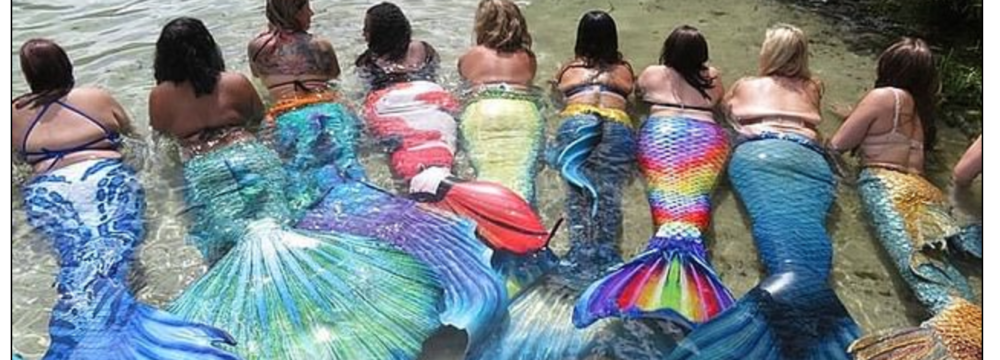
Week 2: Merpeople

Reading chapter one of Merpeople by Vaughn Scribner was eye opening. I would’ve never thought how much mermaids were associated with religion during the Medieval period. I can’t seem to understand how “denigrating the feminine” (Scribner 29) brought more people to Christianity and why it worked. Chapter one continues by explaining the first depiction of mermen around 5000 BCE. Acadians worshipped a mermen named Ea, who was adopted by Babylonians as a god of light, wisdom and civilization by the name Oannes. How and why did Oannes become a deity of wisdom? As mentioned in page thirty, Oannes “gave men an insight into letters and sciences, and every kind of art…” (Scribner 30) In opposition to the well intended wise mermen, mermaids were seen as creatures that emerged from ugly forms “seeking to bring human men to agonizing deaths”. (Scribner 31) It’s no secret that with the help of these ancient myths of mermen being good hearted leaders and mermaids/sirens being wicked beings looking for men’s demise helped the Christian church to belittle the feminine as “females symbolized a carnality linked to vice”. (Scribner 35).

As I mentioned to my peers in past class discussions I believe that even thought the image of mermaids has changed, unfortunately, the meaning behind it has not. Mermaids are still to this day seen as a symbol of lust and demise or straight up vile monsters (as seen in Hollywood movies). This image of fault and evil is sadly not limited to mermaids, for example, in Christianity, Eve is seen as the one at fault for the expulsion of the Garden of Eden by commiting the act of sin. In the Greek pantheon, if not all, most feminine deities are depicted as extremely jealous and evil towards humans if crossed. On the bright side, in today’s world the mermaid aesthetic has been claimed by women all over the world, giving mermaids a new and empowering meaning which I’m looking forward to learning how the evolution to today’s modern world came to be.

Week 2/3 Reading Anaylsis

When I walked out of the first day of class I was left wondering how I got myself signed up for a college course centered on mermaids and thought to myself I was either going to love it or hate it. After our initial discussion on Thursday and reading through the first few chapters of Vaughn Scribner’s “Merpeople” I have already begun to take an increased interest in the variety of lenses with which we can approach the subject of mermaids to explore what they symbolize and the importance of their persistence throughout generations of many different human societies and cultures. The in-class analysis of the etymology of certain words such as environment, nature, and monster sparked some ideas in my head about the way humans have defined themselves in relation to the “natural world.” I found it incredibly interesting that nature was first defined in terms of human nature as a description of people and later amended the definition to what is commonly known today. This sequencing of these definitions leads me to believe that people initially considered themselves to be separate from the natural world and later realized that the relationship is much more complex.

The word that has stuck in my head the most throughout our first classes and readings, as it pertains to mermaids, is hybrid. The mermaid, being a hybrid mix of human and animal is the perfect symbol to represent how human beings are a part of nature while also separate. The fact the upper half of the mermaid is human is also symbolic in a sense that the familiar human characteristics that supposedly set humans apart from animals such as the potential for conscience thoughts and the ability to use our hands in contrast with the lower half which binds the mermaid to the ocean and natural world. The way humans defined nature creates a hybrid situation similar to that of the mermaid, as much as our human qualities separate us and make us different there is no way to separate ourselves from nature, we are a part of it regardless of our greater potential to alter the natural world.

My parting question for the week pertaining to etymology that I am interested to explore more throughout the semester is: “How we define what it means to be human?” People have mimicked animals in their creations, and we have witnessed certain animals mimicking human behaviors. For example, we designed airplanes with birds flight as a model and we have taught chimpanzees and gorillas to communicate in human sign language, which in my mind leaves a lot of grey areas for defining how we could possibly be 100% separate from nature. A final note in regard to my “man-made” comment in class on Thursday, I thought a lot about this since that class and one thing that initially I thought of as a defining difference was the way we build structures and homes, however this is evident for animals as well in bird nests, beaver dams, burrowing communities, etc.

Week Two: Merpeople: A Human History

Chapters one through two of Vaughn Scribner’s Merpeople: A Human History discuss the origins of mermaids and how these creatures became a cultural phenomenon. As someone unfamiliar with the history behind mermaids, I found it fascinating to learn how Christianity impacted their perception.

Initially, churches used images and sculptures of mermaids to “remind followers of the infinite power of God” and force onlookers to confront their “relationship with their faith” and “sinful nature” (Scribner 43). From a modern perspective, I found this particularly interesting as I never considered mermaids to be overtly monstrous. However, as I consider the era in which these images were created, I can understand how these creatures may be jarring. In the medieval ages, women were demonized and expected to be subservient to men. Early depictions of mermaids reflect this as they describe these women as “a monstrosity” and “suggestive reminder of the dangers of feminity” (Scribner 51). Essentially, mermaids were thought to be destructive, “vengeful creatures” who would lead men “to their misfortune” (Scribner 55).

Growing up, I only ever thought of mermaids as strong, independent women navigating the difficult nature of the ocean. I looked up to mermaids and would often daydream about a life where I was one. So, upon reading this week’s chapters, I was shocked to learn that this perspective was entirely different from those in the medieval ages. I can only imagine what it would be like to be a woman at a time when these stories were believed to be fact. To men, women were purely figures of fear and desire. I am curious to see if the book discusses how the perception of mermaids evolved to become the symbol of female empowerment I associate them with today.

Week 2 – Reading Post

In this weeks reading of “Merpeople: A Human History” by Vaughn Scribner, I was completely fascinated by the Catholic Church’s involvement in the use of mermaids to manipulate the general public. When I began reading, I mostly expected the reading material to mainly feature the evolution of mermaids throughout different cultures. I had no idea that mermaids were instruments of manipulation for the Catholic Church, which intended to use mermaid imagery to “dethrone femininity” (Scribner 12). Painting mermaids in an overly sexual light, the church used mermaids to symbolize seductive beings that made men fall into their lustful desires. Ultimately, the Church was using these creatures to spread their propaganda about sinning.

The Catholic Church benefited from the globalization of mermaids in Western, Eastern, and African folklore, because it further pushed their agendas. Sailors across the world would make claims about interacting with mermaids, and their “encounters resonated with the Christian Church’s imagery” and further pushed the Church’s “efforts to denigrate the feminine” (Scribner 56). My focus on the Catholic Church with these chapters comes from the idea that mermaids could not possibly be the only things that the Catholic Church used to manipulate people. By studying how effective the use of mermaids was, it gives me the ambition to look into what else the Church has used to maintain relevancy. Science has only been a generally accepted concept for a couple centuries, yet society has existed for thousands of years. Even in modern media that I can recall, mermaids are still commonly sexualized, which could still subconsciously push the old agendas of the Church.

I grew up going to Catholic Church, and I cannot recall ever seeing any mermaids, or any mythical creatures besides angels and demons in paintings inside of the church. It is extremely fascinating to me to see how the same Church I grew up attending used manipulation tactics to push their agenda. It is also interesting to me to see what the church’s agendas were as the church was developing. It makes me wonder if this type of behavior is still happening in the Church, but with more modern methods.

Week 2 Merpeople: A Human History

After reading Chapter 1, I was intrigued by the growth of mermaid mythology, which revealed that these enigmatic beings underwent a tremendous shift over the medieval and Renaissance periods. These mythical creatures were diverse, representing both beauty and danger across cultures. As the story evolved into the medieval era, I became interested in how the Church Christianized mermaids. The deliberate use of mermaids in Christian imagery shows a complicated interplay between church power and society narratives. Christianity merged with old pagan ideas, ushering in a new era of mermaid symbolism. The Church’s use of mermaids to communicate ideas about masculinity, femininity, wonder, and danger became an intriguing component of medieval art and sculpture. Moving on to the medieval interpretation, Pliny the Elder’s “Natural History” and later bestiaries depicted tritons and nereids vividly. It was fascinating to see how medieval historians, influenced by Pliny’s descriptions, regarded these beings as half-human, half-fish. The following sexualization of mermaids in illuminated manuscripts was a fascinating look at the junction of religious symbolism and artistic freedom. The contrasted images of mermen, frequently dressed in monk’s robes, emphasized the Church’s emphasis on piety and self-discipline. The recorded encounters with merpeople during medieval times helped to bridge the gap between myth and reality, supporting the Church’s vision. Folktales depicting mermaids as terrible sirens capable of causing men to suffer and die added another layer to the unfolding storyline. The journey through the evolution of mermaid mythology was more than just a chronological progression; it was also an engrossing investigation of the relationship between mythology, religion, and societal attitudes. From ancient myths to Christianized emblems, the mermaid’s transformation reflected larger transformations in cultural perceptions and religious power relations, finally ingraining these mythical figures profoundly into Western folklore and society.

Week 2? 3? Reading Post (59 – 99)

I had read that first two chunks of reading last week so I decided to do the third chunk of reading. It opens up with the Renaissance and how discovering the New World had influenced how the Old World saw and interacted with mermaids. Somewhere in the beginning there was a tidbit about how Old Worlders were interacting with the New World environments and how they found opossums. “Though hindsight relegates these creatures
to fantasy, other animals proved very real and just as terrifying to early modern Europeans. The female opossum, for instance, was a strange New World ‘composite creature’, combining parts from Old World animals and humans to create ‘an inorganic multiplicity’.” (page 61, ch 2) I think it really feels like grappling with the strange creatures bolstered the otherness of the mermaid. Especially given what their modern society was, and their modern ideas.

It also, weirdly enough, makes the mermaid feel more natural. When you have creatures like the opposum and maybe even the platypus (dont know if it was named in this portion specifically but it is a mishmash creature), then mermaids by proxy are natural- a mishmash creature. Funnily enough there was also a mention that Old Worlders expected to see mermaids and tritons everywhere (its early in the chapter), I thought that was really interesting. They were going off the opposum and whatever other animals they had found, or maybe perhaps their perception of the New World.

Week 2: Mermaids and Sin in the Early Church

In ‘Merpeople: A Human History’, the author explores the connections between mermaids as symbols of sin in the context of the early Church, and how the notion of sin increased its power. Within this period, mermaids were transformed from their place as pagan symbols and were then turned into spiritual vessels for sin as a cautionary tale against temptation. Usually, this sin would be in the form of carnal sin; those who didn’t live piously and prioritized indulging in their sexual desires would not enter the Kingdom of Heaven. In this time when the early Christian church was the dominant religious and political power, engaging in sin was a very real spiritual and literal threat that hung over the heads of churchgoers. 

However, sin itself is abstract and varies from culture to culture; anything can be considered sin depending on the value system of said culture. Even knowledge can maintain a connection to sin. Within Homer’s Odyssey, a tale promoted by the Church, sirens didn’t promise sex but instead promised infinite knowledge to Odysseus and his men. This knowledge would in turn bring death and destruction unto them (Scribner p. 30). In the eyes of the Church, Ulysses (Odysseus) represented the Son of Virtue while the Sirens were the Incarnate Vice (Scribner p. 35). By being seen as the Incarnate of Vice, the infinite knowledge that they promised was also seen as wicked as well. What about knowledge would be seen as wicked and immoral? Why was Ulysses seen as righteous for rejecting it? Why did the Christian church promote the tale of the Odyssey in the first place? 

The quote “knowledge is power” may shed some light on these questions. The early Church wielded a lot of power, mainly through attempting to convert as many non-Christians as possible. By amassing such a large number of followers, the Church’s power and influence would continue to strengthen. Those in power are always concerned about maintaining it, and they want to keep wielding it through any means necessary. This is why the pursuit of knowledge as whole could be seen as dangerous, it may show alternate ways of existing that are outside of the realm of the church. If people stopped believing in the teachings of the Church, then its influence on society would diminish, leaving them vulnerable to other political and religious factions that may want to control medieval Europe. The story of the Odyssey is important to the Church because it sees itself in Odysseus fighting against a perceived evil. When that evil is paired with knowledge and sin through the form of mermaids, the early Church strengthens the belief that the only way to secure one’s eternal soul is by strictly following the teachings of the Church, further securing its place of power. 

Week 2

Before this reading, I didn’t know much about mermaids or where they originated from but it was so interesting to read and learn about. The perception of mermaids has changed over time through different cultures and places based on the stories and illustrations passed on. I thought it was interesting to read about how sexualized mermaids became, especially from a Christian perspective. It reflects a power dynamic between men and women that still very much exists today. Women’s bodies are often objectified and seen as controlled by men, which is shown frequently throughout the illustrations and pictures in the reading. I think that the sexualization of mermaids serves as a view into the deeper cultural beliefs and narratives about women and their role in society. In the text, there’s a quote that really stuck out to me, “Mermaids continued as mascots for the defamation of the feminine, representing religious traditions as well as folk-portents of storms, doom and death. Perhaps even more overtly, sixteenth-century Westerners often called prostitutes ‘mermaids’ or ‘sirens’.”

I also found it very interesting about how many people claimed to see merpeople in the medieval period. After claiming to see a mermaid or merman, these people seemed to gain some attention and/or fame. In the reading, it talks about how many of the people who said they interacted with merpeople were often a part of a higher class and were considered to be trustable people in society. I think this may be a main reason of why no one often questioned that they were lying or possibly fabricating something they saw in the water. There was a quote in the book that reads, “Perception, in short, is everything.” This quote expresses the the idea that people’s beliefs and interpretations can shape their understanding of the world around them, like their perceived sightings of merpeople in these times. I think it is very understandable as to why many believed they saw merpeople in the oceans because humans have a natural tendency to make sense of their surroundings with figments of our imagination.

Merpeople

In Merpeople “A Human History” the historical background of mermaids is discussed and has brought a great amount of new perspectives. Prior to this my understanding of mermaids was slim to none, sure I have enjoyed fictional works with mermaids, but I have never questioned the history behind these creatures. After studying this I am fascinated but also not surprised as the traditional views of women remain similar to the historic understanding mermaids. The way that mermaids are perceived as sexual and objective is similar to the way that women were, and still are, viewed in life and various fictions. Similarly, stereotypes between mermen and man linger simultaneously. The idea that they are with “lust for sex and power”( Scribner,11) does not fall short of how they are perceived in a non-mermaid world. With that being said, there are ways were I can connect the two and reiterate that merpeople are used “to gain a deeper understanding of one of the mysterious, capricious and dangerous creatures on Earth: humans( Scribner, 7).

On the contrary, there are surely some ideas that have come to my surprise. Specifically, the fact that religion plays great a role in the history of mermaids. What specifically caught my attention is how the Christian Church typically encourages a modest, more reserved lifestyle yet the mermaid was deemed such a sexual creature. Considering my lack of previous study on this topic, I am interested to see how mermaids are perceived and understood in different religions apart from the Disney films I have seen. I guess my knowledge also comes from a very specific type of mermaid film, and one thats audience is much younger. I am excited to broaden my understanding and learn more about this character.

The Human Woman and Mermaids-A degration

One of the major themes that I found when reading Vaughn Scibner’s, Merpeople: A Human History, was the degradation and defamation of feminity and womanhood as a whole. This stood out to me because my personal beliefs revolving around mermaids focus solely on their beauty and praise of feminity, not on their negative associations. Keeping this in mind many questions arose when thinking of this concept, how does the role of mermaids attempt to tame and train women? What do depictions/ texts about mermaids reveal about women’s relationships at the time? How did a mermaid’s sexual appeal build over time” And What does the depiction of mermaids and mermen express about genre roles, specifically opinions on women? I would love to touch on every one of these specifically but I want to dive into the overall concept and think of all of these questions under one bubble.

On page 41, he states the idea that medieval church men had the “ultimate goal remained tethered to decentring the feminine. Hence the repeating image of mermaids as dangerous, passionate, sexual beings…”(Scribner, 41) Mermaids were often depicted to be enticing representations of sin and deception, which I believe was to scare human women. Depictions and stories constantly disrespect the mermaid figure and blatantly say that their depictions were intended to tear down the representation of women. A similar concept continues with the idea of “equating femininity with inferiority. Renaissance woman accordingly experienced a fringe existence in public society” (Scribner, 61) where one can truly see the connection drawn between mermaids and women. The intention behind this quote is a negative, and attempts to degrade/ oppress not only the mermaid but the woman as a whole.

“Nevertheless, mermen remained clear reflections of the Church’s ability to merge the wondrous and the religious sin in an effort to denigrate femininity while vaulting men to positions of prominence and piety ” ( Scribner, 53) Rather than focus on the mermaid, this quote focuses on the depiction of the mermaid to express the concept of opinions on women and taming the woman figure. The words hold negative connotations and denotation, using the words, ” denigrate feminity” yet the “prominence” of the male figure. These phrases juxtapose each other in the most clear way, showcasing a revelation about women in literature and art in a negative light.

While I focused on the negative depictions/relationship between womanhood and mermaids, mermaids can be depicted to signify beauty, strength, and popularity. Throughout the book, one can clearly see the changing attitudes and depictions, from beauty to fear to sin, etc. This is the duality of the mermaid in the most pure form and represents a tie between womanhood and the depiction of mermaids.