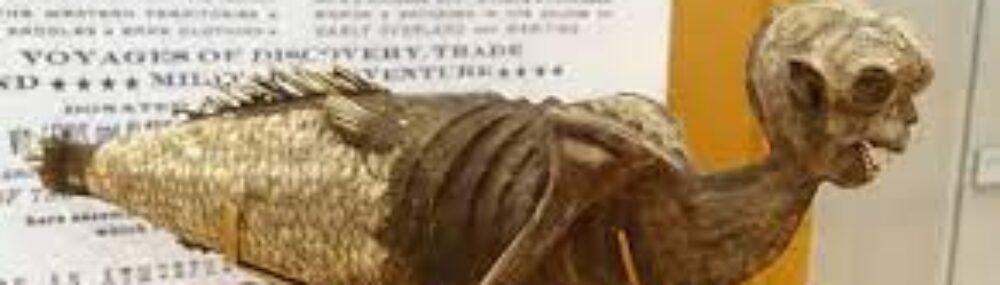
One of the aspects that I found most interesting in this week’s reading, was how the Christian church utilized and in some ways adopted the pagan figure of the mermaid in order to convert people to Christianity. It is common knowledge, I believe, that the church often employed this form of appropriation to convert worshippers of pagan religions. One of the topics that most interest me is how Beowulf is another story of pagan origins that was used and re-contextualized by Christian monks in order to promote Christianity. So much so that, the story as we know it today was adapted to the written word and visibly altered by its translator. It is interesting to read the account of Beowulf and see how the author is unable to avoid the staunch paganism of the story yet also makes the contradictory effort to condemn said paganism. A lot of scholarly work also examines the role of Grendel’s mother. She is commonly portrayed as a horrific monster within the narrative and is shunned and treated as a horrific other for being a woman that displays the characteristics that so many men within the story are admired for. It is therefore interesting to me that early concepts of this fish and human hybrid was originally conceived as a male creatures “of knowledge and improvement” (Schribner 30), and when the focus shifts to mermaids they are turned into monsters who often lure people by means of lust, and promises of knowledge. To bring in one more point of connection I recently read an essay of Toni Morrison titled “Unspeakable Things Unspoken” and she mentions how when the Western romantics where creating the cannon of Greece as the pinnacle of western civilization they chose to ignore the role that Egyptians and Semites played in shaping the idea of Greece. To me it seems that Christianity and Racism operate in similar ways to create their systems of power. It will be interesting to me to consider these topics as we go forward in the semester and I would like to consider the role of the environment with the text as we continue on.
On Mermaids, Beowulf and Christianity
2