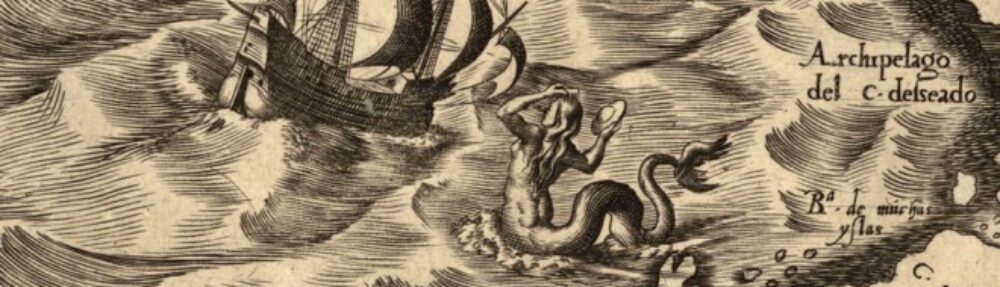
In the poem, “We Are Mermaids” by Stephanie Burt, different sets of pronouns in the form of ‘we, us, they, you,’ weave throughout the poem to involve the speaker, the audience, and others outside the stage of the text to invite them as a collective into the world of mermaids, a symbol for multitudes, and allows the collective to exist as they are. In the title of the poem ‘We Are Mermaids,’ those who fall under ‘we’ are gathered under the mermaid umbrella with ‘are’ emphasizing the action of simply being. Being a mermaid, like more oceanic ways of thinking, is not constrained to rigid structures that have been imposed on them by society and other terracentric ways of thinking. Instead, mermaids and any other aquatic creatures can occupy any space or even become a part of that space where fluidity and water is found. Whether this is at the bottom of the ocean where benthic water is found, or at the esturaries, where salty sea water and fresh water come together to create a brackish mix, a mermaid can come take up this space. The ‘you’ portions of this poem are particularly powerful and connect back to mermaids as an agent outside of the realm of humanity. The poem tells the reader that ‘you don’t have to be useful, you are not required to come up with something to say.’ In a terracentric world, a humans value originates from what they are able to perform and communicate to the rest of the world. This can be through labor, gender, and other social expectations and norms that make up daily life. However, the second half of the stanza negates and outright rejects this belief. Instead of a grueling day-to-day performance, which many people of marginalized lgbtq+ identities experience, as a mermaid, an individual can simply exist within the solitude and comfort of the sea.
Tag Archives: readingresponse
Week 15: Stuck at the Bottom
I really enjoyed reading Stephanie Burt’s poem, We Are Mermaids. The poem is ripe with brilliant imagery and metaphor that do a great deal to describe the internal struggle of being a transgender person.
The ocean is presented almost like a landscape in the poem, which hones in on terracentric language to describe those who subscribe to beliefs and lifestyles they are familiar or comfortable with. The full potential of the waters between the surface and the ocean floor are ignored, with the speaker often reassuring the reader that they do not have to leave the water they are comfortable in.
“You can spend your life benthic, or brackish,
subsisting and even thriving where a fingertip
comes away saline and still refreshing,
exploring the estuary, the submerged lip
and congeries of overlapping shores
on the green-black water, the harbor, the bay.” (Burt Pg. 1-2, 24-29)
This is followed by the sentiment that it’s okay to be scared to go into the vast, open ocean; the rest of us will be all right out here.
I think this poem has two target audiences. One is transgender people who are afraid to embrace their true identity – in which case the poem is a kind and welcoming invitation to a better, more belonging life. The other is people who are transphobic and who are choosing to keep out of the issue of transgender rights. Either way, the poem paints the ocean (or this more free way of living, unrestricted by the rules and patterns of the land) as a sanctuary thats in reach and ready for you to embrace it.
Embracing the mermaid as a symbol of transgender people is a beautiful way of showing someone who comes from the constraints of land (society) and has embraced the water and turned it into their home (identity). This was a really powerful piece to end the semester with.
Week 14 – Yetu’s journey
While this entire section of “The Deep” by Rivers Solomon was interesting, I was especially interested in reading about Yetu’s initial escape in chapter 5, and her relationship to the Wajinru through her pain. What interested me the most about the initial escape from the Wajinru was how the journey she went through after the Remembrance could be an anecdote to the pain and suffering that people have experienced as a result of slavery and the slave trade. Yetu’s body gives out while trying to escape but her will keeps her pushing through. She goes days without eating and has horrible migraines and pain in her limbs. Historically, there have been forms of systemic racism that have been implemented to prevent people of color from achieving what white people have been able to achieve throughout the generations post-slavery. This has been proven true even in recent decades. I believe that her experience was a big focus because it alludes to what people of color have gone through due to the History. I also liked the idea of being a unified group of people because of the history. While Yetu is suffering, she has a “deep, restful sleep. There were no nightmares, Remeberings didn’t haunt her… She wasn’t quite sure who [Yetu] was, but she didn’t mind the unknowing because it came with such calm… (70). I thought this was an interesting sentence because it shows that the history serves to not bring pain, but create a relationship of unity with her people. There was calamity and comfort in her pain, and although she left her tribe, she subconsciously knew they felt the same way. She feels a sense of “freedom” (70) from her pain. I believe that this is one of the main points of the entire novel. History is a painful subject that needs to be embraced in order to have a sense of unity, as horrible as it may be sometimes.
Week 14: Nature Doesn’t Need Validation.
Sorry for the short post, everyone. It’s been a very difficult weekend, so my creative juices aren’t flowing as freely.
This remark encapsulates an important aspect of Wajinru living. The whale, which represents nature’s protective and caring features, cares for the Wajinru and even feeds their smallest members. Our need to assign specific meanings and purposes to everything contrasts dramatically with nature’s intrinsic ability to exist in harmony and serve its surroundings.
People frequently seek meaning and purpose via their actions and lives. Everything, to humans, has a certain function. We provide little to no wiggle space for these specified reasons to change, and we are terrible at admitting when something does not contribute to society in the way we EXPECT. As we strive to understand our place in the world, we assign events, objects, and relationships significance. Nature, however, functions in a different way. Without making a conscious effort to define its function, each component of the ecosystem operates in tandem. This natural hierarchy is best demonstrated by the whale in the quotation, which provides care and nourishment without needing to justify its actions or seek acceptance from others.
Entering Chapter 3 of “The Deep,” readers are prompted to consider the complexities of human perception and our proclivity to provide meaning where it is not required. We are urged to contemplate the natural world’s intrinsic equilibrium of cohabitation, as well as the balance of seeking meaning through the lens of the Wajinru’s story and their relationship with the whale.
Sorry, again, for the brevity. I’ll see you all in class.
week fifteen: the Deep Again
So our girl Yetu was rescued by humans, which I find an interesting take on the mermaid mythos because usually its the mermaid who does the rescuing? Like how in the Little Mermaid, the mermaid in there rescued the prince from drowning, but in The Deep, Yetu’s being fed and looked after.
Also her relationship to Oori is interesting to me, because its this book’s instance of the two worlds meeting in the middle- both grapple with companionship as well as the past. I think Oori continuing to ensure that her homeland stays up despite being the last of her entire group/kin is important because in a way, it ties into the whole “ocean is an archive” thing- she’s ensuring that her history stays up, and that there IS a homeland that exists out there for her to return to. In way, Oori represents the idea that it is one’s duty to ensure that their history stays remembered. Yetu is a sort of a parallel because her entire culture is based on the idea that only ONE person should remember so everyone else can forget, and like… The way they contrast each other in this aspect is interesting.
Both were essentially forced into being the upholders, the historians, and yet they have such different approaches to how they do this. This is such a refreshing take on the mermaid tale and I’m really enjoying it so far.
Aganju and Yemaja
In this weeks reading, we learned about the origins and some of the stories of African spirits that fit in well with the stories we have read so far about mermaids and other natural spirits. For this reading, I found a lot of it interesting but I want to focus my close reading on the story of Aganju and Yemaja. The idea that so many different gods came from Yemaja, especially considering she is the “mother of fish”, is such a fascinating concept. I would have thought that her extremely traumatic experience with her son Orungan would lead to death and destruction, but instead, it led to creation. From her came fifteen gods that provide, whether it’s water, air, natural resources, or food. When reading the story, I thought it was comparable to the story of Jesus Christ. He was brutally sacrificed for the betterment of humanity. Although the intention wasn’t necessarily the same, the outcome basically is the same, humanity gets “saved” whether it’s from being given more resources to live, or to avoid Hell.
The fact that these Gods are still worshiped is a beautiful teller of how much respect African culture must have for nature. In the previous story of “African Mermaids and Other Water Spirits”, we learn a lot about the beliefs that are still extremely prominent in Africa. Although tribes preside in areas that are not close to each other, they share a love and respect for nature which has “remained strikingly relevant” (3) throughout the generations. People believe in spirits that provide, and avoid building where Mermaids have been thought to potentially seen to live. I think that faith is the best thing that people can have in respect to nature. Faith teaches people to live a certain way, and when people believe something hard enough, they are willing to set aside their wants and needs for the greater good of their faith. By faith being intertwined with nature, people show more respect to it, as we have seen in this reading. This makes me wonder why people do not treat nature better despite it being such a prominent concept in almost every religion.
Week 13: Ti Jeane
The story of TI Jeane was particularly striking to read because it both contains traces of the folklore elements present within western mermaid folklore but The mother of the water has a much more active role as a protector of the forest. Much like how mermaid stories of the west are full of history of the christian culture that shaped them so to does this story tells us of the markedly different relationship that the native people’s of the caribbean had with the environment.
I appreciate that the text preceding the story explains Mother Water as being a “transnational Deity”. We have been considering mermaid folklore stories to be an archive that can teach us of the cultural history of a group of peoples. Since this story is widely known amongst the Caribbean and through many different language we can imagine how the trafficking of enslaved people across the ocean contributed to the creation of this transnational deity. As we know how Christianity sought to break people’s ties to their cultural beliefs through conversion, to have this story survive and spread can be considered as an act of resistance. Here then we can also see the ocean acting not as a barrier to the spreading of this story but rather as the vessel through which this story is carried and spread.
week thirteen: african water spirits
we had two different cultures- african and then Afro-caribbean water spirits. while they had their differences, it was very interesting to see how similar they were to one another. Both of the main water spirits were mothers, which I felt could be connected to how water itself is a source of life, and how mothers / the feminine is also connected to life because birth.
and then that leads into a segway about Yemaja being a mother and then giving birth (after being raped) to all sorts of bodies of water, among other things like gods of diseases and iron and war, but also vegetables and lightning. But you could argue that water is necessary for all of these things to thrive (war im not so sure about)… water is necessary for life. water had to be created out of somewhere, much like how women bear children (which one could argue is like making something out of nothing), so there’s that parallel. to be honest (and sorry another tangent) there’s something kinda fucked up about how “woman suffers at the hands of a man and gives birth to a bunch of interesting demigods” because we see a similar parallel with medusa being decapitated and giving birth to pegasus and someone else.
weird how mermaid stories are so quick to go to women suffering for the sake of others… then again i think that’s more tied to how femininity is viewed in the lens of the patriarchy? its a little different because you have maman dlo, who seems to thrive in spite of her femininity (but then also takes pretty young women to become pretty mermaids…) interesting bits of folklore this week.
Week 13: Ti Jeanne and Maman Dlo
One of this week’s reading was the story of Ti Jeanne and I wish the story was longer or that more stories like this would appear. I grew found of Maman Dlo in this story as I can relate her back to Mother Nature in a way, a mythical being who serves a purpose to teach humans lessons. My first read through I didn’t see anything wrong with what Ti Jeanne was doing but taking a moment to process what I was just and then reading it for a second time I can see how what she did was not okay. Maman Dlo was the “mother of the water” in Caribbean island folklore, and I think it is important to tell the story of her as the islands are surrounded by the Ocean so at some point there should be a better teaching for generations to come about the importance of not polluting the water as it is what surrounds the island people. The part I thought was interesting was when Ti Jeanne was realizing that doing laundry in the river pool was bad and is what caused her worry, “For the girl knew that punishment awaits the one who offends the forest creatures, the plants or the animals,..” (pg 275), but yet this was nothing that was thought of before she began washing. This story teaches the importance of smaller actions can and will still do harm to our environment, even if it’s unintentional or intentional but humans need to do better in realizing such. The story of Maman Dlo is one that should be told as it resonates with our current state of global warming and climate change, it advocates for the Ocean and Earth about the punishments that will be given to humans for the deconstruction of the natural environment.
Week 13: Nature is Violent
Good afternoon, everyone. For today’s blog post, I want to discuss a crucial theme I noticed reading Aganju and Yemaja, nature is violent.
Aganju and Yemaja is a perfect example of a creation myth. Aganju and Yemaja are the children of Odudua and Obatala. The story says, “The name Aganju means uninhabited tract of country, wilderness, plain, or forest, and Yemaja, “Mother of fish” (yeye, mother; eja, fish). The offspring of the union of Heaven and Earth, that is, of Obatala and Odudua, may thus be said to represent Land and Water.” (Penguin pg. 168). The siblings marry and have a child named Orungan (Air), who falls in love with Yemaja and assaults her, which causes the creation of 15 new Gods.
This is where I believe the theme that Nature is violent really shines through. After Orungan sexually assaults his mother, she attempts to flee from him. “Orungan, however, rapidly gained upon her and was just stretching out his hand to seize her when she fell backward to the ground. Then her body immediately began to swell in a fearful manner, two streams of water gushed from her breasts, and her abdomen burst open…” (Penguin pg. 168). These two sentences depict truly jarring body-horror. Yemaja explodes after her being savagely taken advantage of – and her annihilation birthed deities representing natural occurrences like vegatables and different African rivers – but also human ideas like wealth and war.
This made me ask myself why, like so many other creation myths I’ve read in the past, the myth of Aganju and Yemaja depicts the creation of the world as we know it as such a disturbing event. I’ve mentioned in blogs of the past that the natural world exists under an equal parts chaotic and serene state. The natural world lacks the order we crave in human civilization; the “wild” isn’t governed. I mean, there’s a reason why we call it “the wild” or “wildlife.”
I apologize because I don’t have a clear enough idea of the relationship between violence and nature to end the post on a clear and concise note, but I do believe that we should ask ourselves to make a distinction between human violence and the violence of the natural world. For centuries, Americans alone have been using terms like “beasts” and “animals” to describe their enemies or people “below” them. The violence that humans commit on other humans is different than the violence that occurs in the natural world – but the comparison has done nothing to help us understand the world better. If anything, this type of language only works to solidify the absurd ego imbalance we are all accustom to.