River McCaughey
Professor Pressman
ECL 305
14 April 2024
Moby-Dick: Chapter 126 The Life-Buoy
Moby-Dick is an 1851 novel written by Herman Melville, an author and poet who lived during a period some would call the Industrial Revolution. In this period, the American people were experiencing a mass movement to cities. Jobs were shifting from small-scale agricultural work to large-scale factories. The citizens of the US were experiencing a literal separation from the natural environment. This is relevant to Moby-Dick, a story about a man’s struggles with the natural environment. The story is inspired by a real sperm whale called Mocha Dick, who is known for destroying many whaling ships and avoiding almost one hundred. Herman Melville wrote the story Moby-Dick, an epic adventure about the captain of the Pequod whaling ship, seeking revenge on a sperm whale who bit off one of his legs. The story contains the ups and downs of the crewmates who get used to a constant macabre in and around their ship from the massacre of other whales. Melville romanticizes the unexplored and treacherous Ocean, despite the dangers. In Chapter 126, “The Life-Buoy”, the crew of the Pequod hears human-like cries in the night. Superstitious crewmen believe they are the sounds of mermaids or ghosts, which signify a bad omen. Captain Ahab scoffs at this, saying they have merely passed a seal colony in the night. His explanation does little to calm their nerves and the next day a crewman falls to his death from the masthead. Herman Melville utilizes the symbol of the mermaid and the omens of the sea to highlight the significance of respecting and understanding the mysteries of the ocean, as well as the consequences of disregarding its warnings and signals. Ultimately, he emphasizes the need for a harmonious relationship with the marine world.
Melville introduces the chapter by outlining the current chapter of the Pequod’s voyage. The boat is sailing South towards the equator. He foreshadows the upcoming disaster by describing the unusually quiet surf, and “strange calm things preluding some riotous and desperate scene” (Melville 537). The author highlights that the conditions are unusually calm in order to foreshadow to readers a possible unexpected tragedy. What Melville doesn’t do is mention that the crewmates notice this. It is only the observers of this adventure that can see a possible accident. By juxtaposing the words “calm” and “desperate,” Melville underscores the underlying sense of foreboding that the Ocean carries.
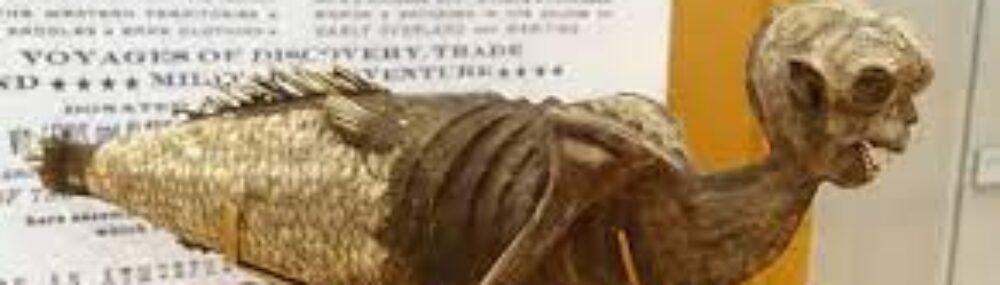
After hinting at the unpredictability of the ocean and the potential for chaos during the calm, Melville introduces suspicion with the crying seals. The crew is met with a scream “in the deep darkness that goes before the dawn” (Melville 537). Again, Melville juxtaposes “darkness” and “dawn” in order to emphasize the impending catastrophe. The scream of the seals is said to be mermaids by the Christians. Ultimately, the cries in the night are just seals near shore. The seals, harmless animals, are perceived as ominous omens by the crew, illustrating the consequences of viewing the ocean through a lens of fear and ignorance. Melville uses this instance to demonstrate the ignorance of the Ocean that ship crews have. The seals are then described as having some human-like characteristics. Besides their cries, the seals seem human “also from the human look of their round heads and semi-intelligent faces, seen peeringly uprising from the water alongside” (Melville 537). Through the superstition of the seals as mermaids and possibly evil creatures, Melville displays the disconnect between humanity and the natural world. By anthropomorphizing the seals, the crew does not understand the seals as who they are, but fragments of something familiar and more human to them. By portraying the seals as innocent creatures that are misunderstood by the crew, Melville shows the importance of acknowledging and respecting the life forms in the Ocean.
After ignoring the signs of warning that the sea gave the crew, they lose one of their crew to the depths. The men aboard the Pequod “saw a falling phantom in the air; and looking down, a little tossed heap of white bubbles in the blue of the sea” (Melville 538). The sailor eventually drowns despite the efforts of the crew to deploy the life-buoy. The imagery of the sailor falling to his demise serves to demonstrate the futility of human efforts to control or conquer the natural environment. Though the message is portrayed several times throughout the novel, this passage in particular shows how powerless the crew is compared to the vast Ocean. The sailor’s fate serves as a warning to the crew, urging them to seek caution in their future endeavors, as well as respecting the Oceanic environment as a dominant force.
After the commotion of the sailor falling overboard, “the first man of the Pequod that mounted the mast to look out for the White Whale, on the White Whale’s own peculiar ground; that man was swallowed up in the deep” (Melville 538). Melville suggests that the man who went overboard is subject to the same dangers of the sea as the Whale. By placing both on the same playing field, he emphasizes the importance of respect for the Ocean as a non-discriminate and savage environment. Melville also draws attention to the initial reaction of the first man, who assumed that it was the White Whale who had taken the sailor’s life. Here, we see a further misunderstanding of the animals in the sea as savage creatures, constantly praying for human demise. Melville uses the assumptions of evil to further portray the human disconnect from the natural environment.
Through the development of vivid imagery, juxtaposition, and symbolism, Melville highlights the consequences of disregarding the ocean’s warnings. He emphasizes the need for humanity to approach the ocean with caution and humility. Through this chapter, Melville prompts the reader to consider their own relationship with the natural world, and whether one understands the consequences of misunderstanding its power and complexity.