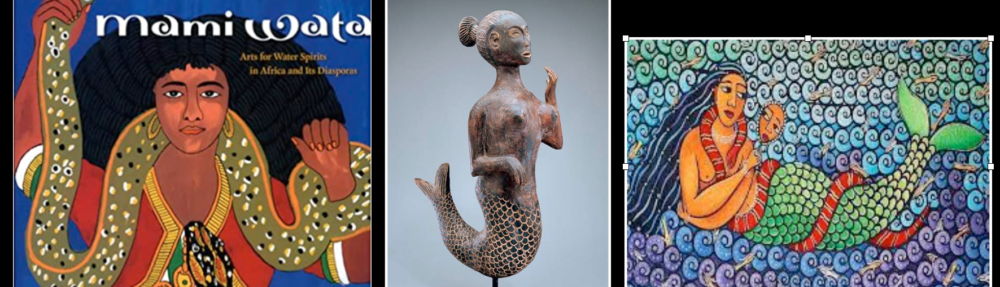
Week 5 Melusine/Great Old Hunter

What I found interesting about Tuesday’s readings is that all three texts are intertwined. “The Legend of Melusine” and “The Faery at the Fountain” are the same story with “The Legend of Melusine” providing more of a general overview of the tale. Both stories mention that Raymond and his uncle (The Count of Poiters) were on a boar hunting trip in Colombier which accidentally ended in The Count dying by the hand of Raymond. This relates to “The Great Old Hunter” who is, Aimery the Count of Poiters, and ends with him giving his intent to go boar hunting in Colombier the following day, possibly the day he dies (pg 15). It was fun piecing these together in chronological order and building almost a movie in my head.

Although these texts don’t mention it, there are a few ways they relate to the character traits of mermaids/sirens. “The Legend of Melusine” and “The Faery at the Fountain” both describe Melusine as extremely beautiful, to the point where it’s “love at first sight” for Raymond and even lessens his guilt of killing of his uncle, “His former sadness, his remorse, even his exhaustion he threw off in exasperation.” (The Faery at the Fountain pg 27). “The Faery at the Fountain” describes Raymond possibly being deceived by Melusine, “If some of this was inclined towards deception, he did not notice but followed her willingly” (pg 28). Going back to “The Great Old Hunter” it says “She sang a lay so beautiful and sweet That birds who came to hear her song Soon after sang it too… Whose eyes, wide open, great and singular, are the best rulers of a bird” (pg 13). This relates to Sirens as we know are a hybrid between woman and bird and sing beautiful “lays” as mentioned in “Odysseus and the Sirens”.

One thing I found interesting was how Melusine is depicted as being involved in some sort of sorcery, “Dear friend, I give you these two wands whose stones have special virtue…preserves from accidental death by weapons…gives victory in any dispute or combat” (The Faery at the Fountain pg 28). In the same text she says, “you must promise not only to take me as your wife, but never again to doubt – you understand, never, sir knight – that I would conduct myself honestly and in a Christian manner, beyond any sorcery” (pg26). Even though she denies her involvement in sorcery, it sounds like sorcery to me.

Week 5: Medieval Melusine

When looking over the reading from this week, the ‘Legend of Melusina’ chapter was quite interesting to read. The depiction of the relationship in between Elinas and Fay was quite interesting. When Elinas first sees her at the fountain, he is dealing with the grief of losing his wife. He is taken by her beauty and she had made him promise to never never see her at the time of her “lying-in”. When he did she left and took her three daughters will her, to a high mountain in Albania. I found it so interesting that when her daughter Melunisa came of age, she asked what her father had did, and then he pledged vengeance against him, which is where the story really begins. Melunisa then proceeds to get her sisters to join her in vengeance and they go to his castle to take him and all of his wealth, and inclose him with a charm. When her mother discovers this, she sentences Melunisa to become a serpent every Saturday for the rest of her being, and could find a husband who wouldn’t see her on Saturdays. In my head, I would have thought that the mother might be glad that Melunisa had done this to the King, but instead she is punished. I feel as this really shows the character of the mother, as she did not want revenge, unlike her daughter Melunisa. When she finds Raymond, he is so taken with her he agrees to these terms, until he breaks them. On page 88 when it says “But it was not the horror that seized him at the sight, it was the infinite anguish at the reflection that through his breach of faith he might lose his lovely wife for ever.” I found this quote to be specially sad and contribute to the story line. Raymond was not disturbed by the sight of his wife with a tail, but he was in pain over the fact that he knew he was going to lose her. This took me by surprise, because so far in all the readings, people have only ever been disturbed by the sight of something like this, something un-human. Raymond was different, he loved his wife so much that even though he might’ve been “un-human” at times, it didn’t matter to him. He knew he breached the trust and the oath between them on Saturdays, and he died. He would’ve rather been dead than without her, and call me crazy but I thought this story was beautifully romantic.

Week 5: Melusina

In this weeks reading of “The Penguin: Book of Mermaids” by Cristina Bacchilega and “The Romance of Faery Melusine”, we read the tragic story about Melusina. Although I did not fully understand it during my first read through, I couldn’t help but notice that this was essentially a cautionary tale about Karma. When her step-father broke his promise to Melusina’s mother and laid eyes on her when he was not supposed to, Melusina opted for revenge. She took her step-fathers money and charm and imprisoned him. This made her mother angry, resulting in Melusina being cursed in a similar way to how Melusina’s mother was originally cursed. Melusina went out, got married to a charming man named Raymond (or Raymondin), but was eventually met with a terrible fate when Raymond saw her in her serpent form when he wasn’t supposed to.

I found a lot of symbolism in the story of Melusina. The most obvious one was the fact that Melusina becomes a serpent from the waist down on Saturdays. I am not sure if this is relevant, but Saturday is the holy day for a lot of religions. In a lot of religions also, serpents are great symbols of evil, deception, and demonic creatures. The idea of Melusina being half serpent is also interesting because she claims she is “as faithful a Christian” (25) as Raymond. Turning into a serpent as a result of her wrongdoings is an excellent example of karma. She eventually had a happy life with the exception of her curse, which ultimately ruined her life in the same way the curse ruined her mothers marriage.

There seemed to be a strong theme regarding beauty and chivalry/masculinity as well. The story of the hunter shows a connection to chivalry and masculinity, which is interesting to read after the story of Melusina. Noble men are drawn to “things that lead them further into unknown… [seeking] in all directions the extension of their physical and spiritual power” (12). It is chivalrous to seek knowledge of the unknown, similar to how Odysseus longed to hear the siren song. Raymond was a chivalrous man who unintentionally committed a horrible act. Karma got him for his actions the same way karma got Melusina. He had a mostly happy life with a beautiful woman after his wrongdoing, but his wife ended up being cursed.

Week 5: Melusine and the Environment

The reading this week was very interesting in the way that it talked about human’s connection with nature. There were multiple times throughout the first chapters where the story described a mutually beneficial relationship between the environment and people. The first instance I noticed of it was in “The Great Old Hunter” where the author mentions that: “Man developed without dissociating or abstracting himself from the world. In short, he knew how to love it, to give and to take in many ways, as he needed” (Lebey, p.12). Humans, men specifically, at this time were able to peacefully coexist with the world. They were not taking excessively from the land but living in harmony with it. This quote explains that this was a process because men “developed” into learning their position and did not just automatically know how to respect the environment. While humans are benefiting from the resources that the environment provides, the environment is benefiting from the love and care of humans. I found this interesting because there is not often any mention of love or giving when discussing the environment. Many modern stories do not acknowledge the respect that the environment is owed and there is hardly any reference to giving back to it in any sort of way. Another moment that stood out to me that revealed a lot about the relationship with the environment was in the description of the wands that Melusine gave to her husband. The wands were made from the elements and contained stones that would help whoever had them with living and battles. These wands were a literal manifestation of what the foundations of the world can help men with. Melusine explains that the core of the stones “is also influenced by what we imagine, and the stones do the rest” (Lebey, p. 28). My understanding of this is that the stones worked depending on the intention of the person using them, so to want to do something that is out of line with nature, in general, would end with not the best results. While the Earth is giving these gifts to someone, they are not meant to be used in a way that would be detrimental to the environment. The environment provides for people but in return requires respect, care, and honesty. 

Melusine and the Importance of Privacy and Personal Boundaries

In this weeks story, Melusine and her relationship with Raymondin highlight the importance of respecting someones personal boundaries and their privacy. When Melusine and Raymondin first meet, the two outline certain expectations and objectives for their relationship. This includes never seeing each other on a Saturday. In this scene, Melusine explicitly says, “You must swear by all holy sacraments as  a christian that on each Saturday, from sundown till the following day, never – and I will say it again so there is no doubt about it – never must you try to see me in any way whatever, nor seek to know where I am” (pg. 27). This isn’t a simple request or suggestion. Instead there’s a heavy weight of responsibility to Melusine’s words, especially through using the term ‘holy sacraments’. This implies that to break this oath is akin to breaking a promise to God, which usually carry severe punishments. She didn’t say this once, but twice in order to further emphasize this clause in their agreement. This statement is unbreakable and leaves no wiggle room for potential change in the future. With all this laid out, Raymondin agrees to marry her. The two share a prosperous life together and are deeply committed to each other which makes Raymondin’s betrayal of their promise and Melusine’s privacy all the more heart breaking. When Raymondin uncovered this secret, he didn’t bear it alone, but instead revealed it to all those who were in the castle. Because of this public spectacle and exposing of her secret, she would never again get to be with Raymondin as husband and wife. This reveal captures the nature of secrets: once revealed, the circumstances surrounding the secret will forever be altered. Had Raymondin kept the discovery to himself, Melusine would have been able to die as a mortal Christian woman besides him. By violating these boundaries, these actions lead to the downfall of both their happiness and contentment, which shows the importance of treating boundaries in relationships with respect and continued acknowledgement. 

Knight, G. The Romance of the Faerie Melusine. Skylight Press, 2011.

Week 5: Melusin(e/a)

What I found most interesting this week was the difference between the Melusine origin story in the Penguin book versus the story told in the Romance of the Faery Melusine. In the Penguin Book of Mermaids, it states that Melusine (called Melusina in this book), has a serpent tale and does not appear as a mermaid. However, as we see in the Romance of the Faery Melusine, she is represented as a mermaid. In fact, the entire room that she hides in on Saturdays is made up for a mermaid–containing sand, water, shells, and coral. I think that this is because of the Christian Church. As we learned in the first chapter of the Merpeople book, the Christian Church chose the image of the mermaid for their own deviant needs (to belittle women and bring more followers to the church). This book, at least from the chapters we read, seems to have big Christian themes and God/Jesus is constantly mentioned. For instance, on page 12: “In those days men identified with things that could lead them further into the unknown; they sought in all directions the extension of their physical and spiritual power. So they believed and so they lived, sure of themselves and strong at one moment, at the next deflated and weak, falling to their knees for restoration from another source, the Lord Jesus Christ. And things, animals or people, trees or weapons, were more themselves… And the law of God prevailed over all.” These not so subtle mentions of Christian ideology are important because they give us context to who may have written this text, and where this text may have originated from. Clearly, it was written during a time where many were religious and believed in God. These men mentioned in this quote rely on Jesus Christ, and believe God is almighty. There are many mentions of God in this text–I will not list them all as it would be boring and extended–-but some important ones are “I am as faithful a Christian as you are” (p. 25), “before God and in the face of ourselves, and will marry you as soon as you wish in a church” (p. 26), “Could it be the Devil?” (p. 121), and “Pray devotedly to Our Lord to relieve my sufferings and shorten the time of my ordeal” (p. 144). These quotes further reveal the Christian beliefs of the time. In addition, Melusine is depicted combing her hair and using a mirror–which are associated with vanity (which I believe came from the Christian Church). She is also sexualized, as the Christian Church did with their mermaids: “flawless figure of a woman, forever young… her bent back magnificent in profile, her breasts raised… the exquisite flesh” (p.125). While the Penguin Book says that Christian framework makes her a more positive character aligned with water, I am not sure this is so true. I feel like this story was adopted to further demonize women, as liars and deceivers (as she was not truthful about what happened on Saturdays). Not only this, but Raymondin accuses Melusine of having damned children, and that she is a phantom and her children are as well, which could maybe imply that women can bear devilish fruit (but it could not be the man’s fault).

Week 5: Melusine

The importance and significance of beauty, attraction, and femininity are all things I have seen and observed in this class. The Faery at the Fountain engraves this in me even deeper, while these things were of importance in this tale, there were also other obvious aspects that I have not seen in stories before. I would like to say this story reminds me a lot of the damsel in distress trope, but the roles are reversed. Raymondin is on the run and seemingly lost when the faery Melusine comes to what seems to be his rescue. While the roles are reversed from what a typical story usually shares, Melusine did not emasculate Raymondin, at least not in my eyes but I am not exactly sure why. “It was always she, indeed, who led.” (p29). Since it is their first time meeting, it leads me to think that Raymondin is not the first nor last man with whom Melusine shares this type of encounter. In the lens mermaids, they both share this sort of enchanting and hypnotic entity, where the men simply cannot resist their beauty and in return the woman, in this case Melusine gives them some sort of knowledge or information. This is what we have seen in the case of mermaids and sirens, it’s interesting to see that faeries also carry this sort of captivating power. Another thing I noticed was the femininity of Melusine and how much of her hair is emphasized, “Then she began to comb it, and as he admired the fine silky, deep tresses he saw the wooden comb that had ran through them..” This was one of the similarities I noticed between the way both Melusine and mermaids have been depicted.

Week 5: Medieval Melusine

For this week’s reading I found it fairly interesting in regards to” mermaids” finally being incorporated into the lives of individuals. As well as finally having that sense of a fairytale story and falling in love. In past week’s readings it has been more based on individual stories about mermaids and their own individual stories but not really intertwined with the lives of regular people and their connection. I particularly liked the sense of romance in this week’s reading with the legend of Melusina. I think this will now open the door for how we see, “Mermaid stories that focus on a water being’s life in the human social world” (Bacchilega, page 85). Although the story of Melusina and Raymond was not lengthy, their interaction can still be discussed, I particularly thought that their love for one another was almost superficial. For one, Raymond didn’t even know Melusina’s name after their interaction; as well during their interaction Raymond was paying fairly close attention, “From her beautiful breasts his gaze descended” (Knight, page 26) conveying him focusing more on her exterior and not paying attention to her and what she’s saying. Their love and eventually their marriage seemed very transactional, since Raymond was going to be able to hide his crime of murdering his uncle and Melusina would be able to get married, so their whole interaction seemed very fictitious and occurred very quickly. But I am excited to finally get into reading with individuals’ direct interactions with mermaids. Also, I did not see the deeper understanding or themes in this story so I hope to come more enlightened and be able to see the deeper meaning.  

Week 5: Melusine

Understanding this week’s European folklore was honestly rather difficult to me. In the last couple of weeks, when we have read about other folklores or sirens, I could make up a certain pattern: the half human being was either presented as beautiful, dangerous, or sinful, or as knowledgeable, meaning that it can teach the humans something deeper. While reading the stories about Melusine, I was confronted with other themes where it took me a longer time to think about it. In the last weeks we have never actually read something about crossing the line between the mythical and real world. What I mean by that is that never in the stories, the merperson was actually in a relationship with a mortable human. With Melusine, it is different. Even though it is depicted that Melusine’s husband Raymond does not know about her transforming into a serpent as she hides when it happens, they still fell in love with each other. This shows to me, that love can transcend the boundaries of both the real and the divine world. I had to think about the romantic idea, that love can overcome any obstacle.

Even though this sounds great at a first glance, I am still more than confused to put the folklore into its historic context. The people in the Middle Ages were highly religious. How can it be, that a human has fallen in love with a serpent? How can it be, that Raymond has never doubted about her being “different”? Does this story want to teach humans about the power of love, of acceptance, or of understanding?

I honestly did not found answers to my questions above. First I thought that Raymond must have been blinded by Melusine’s beauty, which could mean that his attraction to her was rather superficial (he did not see her true personality). An evidence in the text could be: “In a long and wide pool set within the dark blue mosaic, decorated here and there with the green leaves of violet and black irises, was the flawless figure of a woman, forever young, whom he knew well. Her bent back magnificent in profile, her breasts raised, as she combed her long golden hair, and the exquisite flesh, more pale than usual, pearled almost to transparency” (p.125). But then I started to think about this Christian image of a forbidden desire. Did the story maybe want to warn the people about pursuing relationships which are unaccepted by society? Or is it rather about the image of forgiveness I have mentioned earlier??

I am eager to hear about your opinions in class. Maybe we can find answers together!

week 5 Melusine

I read over the story of Melusine, as per our reading today, and I noticed some things that felt very similar to the Sirens we were talking about last week.

For one, we see the sort of not-quite fish but close to fish hybridity (Melusina is a snake lady but only one day a week?). But then we see more similarities. There’s sky elements in this folklore too: “He hid himself; and then saw how the lovely form of Melusina ended below in a snake, gray and sky-blue, mixed with white.” (Page 88, penguin) So this supposedly demonic and unnatural woman creature with ties to water has ties to the skies? Not only that, but then further down when she’s giving her epic speech, she says “…shall know that whenever I am seen to hover over the fair castle of Lusignan, then it will be certain in that very year the castle will get a new lord; and though people may not perceive me in the aid, yet they will see me by the Fountain of Thirst…” (88)

So she’s able to hover/fly as a snake woman creature. She also has a connection to nature but why exactly do we keep seeing the creature that’s tied to water being also tied to the air? This is giving binary oppositions but in a much more confusing way. I hope we can figure this out more later because my head is starting to turn into scrambled eggs. My guess is that she represents a sort of human tie to nature, because she didn’t quite start out as the creature, but rather she went from civilization into nature. And since nature doesn’t stop at the ocean, or water, or the skies above, she embodies them all?