I don’t have a set thesis statement, but it will discuss literatures use of mermaids as a lens to discuss the environment. This will be a culmination of my two essays about Sedna to further my analysis. It will dive into the way literature is a way of understanding the culture from which it comes from, and also how Sedna’s entangled hair is symbolism for pollution and how highlights a close relationship between human actions and the health of the environment. I may also include some exploration of the Shaman and close read/ analyze that area more. My goal for this final essay is to emphasize that literature is powerful by exploring how in this class, it helps with understanding humans’ relationship to the Ocean.
Tag Archives: final essay proposal
Final Project Thesis/Proposal
I wanted to view The Little Mermaid as a story of colonization, how the little mermaid loses her identity–the things that make her a mermaid and that give her power–through the political transaction of rescuing a prince and exchanging her identity for his companionship. I will explore this through redrawing illustrations inspired by Helen Stratton’s illustrations and using Filipino pre-colonial and colonial fashions to dress the mermaid. I use pre-colonial Philippine fashion and a Filipino mermaid as a challenge to the “universality” of The Little Mermaid’s canon and mermaid canon as a whole, where mermaids are typically blonde, white women, as well as a way to map how Filipino identity has changed through the centuries of colonization. I will include a short essay to accompany these illustrations and to point out the details that I include.
Hans Christian Andersen’s The Little Mermaid was written in the 19th century, at a time when European colonization was at its peak. The Philippines was already heavily colonized by the Spanish in the 19th century and the changes enforced affected so much more than fashion–it affected appearances, lifestyles, and values. By recontextualizing The Little Mermaid through the context of Philippine colonization, we can also see how the story itself is as much a process as well as a product of colonization, its origins and associated images altered over and over again in the same way that the people and their identities are altered over and over again. Viewing The Little Mermaid as a story of colonization adds a new intersection to the little mermaid’s identity–not just as a woman, but as an individual who is forced to assimilate by altering her body to fit into the colonizing culture in order to avoid, at best, ridicule or, at worst, persecution.
Final Essay Thesis
ECL 305 – Final Essay
Thesis: William Cronon, “The Trouble with Wilderness” (1996)
In the face of escalating environmental challenges, particularly climate change, Cronon’s critique prompts a reassessment of wilderness preservation strategies, highlighting the need for adaptive management approaches that prioritize resilience and ecological integrity. However, the emotional connection to nature fostered by these ideals can serve as a powerful motivator for conservation efforts, suggesting a nuanced understanding of human-nature relationships. This necessitates the adoption of adaptive management approaches that not only prioritize resilience and ecological integrity but also harness the emotional resonance of wilderness to inspire meaningful action in mitigating the impacts of climate change and safeguarding the planet’s biodiversity.
1) What do you see?: This is your insight
Cronon’s exploration of the emotional connection to wilderness underscores its potential as a powerful motivator for conservation efforts.
2) Where do you see it? How is it being done?: This is where you use specific elements from the work to support your insight
Cronon’s critique in “The Trouble with Wilderness” challenges the idealized view of wilderness as pristine and untouched, while acknowledging its emotional resonance in historical and cultural narratives. He suggests that this emotional connection can be harnessed to inspire conservation efforts.
3) Why is this relevant? So What?: This is where you explain why your insight is relevant, where you make an argument about what the work is saying/doing with and through your insight. This is where you push your insight to larger conclusions about the work as a whole.
This insight is relevant in the face of environmental challenges like climate change, as it advocates for a shift towards adaptive management approaches that prioritize both ecological integrity and emotional engagement with nature. By recognizing and leveraging the emotional appeal of wilderness, conservation efforts can become more inclusive and effective in addressing pressing environmental issues.
Final Essay Proposal
I have a thesis and a general idea of where I’m going with this essay. I was able to draw from material I really enjoy, but I think I have to narrow down my claim a bit more and figure out what bits I will draw from each text. This is what I have so far:
The Western World first began the detachment from the natural world in Feudal Europe, and this separation from nature was further widened by the creation and romanticisation of the wilderness through America’s newly created National Parks. The Western World fails to understand that it is possible to coexist with the natural environment without separating humans from nature. The Western World’s separation from wilderness is what caused wilderness to be invented.
I will be building on my close reading on Melusine which discusses the origin of the Western World’s separation from nature. Then, I will discuss/close read parts of The Trouble with Wilderness as well as a silent black and white short film created by the U.S. Department of the Interior, National Park Service called Natives of Yosemite in order to further my argument about how the romanticization of nature and the removal of Native Americans from land to be used as “wilderness” furthers this issue. The short film I want to dissect ironically is called Natives of Yosemite, but it does not include any Native Americans, it mostly lists some stats about the biggest trees and the Wawona Tree. Contrary to the literal tree being closer to man and its invention of the car with it being carved out as a tunnel, the commodification of the natural world is what separates man from nature, subsequently leading to the justification of environmental destruction.
A somewhat ambitious addition to this project could be the inclusion of Michael Pollan’s The Omnivore’s Dilemma to further back my claim that the Western World becoming separated from nature is what drives environmental destruction (industrial food system, capitalism, etc). This would of course make my thesis more complicated.
Texts:
https://www.youtube.com/watch?v=nFWQjZIQPec U.S. Department of the Interior, NPS
Melusine
The Trouble With Wilderness
Final Essay Proposal
Thesis: Non-Western mermaid folk tales and stories use ocean-centric language to emphasize the importance of the ocean to their cultures. By doing this, the people of these cultures have a deeper understanding and a more profound respect for the ocean and all bodies of water than Western societies.
I plan to use Steve Mentz’s “Deterritorializing Preface” and Eric Pal Rooda’s “The Ocean Reader” to set up the argument for my essay.
Final Essay – Thesis Proposal
For my final essay I decided to extend on my second essay of Gabrielle Tesfaye but also try to incorporate The Deep as a second text as I believe they are both similar in story telling and the stories that are hidden from the world, but also with the story of slaves being thrown overboard. Any feedback is very appreciated :).
Thesis: In the short film The Water Will Carry Us Home by Gabrielle Tesfaye shows the demonstration of how selected stories portray what is known to be history. Tesfaye conveys this message through the use of stop motion art which is able to produce a story. This is significant as it shows a side of history that is not told or paid more attention to and it also shapes viewers thinking about the history that is already known.
Final Proposal — Essay Thesis
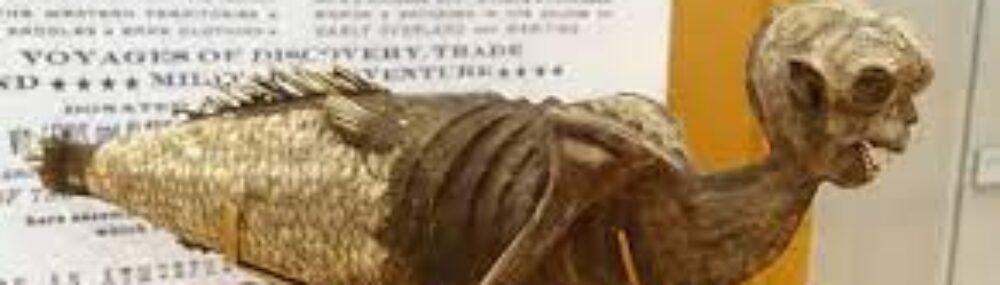
Studying mermaids in Christian Literature, Barnum’s Feejee Mermaid attraction, the cultural influence of ‘The Little Mermaid,’ and Starbucks’ marketing tactics exemplifies the concept that marketing and Literature are one and the same. Christian allegories of mermaids resembled a physical embodiment of lust and temptation, while Barnum capitalized on the Feejee mermaid as a source of exotic entertainment. Similarly, ‘The Little Mermaid’ shaped social norms and values in young American girls, while Starbucks utilizes a mermaid as its brand image to symbolize indulgence and desire, all of which reflect the blurred line between marketing and Literature.
I think I kind of say the same thing twice but struggled to do it all in one sentence without it being a crazy run-on sentence, not sure if I should remove the first sentence or find a better way to combine it all.
final essay proposal + my thesis
tbh I don’t know where to post this because I forgot if it was better to either email you directly or just post it here so I’m posting it here.
The Pisces is an unconventional love story that turns the standard tropes in the mermaid story on their heads, displaying how the stereotypes and gender roles presented within the mermaid story are a product of their time, this one being more relevant to the modern day, and ultimately turn the traditionally patriarchal, misogynistic view of the mermaid on its head and upend that view. The unconventionality of The Pisces centers female sexuality, as opposed to stories such as The Little Mermaid and Melusine, who neglect the female. The Pisces is special because the woman is not the sexual object, but it also doesn’t objectify the merman. These two characters are allowed to mess up and be messy, and therefore portray more realistic experiences.