Week 8: The Trouble With Wilderness

I have noticed a common theme with the association of nature and the environment to the Christian religion. In past weeks we have read stories that have told the Christian belief and role in stories surrounding mythical creatures and the environment. It is clear to me now how much of an impact nature had on the Christian religion, causing those followers to tell such tales. Going back 250 years in history, the wilderness was seen as a scary, savage, and deserted place. “The wilderness was where Christ had struggled with the devil and endured his temptations” (Cronon, 8). The wilderness was seen as a place where people, or Christ, would go fight in a way because of its dangerous nature. This can be connected to mermaid depictions by the Christian religion near this time. At a time when the wilderness was an unknown place that was filled with risks and temptations, it makes sense that stories about merpeople or sirens trying to tempt humans to come to them were being told.

As time went on, the views and ideas of the wilderness and nature changed. Nature was beginning to be appreciated as one of God’s creations. The wilderness shifted from an undiscovered mysterious land to a land of freedom. “It is a place of freedom in which we can recover the true selves we have lost to the corrupting influences of our artificial lives. Most of all, it is the ultimate landscape of authenticity. Combining the sacred grandeur of the sublime with
the primitive simplicity of the frontier, it is the place where we can see the world as it
really is, and so know ourselves as we really are-or ought to be” (Cronon, 16). This change of heart about the wilderness can be correlated with the change of heart about merpeople in the Christian religion. Christians began to depict mermaids through beautiful artwork and texts, showing them in a more positive light. It is interesting to me how much nature contributes to the beliefs and ideals of a religion.

Midterm: Close Read Essay

Carina Virto

ECL 305

Professor Pressman

03, March 2024

How to get into Heaven: Womens’ Edition 

Hans Christian Anderson’s The Little Mermaid is a religious, Christian,  how-to in terms of being accepted in the kingdom of Heaven. The story centers on a young mermaid, at the coming of age, who sacrifices everything, including her life, in order to win the affections of a mortal man, and consequently a soul. In Christian norms, it is traditional for a woman to marry a man, become a mother, and serve her husband and family to the fullest extent. Religion plays a substantial role in how those who follow its faith behave in society. In The Little Mermaid the emphasis placed on a woman marrying a man, or devoting her life to God, serves as a Chrstian allegory for the low value women possess on their own, further perpetuating harmful gender roles and overall treatment of women in society.

The little mermaid gives up her princess life, natural form, and family and chooses to undergo mutilation to her natural form, risking her life, and the loss of her voice for the chance to gain the affections of her male interest and an immortal soul. At the age of 15, the little mermaid was able to swim up to the surface of the ocean and view the human world above. One of her many visits to the surface sparked a deep, romantic, interest in a prince whose ship sank and that she had saved. Ultimately, her love interest furthered her fascination with the human world, inclining her to ask her grandmother about the life cycle of humans. Through this conversation, the little mermaid learns that humans possess an immortal soul that grants them ascension into “… favored regions, that [merpeople] shall never be privileged to see. (Anderson, 118)” These supposed regions are a direct reference to the Kingdom of Heaven in Christianity. In the Christian religion it is humans who may ascend into Heaven, not animals, spirits of nature, sinners, or non-believers. In this case, the little mermaid is still in the form not of man, therefore it is vital that she does something in order to change herself to gain the opportunity to ascend in her afterlife. Her grandmother then goes on to detail how the only way to acquire an immortal soul is to be loved by a human “so dearly that you were more to him than either father or mother–”. This caveat is an obvious ode to the idea that if a Christian woman wishes to gain access to the kingdom of heaven, she must follow through with her expected role as a woman in this society: to be wed to a man. If she fails to do so, her duties will have not been fulfilled as God intended. This ideology screams the notion that women are second class citizens to men, and were simply put on this earth to appease a man. This type of theme has been spun many times, especially in Genesis 2:18 which reads, “The LORD God said, ‘It is not good for the man to be alone. I will make a helper suitable for him.’” Eve was then created from one of the ribs of Adam, made solely for his benefit. Eve was not created when Adam was, but instead she was created to perfectly suit Adam’s needs and along with his own personal timeline, and for no other reason. Therefore it would seem that a woman’s sole purpose is to find their own Adams and contort themselves by whatever means possible to be able to serve him, as it was why she was created in the first place. To fail at this duty is to defy God’s intentions and to be denied access to Heaven.  With these ideologies in mind, the little mermaid eventually finds herself making a trade with a sea witch. The sea witch agrees to help the little mermaid for the price of  “the best of all [she] possesses in exchange for [the] valuable potion. (122)” These attributes include her tail, which shall be split into two and will condemn her to excruciating pain every time she walks, but not when she dances, and her voice. After learning the price of her desire to become human, the little mermaid asks, “But if you take away my voice– what have I left?” To which the sea witch replies, “Your lovely form– your buoyant carriage, and your expressive eyes.” The entire exchange not only expresses to the reader the sacrifices women are expected to make in order to be loved by a man and appease God’s intention for her, but it degrades her to simply a vessel of a person. The little mermaid will be a dancing monkey with no voice or value, just her body and beauty to give to her potential husband. She will not be able to express herself through words, because womens’ emotions cease to matter, she will not be able to feel comfortable unless entertaining her male counterpart as she has no other duty, and she will not be able to continue on physically living if she is denied by him. This degradation of women further reinforces the hierarchical gender roles perpetuated in Christianity, which is highly damaging to the perceived female value among society. 

Although the little mermaid is ultimately rejected by her love interest, all is not lost as there will always be another man to be devoted to– God. After the little mermaid turns into seafoam, having failed to capture the unrequited love of her love interest, Anderson writes an extension of the story to explain what other option a woman has if she is to fail her Christian duty of marrying a man: devoting your life to God. As the little mermaid floats as seafoam she then transforms and her body begins to rise out of the foam and high into the sky. When she inquires those around her where she may be they respond, “Amongst the daughters of the air!” (129). The daughters of the air also lacked an immortal soul but could “obtain one by their good deeds.” The little mermaid learns that after three hundred years of good deeds she may obtain an immortal soul after all. The daughters of the air are essentially aerial spirits, in which no human being can see. In Christianity there are a group of women who devote themselves to the Lord, abstain from sin, and are hardly seen by the public: Nuns. It would seem that Anderson is telling his readers that if you pursue your duty of deviating yourself to a man in holy matrimony and come out unsuccessful, after one try of course, you may then switch your course to instead serve God himself for the rest of your lifetime. The spirits then go on to confirm that indeed “[they] shall glide into the Kingdom of Heaven, after the lapse of three hundred years.” It is customary that Christains act in good deeds and abstain from sinning in order to be deemed worthy of a Heavenly afterlife, therefore it would make sense that this route was the next best thing for the little mermaid to pursue. Despite the idea that the little mermaid is still getting her immortal soul after all, the idea that she herself still needs to endure three hundred years as a daughter of the air in order to be granted access into heaven whereas men simply have to abstain from sin, is a clear representation of the pedestal men stand on in which women reside below. It is important to note that there are no “sons of the air” but that they are daughters, women. This sort of path is not necessary for the man, just as it was not necessary for Adam to require a purpose to be created. 

Men were created by God as a representation of his love and to spread love, whereas women were created as an afterthought, so that men would not live alone. It is clear, through the depiction of the little mermaid’s life, that according to Christainty, the widest followed religion in the world, that women lack value if she is not to be serving a man or serving the Lord. Notions of this substance attack the value of a woman and her importance as a human being, and give society an excuse to treat them as less than. Moreover, it is imperative to dissect texts like these to avoid being misled into thinking that if you are a woman then you’re insubordinate or that if you are a man that you may treat her as such. Literature is powerful in its ability to spread ideologies and influence society, therefore stories like these need not be blindly accepted as truths, but rather critically analyzed to understand societal biases against women and unveiling the absurdity gender roles confine them to in their pursuit for happiness.  

Works Cited

Anderson, Hans Christian. “The Little Mermaid.” The Penguin Book of Mermaids, ‎Penguin Classics , Westminster, London, 2019, pp. 107–129. 

“God Made Eve and Ordained Marriage .” The Elegant Farmer, www.elegantfarmer.com/wp-content/uploads/2014/08/God-Made-Eve-and-Ordained-Marriage.pdf. Accessed 4 Mar. 2024. 
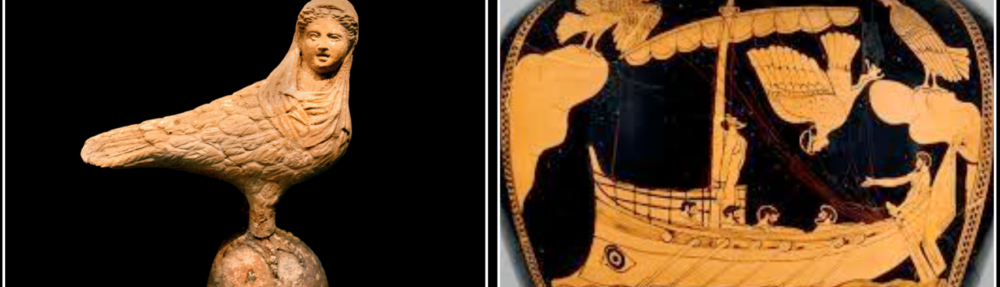
Week 7: The Little Mermaid and Christianity

The Little Mermaid contained a lot of Christian imagery and ideology, but I found the contrast between air spirits and mermaids really fascinating. The two different creatures were representations of heaven and hell where souls were either present or not. Mermaids are described many times as not having an immortal soul which signifies that they cannot live in an afterlife. For instance, the grandma of the little mermaid explicitly tells the little mermaid that their “souls are not immortal. [They] shall never enter upon a new life” (Andersen, p. 116). This means that a mermaid’s soul is returned to the earth and is not meant for anything further than that. In Christianity, a person who has been “saved” by Christ is seen as having an eternal soul that will continue to exist in another plane after death. However, people who are not saved by Christ are not allowed to experience eternal life. In this way, mermaids represent those who were considered unholy and destined for hell at the time. Their souls will never be able to experience the “greatness” of the “unknown and favoured regions” (Andersen,p. 116) humans enter after death. 

Comparatively, the air spirits are a clear representation of heaven and godliness. The imagery of the air spirits resembles angels who are messengers of God in Christianity. The aerial spirits exist to do good deeds for humans and are given the chance to live in the human afterlife. It is explained to the little mermaid that “the daughters of the air, although not possessing an immortal soul by nature, can obtain one by their good deeds” (Andersen, p. 128). This opportunity to get an immortal soul is the closest that un-human entities can get to being human. From my understanding, this is a representation of becoming “saved” in Christianity. In the religion, a person must follow God and do good deeds, which is what the aerial spirits are doing. They depict the people who at the time were considered to be righteous and who would do God’s work. 

This dichotomy also made me think of the discussion in class we had about verticality. The mermaids are underwater which hints at hell because it’s below and the only way to get an immortal soul would be through duplicity. The air spirits are in the air which hints at heaven because it’s above everything and the only way to get an immortal soul would be from doing good in the world.  

Week 6: Anthropocentrism in Undine and The Little Mermaid

Something I noticed within the stories of Undine and Hans Christian Andersen’s “The Little Mermaid” are how anthropocentric these stories can be, especially when it comes to seemingly-simple concepts like tears and the human soul.

Undine tells Huldbrand that “there is one evil peculiar to [nature spirits]” (103) and this “evil” refers to the fact that nature spirits like her have no soul. Because of this, when they die, they are simple reborn back into the cycle of life on Earth rather than passing over into the afterlife, as human souls do. Undine goes on to say that while it is a satisfactory existence to live through, “all beings aspire to be higher than they are,” (103) which is essentially what drives her father to seek out a human for her to be wed to and thus gain a human soul in order to become a higher being than that of a spirit.

Anthropocentrism refers to the ethical belief that humans alone hold intrinsic value and hold power and importance over everything else in nature. Much of European/Western thinking tends to be very anthropocentric, especially with the ideas of “conquering the land” and seeing nature as something to be tamed rather than worked with. The concept of humans alone possessing souls and animals and nature possessing none is also an idea upheld by the Christian church. By placing the possession of a human soul as being above that of a powerful nature spirit, the character of Undine directly promotes these anthropocentric, Christian ideas.

Week 6: Undine

The story Undine from the Penguin Book of Mermaids was the most interesting of the readings this week. While the other readings focused more on accounts of mermaids in the past few centuries, this story was of romance between a human and a mermaid. What I found most important in this story was the connection between mermaids and nature. As we have discussed in class, there are many connections between mermaids and nature throughout many stories. Mermaids often embody or represent nature, and how humans interact with them can represent their attitudes toward nature and the environment. This story has some of the most explicit connections between nature and mermaids that we have seen so far. During Undine’s speech, she states: “We and our like in the other elements, vanish into dust, and pass away, body and spirit, so not that a vestige of us remains behind; and when you mortals hereafter awake to a purer life, we remain with the sand and the sparks and the wind and the waves. Hence we also have no souls” (p. 105). This quote shows the difference between mermaids and humans, and the connection that mermaids hold with nature–they are one and the same, and mermaids will eventually return to the earth. Another important part of this quote to note is the choice of words ‘purer life’. This reveals the Christian nature of the text, as purer life is implied to be heaven. Toward the end of this chapter, Undine also makes a comment about her uncle that furthers strengthens this melding of mermaid and nature: “I will dive into this brook, which is my uncle; and here in the forest, far removed from other friends, he passes his strange and solitary life. He is however powerful, and is esteemed and beloved by many great streams” (p. 106). This quote also reveals the deep connection between nature and merpeople. Not only is Undine’s uncle a brook, but she is also able to recognize him in his nature form (unless this knowledge was acquired previously). It seems to imply that when a mermaid dies and goes back to the earth, they become some sort of water, as Undine will do on her husband’s grave when he dies. Perhaps the overarching storyline described in italics at the beginning of this chapter is supposed to represent man’s troubled relationship with nature–at one moment, in love and full of respect, the next having betrayed her.

Another interesting part of this story was the elements of Christianity–the gaining of a soul, the inability to go to Heaven/any sort of afterlife without one. I also found it interesting that similar to Melusine, Undine is not upfront about who she is to her romantic partner. Although she does willingly tell her husband of her mermaid side (unlike Melusine), she still decides to hide her true self before they marry. Is this to add a lack of trust to mermaids? Or to make commentary that one does not need to fully divulge every bit of one’s self to be in love? That some things can be kept secret without hindering a relationship?