Week 6: Freakshows and Fantasies – The Confirmation of Merpeople

I found great interest in this week’s reading in “Merpeople: A Human History”, Freakshows and Fantasies. I was very intrigued by how the belief of merpeople spread throughout the United States and London. Most of the stories we have covered so far take place on different continents, such as France (Melusine) and Tamriel (sirens), which has led me to believe that the merpeople did not have an origin in a place like the United States. The ideas and beliefs of merpeople were spread widely through newspapers. Cities such as New York and London used newspapers as the primary way to spread news throughout their area. This intrigues me because most people during this time were learning about mermaids through the news. This led these people to believe in mermaids before they were even given any proof of their existence. Newspapers were publishing many hoaxes when it came to mermaids but also featured sightings. I am wondering how readers distinguished what they believed with such contradictory stories coming out at the same time. This has also brought me to connect this time with the period we are currently living in. The media has always had a large effect on people and what they believe.

I have also found great interest in P.T. Barnum’s influence on mermaid confirmation. Barnum was known for taking “freaks”, or non-conventional people, and putting them in a show. I find it interesting that he “imploded belief in merpeople” (128) when he was such a believer in the unknown. I would like to do further research on Barnum’s belief and interest in mermaids and learn about the effects that had on people during the time.

Week 2 Merpeople: A Human History

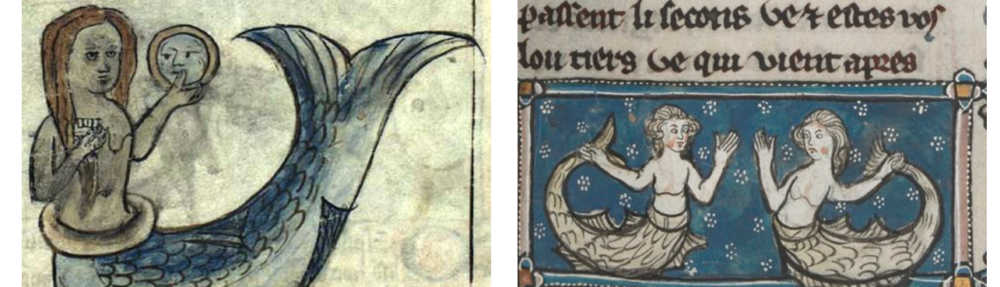
After reading Chapter 1, I was intrigued by the growth of mermaid mythology, which revealed that these enigmatic beings underwent a tremendous shift over the medieval and Renaissance periods. These mythical creatures were diverse, representing both beauty and danger across cultures. As the story evolved into the medieval era, I became interested in how the Church Christianized mermaids. The deliberate use of mermaids in Christian imagery shows a complicated interplay between church power and society narratives. Christianity merged with old pagan ideas, ushering in a new era of mermaid symbolism. The Church’s use of mermaids to communicate ideas about masculinity, femininity, wonder, and danger became an intriguing component of medieval art and sculpture. Moving on to the medieval interpretation, Pliny the Elder’s “Natural History” and later bestiaries depicted tritons and nereids vividly. It was fascinating to see how medieval historians, influenced by Pliny’s descriptions, regarded these beings as half-human, half-fish. The following sexualization of mermaids in illuminated manuscripts was a fascinating look at the junction of religious symbolism and artistic freedom. The contrasted images of mermen, frequently dressed in monk’s robes, emphasized the Church’s emphasis on piety and self-discipline. The recorded encounters with merpeople during medieval times helped to bridge the gap between myth and reality, supporting the Church’s vision. Folktales depicting mermaids as terrible sirens capable of causing men to suffer and die added another layer to the unfolding storyline. The journey through the evolution of mermaid mythology was more than just a chronological progression; it was also an engrossing investigation of the relationship between mythology, religion, and societal attitudes. From ancient myths to Christianized emblems, the mermaid’s transformation reflected larger transformations in cultural perceptions and religious power relations, finally ingraining these mythical figures profoundly into Western folklore and society.

Week 2 or 3: Noah as a Merperson

I had a very Catholic/Christian upbringing, so the name Noah and terms like “the Great Deluge” ring a bell or two. I know the gist; God gets angry and wants to essentially factory reset the world. He makes an exception for Noah and his family. He bestows upon him the responsibility of gathering two of every living animal and putting them on a big boat to survive the flood. I’ve seen movies and countless illustrations showing that big boat and the grumpy old man of God who built it – but I’ve never seen or witnessed Noah portrayed as a Merperson.

In Chapter 1 of Merpeople: A Human History, Scribner mentions Noah being depicted as half-man, half-fish. He also mentions that Early Christians saw Noah as “The second father of the human race, and the preserver and teacher of the arts and sciences as they existed before the Great Deluge” (third page of Chapter One). This is super interesting because while mermen symbolize knowledge and religion, Mermaids weren’t held in such high regard by Early Christian leaders. According to Scribner’s book, women were symbols of “lust, weakness, and man’s fall from grace.” But with Mother Mary being a symbol of purity and faith, they had to get creative – and thus, they borrowed the mermaid to make it clear that there’s no correlation between Mary and all the other evil women in the world. While this drastic generalization of women is, on all accounts, silly – nobody can deny that both the mermaid and the merman share a trait -power. Mermens’ power inspires Early Christian men. It almost seems like they are a representation of what man should strive to be—master of men and sea. The power mermaids hold is meant to be interpreted as something to be cautious of. Women tempt men on land; mermaids tempt men at sea? I don’t want to speak too confidently about this, as I am still learning, but I find this line of thought fascinating.

Luckily, my Catholic/Christian upbringing was very loose, and I’m able to freely think for myself. That being said, I read the first chapter out loud to myself and thought the Early Christian interpretations of women and mermaids were wild.

Week 2/3: Merpeople: A Human History

In Merpeople: A Human History, Chapter 1, Medieval Monsters, discusses how the mermaid evolved throughout the Medieval period. During this period, the mermaid defined and reflected Western ideas of religion, sex, and power. This chapter specifically focuses on the Christian churches use of the mermaid. The Christian church and its symbols adapted from the ones of pagan, including mermaids. Similarly, the representation and appearance of Jesus was as well. Because many pagan Gods were both male and female “many early Christian images of Jesus appeared androgynous, with Jesus boasting feminine hips, suggestions of breasts and a beautiful face” (36). The image of a male Jesus we recognize today was created in the Middle Ages as the church tried to distance itself from pagan pasts. 

Mermaids became a symbol of the church and evolved from a more hideous creature to an enticing and female creature. Mermaids became overly feminine, for the church women representing lust, weakness, and mens falling from grace, and now so did mermaids. But why would illustrations of mermaids be present in a church? As the book says “What better way to demonstrate the titillations of the flesh than to display an enticing image in the holiest of spaces?” (39). The beautiful, female mermaid served as a warning against flesh and desire in the church, which derived greatly from some of the oldest images of mermaids as sirens or half birds. Still, both were made to remind men “of her ability to steal their souls” (41). Like many symbols, the representation and meaning of them changes depending on who controls them, or obtains the “power”. 

Before reading, I was unaware of the history behind how mermaids were represented, and how we’ve come to know them today. I was even shocked at how the image of Jesus was changed and used, similar to the mermaid. 

The Human Woman and Mermaids-A degration

One of the major themes that I found when reading Vaughn Scibner’s, Merpeople: A Human History, was the degradation and defamation of feminity and womanhood as a whole. This stood out to me because my personal beliefs revolving around mermaids focus solely on their beauty and praise of feminity, not on their negative associations. Keeping this in mind many questions arose when thinking of this concept, how does the role of mermaids attempt to tame and train women? What do depictions/ texts about mermaids reveal about women’s relationships at the time? How did a mermaid’s sexual appeal build over time” And What does the depiction of mermaids and mermen express about genre roles, specifically opinions on women? I would love to touch on every one of these specifically but I want to dive into the overall concept and think of all of these questions under one bubble.

On page 41, he states the idea that medieval church men had the “ultimate goal remained tethered to decentring the feminine. Hence the repeating image of mermaids as dangerous, passionate, sexual beings…”(Scribner, 41) Mermaids were often depicted to be enticing representations of sin and deception, which I believe was to scare human women. Depictions and stories constantly disrespect the mermaid figure and blatantly say that their depictions were intended to tear down the representation of women. A similar concept continues with the idea of “equating femininity with inferiority. Renaissance woman accordingly experienced a fringe existence in public society” (Scribner, 61) where one can truly see the connection drawn between mermaids and women. The intention behind this quote is a negative, and attempts to degrade/ oppress not only the mermaid but the woman as a whole.

“Nevertheless, mermen remained clear reflections of the Church’s ability to merge the wondrous and the religious sin in an effort to denigrate femininity while vaulting men to positions of prominence and piety ” ( Scribner, 53) Rather than focus on the mermaid, this quote focuses on the depiction of the mermaid to express the concept of opinions on women and taming the woman figure. The words hold negative connotations and denotation, using the words, ” denigrate feminity” yet the “prominence” of the male figure. These phrases juxtapose each other in the most clear way, showcasing a revelation about women in literature and art in a negative light.

While I focused on the negative depictions/relationship between womanhood and mermaids, mermaids can be depicted to signify beauty, strength, and popularity. Throughout the book, one can clearly see the changing attitudes and depictions, from beauty to fear to sin, etc. This is the duality of the mermaid in the most pure form and represents a tie between womanhood and the depiction of mermaids.

Week 2 – Merpeople : A Human History

After reading this week’s chapter of “Merpeople: A Human History” I learned a lot of new information I had never known before. I don’t have a large background on the history of mermaids and how they were involved in human history, so I did not know that they correlated to Christianity or any religion at all. I found it interesting how the church learned, appreciated, and believed in mermaids through art, sculpture, and myriad texts after such a long time of the Christian church and churchgoers in Europe overly sexualizing mermaids. While I do have the knowledge that mermaids have been sexualized over time, I did not know how the true belief and appreciation of them started.

As Scribner elaborated on the involvement of mermaids in the Christian Church, I was also intrigued by the fact that the Christian Church bridged “the gap between the supposedly ‘savage’ and the civilized,” (Scribner, 16). It is surprising to me that mermaids were accepted because of how the Christian Church portrayed them after it contributed to such extreme sexualization of them. Stories about mermaids today, that I have personally read or seen myself, typically do not have a religious belief tied to their background. The history of mermaids is much different than what is depicted in some popular media today.

While the beliefs and depictions of mermaids have been different throughout history, the Christian Church belief is one that intrigued me most. Comparing how mermaids were seen in different periods gives us a good idea of how we got to where we are today. It helps explain how mermaids are seen now in literature, media, and real-life beliefs. I am excited to expand on this topic through more research and discussion in class.

Week 2: Merpeople

Reading this text, I was able to see and decipher many new meanings of the symbolization of a mermaid that I had never seen or thought of before. While some and most ideas I read about were fascinating, there was one mentioned around the beginning of the introduction that caught my attention. “Humanity maintains a tenuous balance between wonder and order,civilization and savagery.” (Vaughn,9). While the text goes on to explain and share the origin of mermaids and merpeople, this concept stayed with me throughout. It made me question a couple of things, along with humanity and just what it means to be a “human.” Since this was mentioned, it made me think of the fine line between human and monster, or animal, when it comes to a mermaid. What this might mean for humans, and made me think that maybe there is also a fine line for humans between humanity, empathy and monstrosity (whatever that may mean for everyone individually). While I wasn’t surprised by the sexualization of mermaids, I was disappointed. The fact that even as mythical creatures, women can’t seem to catch a break from men, is overwhelming. Mermaids we’re seen as derivatives of beasts, and we’re to blame for men’s lust, which was another thing that was upsetting. While learning of these origins might’ve not been the ones expected, it was interesting to learn how mermaids can hold so much symbolization and significance, when I had never thought of it before.