Lixia Pena
Professor Jessica Pressman
ECL 305
9 May 2024
Final Essay
This semester we have been studying the path of mermaid folklore across time. As we are introduced into the mermaid mythology of the 19th century there is an interesting duality that is occurring. The mermaid becomes the most humanized that we have ever experienced by way of Hans Christian Andersen’s fairy tale The Little mermaid; She also becomes the most monstrous that she has ever been by way of P.T Barnum’s Feejee Mermaid Hoax. It is interesting that we get these vastly differing versions both within the same century during a time that is moving the west into the future of industrialization and capitalism whilst the romantic movement is being developed and actively rejects these systems. If we are to view stories as being archives of a point in history, then comparing and contrasting these two different mermaids can give us a better understanding of the people of this time.
We begin with an examination of Hans Christian Andersen’s The Little Mermaid. As mentioned previously, in this story we see the mermaid be more humanized than ever. Andersen starts his story by painting a portrait of what this underwater world looks like. Contrary to the common idea of the time that the ocean was a barren place, Anderson posits the idea that the underwater world is much like the human world. It is ruled by a monarchist society, not unlike the governments of the human world. Even the architecture underwater resembles the structures of our own world. By making the underwater environment parallel the human world, the reader is able to identify the little mermaid less as a monster and in closer proximity to humans. Another example of this humanization can be found in the text, “So do they rise to unknown and favoured regions that we shall never be privileged to see” (118) This is part of the grandmother’s explanation of what makes humans and mermaids different. Contrary to the differences the narrative highlights we must consider the trope of promised knowledge that constantly appears through the mermaid mythos. The earliest stories we have of mer-people is from the Babylonian god Oannes. They are positioned as holders of knowledge unknown to humans. It is this promised knowledge that is used by the sirens to tempt Odysseus. Within Andersen’s story it is the humans who are possessors of knowledge that the Little Mermaid longs and bargains for. It is interesting that this trope is inverted at this point in time when the development of the study of science is in full force and society is shifting away from the church into a more secularist education. Humanity has apparently evolved past the need for the mythic to impart knowledge to them. At the same time, placing the little mermaid as desiring access to this knowledge humanizes her by giving her the same wants that humans can identify and sympathize with. While the humanization makes her more sympathetic to the reader, it is important that she is not fully humanized. The romantic period after all, strives to define what makes us human and so the mermaid continues to walk that fine line between the other and the human.
So let’s consider the differences which her grandmother reveals to her, “-the term of their life is even shorter than ours. We can live to be three hundred years old; but when we cease to be here, we shall only be changed into foam and are not even buried below amongst those we love. Our souls are not immortal. We shall never enter upon a new life… human beings, on the contrary, have a soul that lives eternally – and that rises up through the clear pure air to the bright stars above” (118). At this point the story highlights the key difference between the other and humans; It lies within the possession of a human soul. Where the mermaids only become an organic part of the natural world, humans have a soul with which they can ascend to heaven. We have previously discussed in class how western thought, shaped largely by Christianity, places emphasis on up v. down. Up being considered more favorable as it is in closer proximity to God whereas down is considered to be a realm much closer to hell. Humans live their mortal lives in a place already closer in proximity to heaven but their immortal soul is granted the “privilege” of ascending further. Mermaids, by living in a realm below humans, are not even given permanence through remembrance, they are not memorialized with a burial. The reader, so far, can surmise that being human is a far more privileged position than to be a being that would eventually just form part of nature. If we understand the mermaid to be a representation of nature then we have to surmise that under western ideas the natural world is not as important as the human world. Here then the story exposes the western views of a social hierarchy in which humans are at the top. And so under this frame of thinking it must be decided who gets to be human or how a being can attain humanity.
The little mermaid’s grandmother informs the little mermaid and the reader that there are conditions under which they can earn the privilege of a soul, “Unless a human being loved you so dearly that you were more to him that either father of mother; if all his thoughts and his love were centred in you, and he allowed the priest to lay his right hand in yours…then would his soul glide into your body…he would give you a soul without forfeiting his own. But this will never happen!” (119). We are no strangers to the presence of the contract of marriage in mermaid folklore. This text emphasizes that marriage, a Christian marriage specifically, is necessary for the mermaid to have a hope of sharing a soul with her partner. Given that the intended audience of this story is most likely going to be Christian we can safely infer that it is the Christian religion that the text is referring to. This quote then establishes that to obtain a human soul the little mermaid has to marry into what they would consider to be the right kind of religion. The only other option proposed by the text is something akin to martyrdom. So our heroine embarks on this journey for everlasting life. Ultimately she is unsuccessful in getting the prince, for even if she now physically resembles a human, the prince still considers and treats her as little more than a slave. We can certainly make the claim that within human society there are borders that cannot be crossed but the little mermaid still circumvents this by becoming an air spirit. We have to wonder if this mermaid is given another chance simply because she is so humanized within the story. It is certainly a version of this particular mermaid that the modern world most often thinks of when the topic of mermaids arises. In a very
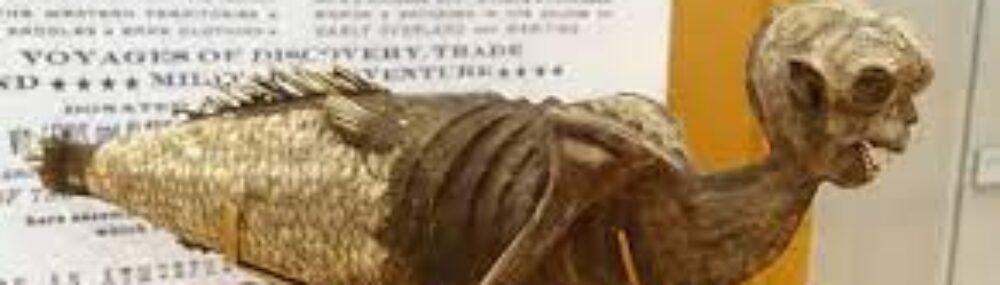
The story of the Feejee Mermaid hoax is a much lesser known figure in mermaid history which is ironic since this story takes place within real life. If the little mermaid depicts the mythical creature as more human than ever, then the Feejee Mermaid acts as an antithesis to the fairytale as she is presented as the most un-human like and therefore more monstrous. Very early on in the article “The Mermaid” This creature is established to be an animal not unlike the recently discovered platypus. The hoax of the mermaid lies not only within the fact that it is a fake specimen made of two completely different animals but it also dismantles the idea of the fair beautiful temptress that is the mythological mermaid. Within the same article that constantly attributes the title of animal to this specimen it also provides descriptions of its human features “It was a female, with ugly negro features. The skin was harsh, the ears very large.” (243) The language implies that the mermaid is ugly due to its “African” features. And further down it describes a second mummified mermaid, “It’s face is like that of a young female- its eyes are a fine light blue- its nose is small and handsome- it’s mouth small- its lips thin…but its chief ornament is a beautiful membrane or fin rising from the temples,” (243) Here the writer is describing a “Asiatic mermaid” the description focuses on the features that would be more pleasing to the western audiences. And so we can deduce that even amongst the “exotic” there is a hierarchy and it heavily relies on how close it comes to the western ideals of beauty. But even this “Asiatic” mermaid’s “human” half is less beautiful than the fins atop her head.
If the story of the little mermaid reveals the Romantic movements quest for understanding what makes us human, then the Feejee Mermaid reveals the racist history within the development of science. In treating both mermaid stories as archives that reveal western culture of the time we can get a better sense of how we end up recognizing the fairytale more readily than the hoax. That the Little Mermaid lives in our collective mind more presently the Feejee Mermaid demonstrates how erasure and re-writing a narrative operates within society.
Works Cited
Andersen, Hans-Christian. The Little Mermaid. Bacchilega, Cristina, and Marie Alohalani Brown. The Penguin Book of Mermaids Penguin Books, 2019.
The New York Herald. “The Mermaid.” Bacchilega, Cristina, and Marie Alohalani Brown. The Penguin Book of Mermaids Penguin Books, 2019.
Just tried out Sprunki Game and it’s a fresh twist on musical creativity! The expanded sound library makes composing feel limitless. Perfect for casual players who love a dash of rhythm and fun.
It’s fascinating how easily we fall into patterns when choosing games – even with so many options! Seeing platforms like 777pnl games offer diverse choices (slots, live casino, sports) could actually help break those habits, though! Quick registration is a plus too. 🤔
Scratch cards always feel like a little burst of optimism, don’t they? It’s fun to dream about what you might win! Speaking of easy wins, I checked out jlboss games online casino & their simple signup looks promising for quick entertainment! 👍
This analysis beautifully captures how 19th-century mermaid folklore reflected the era’s tensions between industrialization and romanticism. Just as gaming platforms like jl69 slot download blend entertainment with technology, these stories mirrored society’s navigation of progress versus tradition.