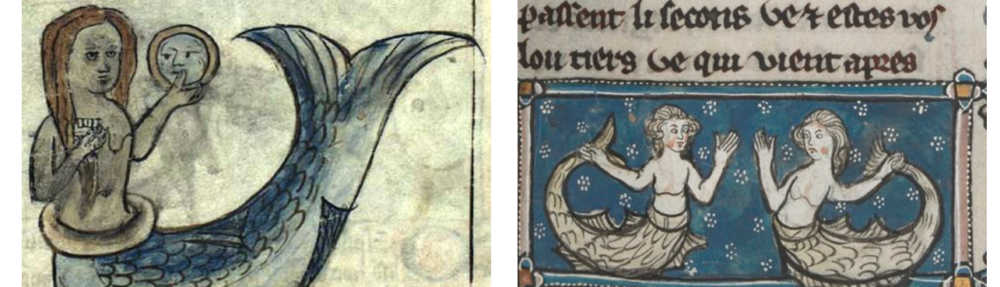
Odysseus and the Sirens
The tale of Odysseus and the Sirens portrays a message that is still relevant today. Through Ulysses’ encounter with the Sirens, the tale illustrates the human relationship between desire and self-control, arguing that pursuing your desires and curiosities with lack of self-discipline may come with consequences in order to persuade the audience to be weary of temptation and reconsider giving in. A close reading will be conducted on the following text to support this argument, “In flowery meads the sportive Sirens play, Touch the soft lyre, and tine the vocal lay; Me, me alone, with fetters firmly bound, The gods allow to hear the dangerous sound. Hear and obey; if freedom I demand, Be every fetter strain’d, be added band to band. While yet I speak the winged galley flies, And lo! the Siren shores like mists arise. Sunk were at once the winds; the air above, And waves below, at once forgot to move; Some demon calm’d the air and smooth’d the deep, Hush’d the loud winds, and charm’d the waves to sleep.” (Penguin 10,11)
The passage begins with describing the Sirens as being “sportive” or lighthearted beings that play soothing music in flowery meadows, depicting them as being quite the opposite of evil and rather innocent and peaceful. The next line immediately changes tone where the peaceful scene of flowery meadows abruptly switches to Ulysses himself alone being “fettered” or shackled firmly in exchange for the Gods to allow him to discover the “dangerous” sound, highlighting Ulysses’ strong desire to hear the Siren’s music which even the Gods acknowledge as perilous.
Next, Ulysses commands his men, that if he demands to be freed from his shackles, to instead tighten them and add more restraints. The reasoning behind this is the men know that the Siren’s song influences them to act irrational, the Siren’s influence on other objects is described later in the excerpt. Ulysses knows that when he hears the “dangerous” sound he will lack self-control that can potentially be fatal; forcing him to rely more on physical restraints than his own words.
The remaining text displays the scene when the “galley” or ship “flies” through the waterway and when the men finally encounter the Sirens. The word “flies” in the text indicates the ship was moving at an incredibly fast pace suggesting there were high and powerful winds at this exact place and time. When the men are met with the Sirens, the weather is described as calm, forgetting, sunk, quiet, and sleeping. These adjectives personify nature by giving it descriptions as “forgot to move” and “charm’d the waves to sleep” emphasizing the strength of merely the Sirens’ presence. The description of the Sirens written as, “Some demon calm’d the air and smooth’d the deep, Hush’d the loud winds, and charm’d the waves to sleep” solidifies their image that these beings have no good intentions, which no “demon” has. Beings that were earlier described as playing in the flowery meadows is now described as unhuman evil entities that possess power strong enough to alter the forces of nature. Yet, Ulysses knew what he and his men were up against and still, his eagerness to satisfy his curiosities was greater than his fear of facing death.
Although this story suggests that the mortals, Ulysses and his men, outsmarted these powerful demons, they had received the advice to restrain Ulysses and plug their ears with wax to avoid the Siren’s melody, from the goddess Circe. It is almost certain that without the help from the goddess, this voyage would have been the end for them. However, even though the end of this chapter of Homer’s Odyssey is positive, it can leave the audience skeptical to pursue their own curiosities and to think twice about surrendering to temptation, probably because they wouldn’t be as fortunate to receive advice from a god like Ulysses did.
Diving even deeper, although this story was composed in the 8th century B.C. it has been translated, passed down through generations, and depicted in several artworks possibly to impose religious influence on the audience. Aside from its mention of gods (Circe) and demons (Sirens), it reveals Ulysses’ temptation to seek out knowledge which is a prominent theme in religious stories including the Christian story of Adam and Eve and the Greek mythology of Prometheus stealing God’s fire for humankind, both resulting in serious consequences or punishments. Sirens having the reputation of singing ethereal songs filled with knowledge and accompanied by death could’ve discouraged the audience at the time from pursuing advanced knowledge (possibly science) in general. Why is this important? Throughout history religion has played a major role and even had its place of power in some governments, with the obtaining of advanced knowledge, works of nature once credited to God could now be given a logical explanation, ruling God out as a factor.
Obviously in today’s world, religion is not as “hardcore” as it was before. Now that we live in a society of advanced technology and logic, we rarely if not at all attribute works of nature or unknown explanations to God, and our hunger for knowledge is only expanding. One could argue that a prominent topic throughout the world now are natural resources and with our advanced technology we have learned to use these natural resources to our advantage in forms of paper, oil, lithium, coal, etc. When influencing natural forces was depicted as an unhuman power in Ulysses and the Sirens, society now seems to slightly possess the ability to do that as shown through the exploitation of natural resources. However, the desire and temptation to harvest these resources for our advantage may result in consequences in the form of pollution having a detrimental affect on climate change which poses a severe risk to all living organisms. Except unlike Ulysses, we don’t have a Circe to grant us some lifesaving wisdom.
Works Cited:
Odysseus and the Sirens, The Penguin Book of Mermaids, Penguin Books, 2019