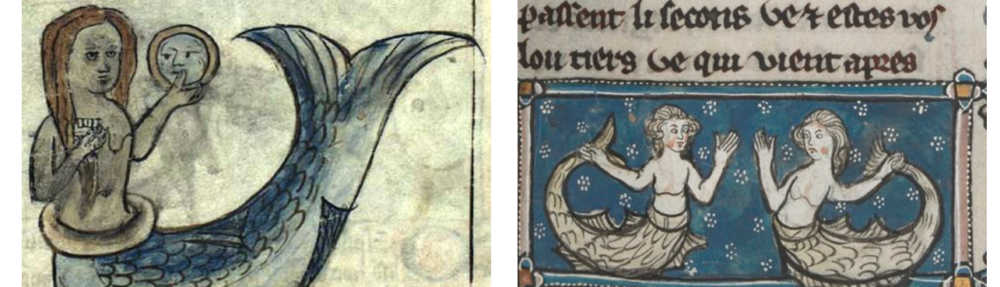
The Article “The Blue Humanities” by John R. Gillis takes the point made in last week’s reading of “The Trouble With Wilderness” by William Cronon a step further—narrowing the human-made idea of “wilderness” to one specific aspect of the environment: The Ocean. In what we observed from Cronon, we learned about how humanity constructed the idea of the untouched “wilderness” in order to blind ourselves to not only our misdeeds (pollution, loss of biodiversity, overconsumption) but our presence in every area of the world. There is no where to hide from ourselves and our wrongdoings, and we comfort ourselves through delusion. Gillis teaches us about the history of human’s perception of the ocean, once being overlooked, to being feared, to being a new place of solace—a new place to hide. Since the ocean, having been believed to be an empty abyss, was vastly unexplored, humanity was able to project their dreams onto and escape into the deep. He states, “Pristine nature, now in short supply in industrialized heartlands, found refuge in the oceans, while the mystery once associated with terra incognita relocated to the deeps.”, explaining the need to escape that affected a vast majority of people, specifically in urbanized environments, who were immediate witnesses to humanity’s destruction of the natural world. As industrialization became more developed, the world as people knew it began to shrink: in cities, as large buildings were raised and city limits expanded, there was less and less world to be found in the common space, and even in nature, as temperate forests were clear-cut to construct these buildings, life that was not polluted by industrial values disappeared. The only piece of the natural world that was left for people to grasp onto was the ocean, so much so “they want about them talismans of nature on their walls, their shelves, their keyrings.” (Paterson-Hamilton), to be kept as reminders of what life is still out there, life beyond the smog and concrete. But even those talismans are part of the grand constructed delusion, as the ecosystems that were reaped in order collect those talismans were forever tainted. In the hands of collectors desperate for comfort that there is still pure life out there, or in the lungs of swimmers desperate to be part of it, or in the literature of Atlantis that plays in the dreams of people who can no longer see the stars, there is hope that not all has been lost to consumption. But it is already too late, and unless those hopes turn into reparations, and we stop running from the reality of our impact, the problem will only worsen with ignorance.
Category Archives: Week 9: Introduction to the Environmental Humanities & the Blue Humanities
Week 9: Blue Humanities
“Early modern science knew much more about the heavens than about the oceans; and more attention was paid to extracting the wealth of the seas, namely fish, than to the waters themselves. All that lay beneath the surface—The Deep—was thought to be an unfathomable abyss, impenetrable and unknowable, a dark dead zone that trapped all that sank below the surface, never revealing its secrets.”
Reading Blue Humanities this week reaffirmed the idea that we really don’t know anything about the ocean. Most of what we know is either what we have explored (which is so minor compared to the percentage of the ocean that is undiscovered), or what we have created through our imagination. Similar to last week’s reading, we created an “aesthetic” of the ocean. What was once considered a scary unknown, is now an element of nature that brings serenity and peace to people. This shift in mindset and attitude towards the ocean and the wilderness in a way is kind of refreshing because I think it encourages us to be more protective over earth. Although preservation tactics and human consumption have been an ailment to nature, viewing natural elements in a humanly-beneficial way can motivate politicians and people in general to shift towards saving the planet.
Week 9: The Emergence of Environmental Humanities
It was interesting to learn in this week’s reading that the environmental humanities did not emerge until the 1970s and 1980s. The field is one that I personally find a lot of interest in and believe has assisted in many other fields of study and discoveries. “The environmental humanities has become a global intellectual movement that reconceives the relationship between scientific and technical disciplines and the humanities, which are essential to understanding and resolving dilemmas that have been created by industrial society” (Emmett, Nye, 4). This quote from the reading helps explain that point. Throughout time historians and researchers have used the humanities to assist in scientific discoveries. Art and literature play a big role in understanding history and are essential to learning about the past. This leads me to agree with the suggestion by arts and design advocates to shift the term STEM to the term STEAM. The arts contribute so much to science, technology, mathematics, and engineering and deserve to be appreciated and studied just as much. Without the arts, there would be much more unknown about history and the development of society. I believe that many of the progressions we have made as a society are credited to the arts and humanities which further surprises me that the environmental humanities were discovered so recently.
The reading also focuses on the term “resilience” and the idea of equilibrium. There are opposing opinions about whether or not resilience is a good argument and method for a sustainable environment. Resilience “suggests that a healthy ecological system is self-regulating and is able to adapt to external challenges within certain limits. A system, rather than being a balanced arrangement that has persisted for millennia, is always in a process of change” (Emmett, Nye, 20). This idea can be compared to the readings on Wilderness from last week. We spoke about the idea of humans living in balance with nature to create a healthier planet and ecosystem. This raises the question of whether or not we can live in balance with nature as people and if that would lead to more resilient ecosystems. The environmental crisis is important to address and I think the connection of “The Emergence of Environmental Humanities” with “The Trouble With Wilderness” can help us better understand it.
Week 9: Blue Humanities
Out of the two readings for week 9, I found the Blue Humanities one to be more interesting. This article discussed our scientific and conceptual history of the sea and how it has developed over the last few centuries. One part I liked was when the author talked about how with more analysis of historical sea documents, we have started to understand our changing perceptions toward the sea. Our view of the sea has primarily shifted from a more utilitarian and mechanical perspective to an aesthetic, modern, beautiful conception. This tied into some of our discussion from last week, when we talked about how the sea used to be only visited by people who went there for work, but it later moved into a more recreational activity for people as it became this beautiful, relaxing concept. Our interaction with parts of nature depends on our subjective value of the entity. This can apply to really everything; for instance, our social interactions with others will depend on our subjective value of the other. But even within our subjective values of parts of nature, there is variance between person to person. No two people see the world the same, as our worlds are shaped by personal experiences and our top down processing of the world creates a biased and personalized living experience. Take for instance–some people go into nature and take the ‘leave no trace’ method, while others destroy and litter. All depending on subjective value. But it is interesting to see when these perceptions of the world are something that are the same from person to person–this shift from a utilitarian ocean to an aesthetic ocean. Mediums such as stories and paintings are fascinating to analyze because of how they may affect the viewers and change their own perspective of the world. How much of our reality is actually real, and how much of it is influenced and made subjective? I don’t believe anyone can truly see the world in objective eyes. I wonder what other parts of the world that we disregard may become more ‘aesthetic’ to us, or the reverse. Will the ocean become less aesthetic and beautiful to us as we discover more about it? Or as environmental pollution/destruction ruins it? Will we have places on land, similar to aquariums, that mimic what the ocean used to be like?
Week 9: Blue Humanities
In last week’s reading we have learnt that recreation at a sea has only become relevant, because humans have culturally produced the sea to be a place to go to take a break. I was reminded of that and saw correlations between the article “Blue Humanities” and last week’s reading. As being said in Gillis’ article, “nations turned away from the sea as a place of work that writers and painters turned their full attention to the sea itself. They turned it, as never before, into a place of spiritual and physical recreation […] they gave it new cultural status, a higher aesthetic power” (Gillis). What I found to be interesting about that, is that this transformation once again reflects broader shifts in societal values and attitudes towards nature and the environment. Apart from, it resembles people’s desires in an ever-changing world (the time of industrialization). Now that industries developed and people moved to the cities, they also got disconnected to the natural world. The sea thus got romanticized as a consequence and beach activities first got developed, “It was in the era of the thoroughly landlocked industrial revolution that the sea first became a part of mainstream mainland culture”. The middle class of the late 18th century was looking for an unknown natural place, far away from urban cities, to call their new place of recreation.
Another interesting aspect I found in the text is that the sea “became a symbol of eternity, a comfort to those who, having lost their faith in divine dispensation of everlasting life, came to see in its apparently timeless flows evidence of nature’s immortality and a secular promise of life everlasting”. Through what is shown above, one can argue that some of the late 18th century people started to lose their faith in religious concepts of eternal life. Looking at the sea and seeing the waves and tides come and go, gave the people a sense of security, knowing that now nature is immortal.
Week 9: Blue Humanities
In the blue humanities reading, the author showcased how Western attitudes towards the sea/ocean changed over time from disinterest and fear to one of fascination and awe. This mimics the attitudes that individuals held towards the “wilderness” as the cultural values associated with both these natural spaces changed to suit the desires of a western audience. I believe that the coast and sea shore itself became a kind of frontier myth for those living in the 19th century. In both the terrestrial and aquatic frontier myth, people looked back to these places as a romanticized version of the past. In the reading, the author states that, “pristine nature now in short supply in the industrialized heartlands, found a refuge in the oceans…Simultaneously, the sublime, previously associated with mountains and forests, came to be associated with the wild water.” In this quote, the author is mentioning how people are once again searching for a space that is untouched/unaltered by humans which is highlighted by the addition of the words ‘industrialized heartlands’. This phrasing positions the sea as something that people saw separate from them and because of their separation, there was a type of sacredness to it, which matches the sacredness that people felt towards national parks. The use of the phrase ‘wild water’ is interesting as well because the water is being personified and altered to fit this idea of untouched wilderness even though people had utilized the open ocean and other bodies of water for hundreds of years.
Humanities: The Journal of the National Endowment for the Humanities. Web. 2013
Week 9: Environmental Humanities
I found the reading on environmental humanities extremely interesting because it brings up a lot of the themes that we have been discussing in class and has also introduced me to some new ideas. An idea that enlgihtened me was that in order to solve the climate issue, multiple disciplines need to come together to create a solution. I have heard a variation of this idea before, but it was a more political version. The idea was that scientists needed to come together with community members in order to create specific solutions for that city, state, etc because community members know what they need and what would work in their specific area better than politicians or scientists who’ve never been to that area. But this reading is a lot more inclusive because instead of just limiting it to scientists coming up with a solution, it suggests that a wide variety of people from different academic backgrounds need to come together. I find this fascinating because it seems like such a simple recommendation, but is so revolutionary because of how Western culture separates academic disciplines in order to make it much harder for them to mix.
Another topic I found fascinating was that recognizing humans as being a part of nature could help with establishing a solution to the environmental crisis. A portion of the text mentions how humans play an active role in nature and that needs to be recognized if we are ever going to come up with any sort of solution or make any progress. This reminded me of the conversations we’ve been having in class the past few weeks because we tend to think that we are above nature but that way of thinking is what has allowed humans to harm the environment in the first place. Emmett and Nye explain that humans need to have a mindset shift so that instead of viewing “animals and plants in terms of their usefulness to humanity, we can see them as having an intrinsic right to exist” (2017, p.11). Thinking of the environment in this way changes our perception of the world from revolving around humans and instead places us on the same level as animals and plants. As much as we have a right to exist in this world, so does every other living organism and that is what makes our world function properly. I wonder if keeping this idea in mind when thinking about solutions for the climate and environmental crisis will produce more effective or safer results for the environment and us.
Week 9: The Blue Humanities
This week reading was interesting and something that I was fond over because it showed the variety of ways in which the ocean/sea is used. Not in just a personal way, but to learn history, in other fields of study, also in literature and arts. There were several points that were made that had caught my attention but one that resonated the most would have to be in the last paragraph. “The manner in which this occurred and the significance it holds for modern culture and society is only just beginning to dawn on us.”. I thought the word “beginning” was impactful as it is implying that we do not know as much as we think we do, there is still millions and probably billions of things we don’t know about the ocean, but the curiosity of humans has caused this start to learn all those little bits of information that make up the ocean. I also believe the word “beginning” is being used to show the shift in which society has taken to the view they have of the ocean; we went from being fearful and almost terrified of the unknown water, to now finding a comfort of the ocean even just by viewing it from a distance.
Another point that stood out to me was, “people began to come back to the sea in search for a quality they felt to be missing in the new industrial environment, that something called wilderness.” (paragraph 10). Speaking from a personal perspective, I never truly saw the ocean as wilderness or nature since it has always just been classified as a separate but special place in my mind. When I think of nature, I automatically start to imagine the forest with trees, wild animals, in almost isolated places to be nature as it provides a reflection area for humans to reconnect to themselves. Being able to reflect and read that the ocean provides the same feelings and purpose as a forest does, in my head does classify it as nature. It is a space that provides us with more than what we need to be able to regain our own self-identity back when our day to day lives are drowning us and not allowing a simple break.
Overall, I do believe that our attitude change towards the ocean is what has caused us to be able to create career fields in subjects like marine biology, led to the knowledge of what we have now of the ocean, given us more opportunities to study the ocean further, gives us what we need for everyday living like food, but also are a significant factor of the personal comfort we gain that does not compare to other forms of comfort. There is more to thank the ocean for than we realize as it has always been a home for many in the times that we longed somewhere we felt like we belonged.
Week 9: Environmental Humanities
For this week’s reading I found it to be quite interesting and thought provoking to be able to have perspectives on environmental humanities. I have often heard this term of environmental humanities but I have not known much of what it is about and throughout the reading I was able to get the general idea of their purpose. They “Show how humanists are improving our understanding of the problems and contributing to their solution … humanists must offer constructive knowledge as well as criticism” (Emmet & Nye page 2). It is more about just giving the public data and numbers to display the negative effects humans have caused to the Earth and about global warming. We all know that the Earth is damaged but they focus more on deepening the public’s understanding of the issue of the negative impacts humans have on the environment. I noticed as well the influence of gender in the reading and the idea that nature, similar to women, have suffered in the hands of men’s desire to control others and everything; “They pointed out that the very idea of humans standing outside of and controlling nature was based on a conception of the natural world that was passive and feminized … Apparently neutral terms such as “man and nature,” though they still appear in policy discussions of climate change, often have masked unequal social relations and exploitation of resources” (Emmet & Nye page 4). Also I noticed that the main theme of the reading and thus connects to the purpose of the class is the idea that man and nature need to live in harmony with one another, cause in the end we are sharing this land with “non-humans” as well, and maybe shifting our ideas and tactics to a more “feminine” and nurturing nature; “Such a new ethic requires a new narrative. This new story, “would not accept the idea of subduing the earth, or even dressing and keeping the garden, since both entail total domestication and control by human beings. Instead, each earthly place would be a home, or community, to be shared with other living and no-living things” (Emmet & Nye page 6).
My question is, how do we incorporate these new ideologies into the school curriculum, and change years of past ideologies from others?
Week 9: Environmental Humanities
“Human beings are not independent of the natural world, but are part of it” (pp 10). We’ve been exploring this topic a lot in our readings and it is so interesting to me the different perspectives people have about it. I think it is important to recognize our interconnectedness to nature in order to have a good relationship with it. We ultimately rely on natural processes to support our lifestyles, but still choose to disrespect the world around us. The mindset that we are separate from nature has led to pollution, the exploitation of natural resources, and habitat destruction. These impacts effects not just the environment but also human lives, which seems ironic to say considering they’re both interconnected parts of the same system.
The concept of human mortality and our place in the natural world is viewed differently from groups, as some ideas don’t align with their beliefs. In the reading, it talks about how some conservative Christians don’t accept the theory of evolution, so their viewpoint is more from the idea that animals are a separate entity of the natural world than humans. According to this perspective, humans are not simply products of evolution but are intentionally created with a divine purpose. They possess rationality, morality, and free will, which are seen as reflections of God’s nature. This view emphasizes the special relationship between humans and God, which may suggest that humans have a higher status and purpose than other creatures. Although some viewpoints may be different between religious teachings and the environmental humanities, I like how the reading points out that they can and are still in support of environmental humanities. Using the Garden of Eden as an example is insightful, as it has traditionally been viewed as Adam and Eve having dominion over the land. In the reading, it suggests that we can instead view it as an ecological system that they were responsible for. This aligns with the idea that we have a responsibility to coexist with other species and ecosystems. By reframing the relationship between Adam, Eve, and the Garden of Eden in ecological terms, the perspective switches to a more conscientious approach where we are not separate from nature, but a part of it. I think if people were able to think about these traditional stories from their original interpretations, it could invite them to think about our role in caring for Earth and can help promote ecological health.