Week 6: Thoughts about Undine

I found the story of Undine entertaining. I am starting to notice some similarities between these mermaid tales, especially between this one and Melusine. First, both stories mention that the mermaids are under some spell or evil, for Undine it was having no soul and Melusine a serpents tail. Second, both women are required to find a man to marry them in order to break the “curse”. Third, both stories end in some tragedy stemming from the man betraying the woman in some way, haven’t read a tale where the woman betrays the man, yet. Fourth, both women lead the man to a body of water. I find the requirement of a man marrying a woman to save her quite interesting because it kind of shows that a woman is dependent and needs to be saved. I can see how this relates to Christianity because I know marriage is a big thing in religion, (weddings are often held in churches with a pastor) not to mention that Undine was written by Christian minister, George Macdonald. In Undine, a part that caught my attention was Huldbrand’s foreshadowing dream, “…disguise themselves as beautiful women, and from beautiful women, they all at once assumed the faces of dragons…” (pg102). I get that this piece was a foreshadow to Undine’s true nature, what I don’t get is why in every one of these tales it’s beautiful women who are seen as evil. I’ve never read a woman who’s described as “unappealing” of committing these acts of deceit. If I were to live in those days, these tales would have me question every beautiful woman’s intentions/nature, I wonder what the reasoning behind this is. 

Week 6: Freakshows and Fantasies – The Confirmation of Merpeople

I found great interest in this week’s reading in “Merpeople: A Human History”, Freakshows and Fantasies. I was very intrigued by how the belief of merpeople spread throughout the United States and London. Most of the stories we have covered so far take place on different continents, such as France (Melusine) and Tamriel (sirens), which has led me to believe that the merpeople did not have an origin in a place like the United States. The ideas and beliefs of merpeople were spread widely through newspapers. Cities such as New York and London used newspapers as the primary way to spread news throughout their area. This intrigues me because most people during this time were learning about mermaids through the news. This led these people to believe in mermaids before they were even given any proof of their existence. Newspapers were publishing many hoaxes when it came to mermaids but also featured sightings. I am wondering how readers distinguished what they believed with such contradictory stories coming out at the same time. This has also brought me to connect this time with the period we are currently living in. The media has always had a large effect on people and what they believe.

I have also found great interest in P.T. Barnum’s influence on mermaid confirmation. Barnum was known for taking “freaks”, or non-conventional people, and putting them in a show. I find it interesting that he “imploded belief in merpeople” (128) when he was such a believer in the unknown. I would like to do further research on Barnum’s belief and interest in mermaids and learn about the effects that had on people during the time.

Week Six: The Fejee Mermaid Hoax

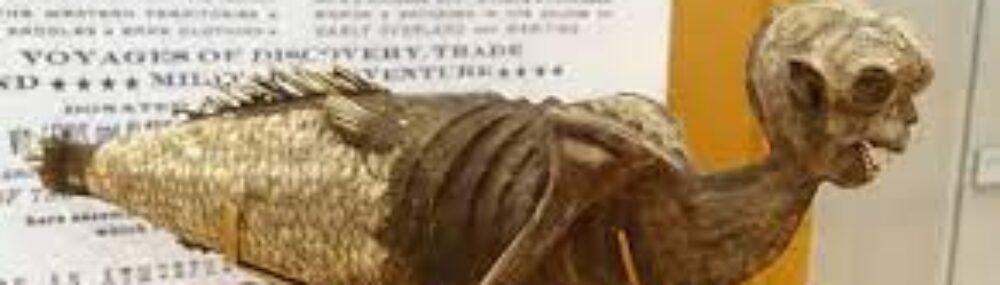
This week I decided to focus more on The Fejee Mermaid Hoax (Penguin Book of Mermaids) and it made almost a guide to how I would want to structure my discovery assignment to go. The way in which this one story has let so many other mermaid discoveries come to light was impactful but also made me wonder if there are so many people claiming what they have seen, why would it still be a debate? Throughout the pages we were supposed to read it was giving clear examples from different years and locations in which mermaid sightings took place and somewhat of a description of how exactly it happened. The last paragraph on page 243 in which there is a description of a Asiastic mermaid in London 1775 was able to describe them but in the way they didn’t want the mermaid to look human and even though she had clear human characteristics I felt as if they were almost trying to portray her as ugly so society can still feel fearful and possibly not confide in what was being said? They would describe her characteristics she held which all sounded human but made sure to incorporate her fishlike features just like “It’s ears are like those of the eel, but placed like those of human species,..” (page 243) which was strange because if they were originally being described as creatures who are human from the waist up and fish from the bottom down, how is it that these features are able to mix together if there has been a divide in their physical traits?

One of the important questions that resonated with me was the way in which there were connections between different species of animals which led to the question of, “…why may we not supposed that there is also a connecting link between fish and the human species?” (page 241). This was the point that made me even question and realize the similarities between so many animals and why is it that I couldn’t make those connections between humans and mermaids? My entire life the only mermaid figure I knew and loved was Ariel from The Little Mermaid but the Disney version which I don’t think truly represents the entire mermaid culture from what I have learned from this course. Knowing the picture of Ariel I have always had in my head and us as humans I was never able to piece how we are both similar in many ways because I felt an important point I learned as a kid through this movie was almost to fear the ocean since mermaids or other creatures that appeared from this movie live there and can cause problems, which almost delayed my realization that humans and mermaids are more connected to each other than society cares to acknowledge. This one section has sparked my interest to truly find or hopefully find any sort of bigger connections that human and mermaids but also the ocean have in common with each other, or even how it forms a cycle between each other.

Week 6: Undine and Marriage

The way that the story of Undine discussed marriage was very telling about the way that women were looked at during this time. Throughout the section of the story that we read, how Undine changes and defers to her husband shows how women, no matter how powerful they might have been before, needed to become secondary to their husbands. I first noticed this when the story mentions how the three people who knew Undine best were waiting for “some whimsical vagary of her capricious spirit [to] burst forth” (pg. 102). The paragraph goes on to mention that she was “mild and gentle” (pg.102) which is a complete change from her previous personality. This change only comes the day after she is married to the knight Huldbrand, which hints that marriage has caused her change of spirit. The shift in Undine has two different representations because she is both a woman and a water spirit. I believe that calming her personality can represent men taming both women and nature. This story places men at the top of all hierarchies, they are the ones who control the estate and can impact how nature itself acts. During the 19th century, the man was the head of the family and the woman was supposed to answer to him, but this show of power was also extended to nature in some ways. As a water spirit, Undine acts like water, she’s unpredictable and wild. But once she is married and gains a soul, she calms and is “tamed”. Huldbrand notices this when they go to a stream and see it “rippling along in gentle waves, without a trace of its former wildness and swell” (pg. 103). Since Undine can control a certain body of water, that water would represent how she is feeling and her personality because it is an extension of her. In this case, this stream represents Undine and her new disposition. Before being married, the stream and Undine were free and wild, as nature tends to be, but after they are both subdued. This shows that men at this time were trying to find ways to control women and nature.

Undine

While reading Undine, it is evident that there are some parallels between human and non-human relationships amongst various mermaid stores. It is interesting to me that most of these tales of love pertain to a female mermaid and a male nonhuman and their attempt at romance. If we are supposed to be learning a lesson from the patterns, it is understood they don’t mesh well. I am curious to know how dynamic character development will be surrounding these relationships. Will human non human romance always fail? Don’t mean to make a generalization, but from analyzing the texts we have already read and the films we have watched we can gather this as a common theme. Having talked about the idea of love and the different perspectives we create that come from influence, I am eager to see if these ideas connect. To be even more abstract, does the love fail in order to prove Undine’s connection with the natural world is too strong? She exclaims how the natural world is and “wonderful salamanders glitter and sport in the flames: lean and malicous gnomes dwell deep within the earth: spirits, belonging to the air, wander through the forests: and a vast family of water spirits live in the lakes and streams and brooks”(p. 104).

Week 6: Anthropocentrism in Undine and The Little Mermaid

Something I noticed within the stories of Undine and Hans Christian Andersen’s “The Little Mermaid” are how anthropocentric these stories can be, especially when it comes to seemingly-simple concepts like tears and the human soul.

Undine tells Huldbrand that “there is one evil peculiar to [nature spirits]” (103) and this “evil” refers to the fact that nature spirits like her have no soul. Because of this, when they die, they are simple reborn back into the cycle of life on Earth rather than passing over into the afterlife, as human souls do. Undine goes on to say that while it is a satisfactory existence to live through, “all beings aspire to be higher than they are,” (103) which is essentially what drives her father to seek out a human for her to be wed to and thus gain a human soul in order to become a higher being than that of a spirit.

Anthropocentrism refers to the ethical belief that humans alone hold intrinsic value and hold power and importance over everything else in nature. Much of European/Western thinking tends to be very anthropocentric, especially with the ideas of “conquering the land” and seeing nature as something to be tamed rather than worked with. The concept of humans alone possessing souls and animals and nature possessing none is also an idea upheld by the Christian church. By placing the possession of a human soul as being above that of a powerful nature spirit, the character of Undine directly promotes these anthropocentric, Christian ideas.

Week 6: The Mermaid Craze

Although I wanted to touch on the idea that this week, at least in the section we read, we finally see a cute love story between a man and mermaid, the overwhelming amount of aha moments I had reading about the mermaid boom essentially warrants its own blog post. The readings pertaining to “The Feejee Mermaid Hoax” (Penguin, 239-244) and “Freakshows and Fantasies” (Vaughn Scribner’s Merpeople) opened my eyes to the answer of why humans are, and have been, so fascinated by mermaids for centuries. As we’ve been reading throughout this class, mermaid tales have been told and recorded for a very long time but I think the Feejee mermaid hoax boosted its popularity for the 1840s. This showman was able to gain a lot of traction on his “discovery” as the Enlightenment was not too far before this time; an era of new thinking and ideas, surely a hybrid human would take the worlds interest with both hands. Although, like we all know, this discovery was a hoax, it did the job on captivating the world once more of this hybrid creature as one of the papers covering the story only discusses the Feejee mermaid in its’ first paragraph while “—the rest is essentially a chronology of mermaid sightings” (Penguin, 240), sparking conversation once again.

Then the transition from learning about this worldwide hoax to reading chapter 4 “Freakshows and Fantasies” you get a clear understanding on how curiosity and curiosities were able to captivate the minds of many people around the world. During this era, 1800-1850s, many Americans were certainly advancing as a nation but still had much to learn as they introduced coal powered engines but weren’t wearing gloves for surgery until a bit later. Therefore with this sort of contradicting, mindset era, playing out the idea of a hybrid beast being out there, but not actually seeing it was somewhat more close to reality than it might be today. Also, the press had a big factor in the culture of this time; there was no Internet, so the newspaper was as bad as real factual information you could receive. Therefore, if the newspaper said there was a mermaid sighting then maybe there actually was. This chapter also mentions how even in the scientific third wave of this mermaid craze people still hoped “—for a brief escape from their hard realities of their daily [lives] more than a peek into mystical wonder.” That quote says it all: essentially we have used this mermaid symbol to teach, to push religious values, to warn, and now for an escape. The mermaid wether it be real or not physically never ceases to legitimize that creative, wondrous spark of hope in our minds and hearts. That’s why myths and legends weather they’re real or not, are able to craft morals and values because of the magical element they hold, and therefore mesmerize a reader.

Week Six: Undine

When doing this weeks reading, I was very interested in the deception of Undine and her knight suitor Huldbrand. When the tale begins we get background into their relationships, and how it ends with Huldbrand leaving Undine for Bertalda, another human. This is the ending we get from the other version of the tale, but as I went on to read the start of the story it was different. Undine and Huldbrand did get married, he did not quite betray her in the same way. Except in this depiction of the tale Undine tells her new husband what she is, a mermaid adopted by humans, and he accepts her. One line that stood out to me was “All rose to meet her, and all stood with surprise, for the young wife seemed so strange to them and yet the same” (102). This quote is referring to Undine meeting her knew husbands friends and family- it seems- after they are married, so they were taken aback by her appearance. It is unclear why, but I believe that maybe it’s because of her being a mermaid and they can somehow sense or feel that she is different from them. It might not be apparent to the eye, but they can feel that Undine is the same as them but different as the same time. This stood out to me just because I think that if they had seen her mermaid form, they might be more astonished than repulsed. Another aspect of Undines story that intrigues me is her description of not having a soul because she is a mermaid. “Our condition would be far superior to that of other human beings – for human beings we call ourselves, being similar to them in form and culture,- but there is one evil peculiar to us……Hence we have no souls” (105). This was Undine describing why mermaids feel a connection to humans, or sometimes group themselves in the same categories. I thought this was an interesting connection between the two and how humans and mermaids have similarities. Undine describes her desire to have human experiences, a big part of why she fell in love with her human husband. the struggles she describes how the elements move her – mermaids- and they have no souls, is why she desires so much to have a connection with a human soul, like Huldbrand. Overall, I found her story to be quite sad, and I pity that her affection she craves so badly from the human world. Although she gained a soul by marrying and falling in love with her husband, it still seems bittersweet to me.

Week 6 — Freakshows

This week, the reading that stood out to me most was the chapter “Freakshows and Fantasies” by Vaughn Scribner. This chapter was interesting because it didn’t necessarily contain any mermaid stories, but instead described the evolution of the term through the detailed accounts of mermaid sightings in the early 1800s. Interestingly enough, Scribner uses contradicting terms throughout the whole passage to demonstrate the opposing views of merpeople that have laid the groundwork for economic benefits associated with mermaids today. Scribner contrasts the differing approaches as: “science and wonder” (129), “discovery and superstition” (131), “scientific credulity and capitalistic profit” (131), and many others. Viewing merpeople from these two opposing perspectives can show how rapidly it gained attention and ultimately resulted in large profits in the economic sector. Bits and pieces that stuck in original works were pulled and reused for similar symbolic purposes, but the flashy bits that attracted coin seemed to be the most prominent.  This also shows how the concept of merpeople has changed over time to reflect our present day values as these concepts sell the best. In the 1800s, the attractive bits were sexualizing women with a large bit of emphasis on the male gaze. Originally, mermaids had been used by the church to signify our temptations/desires as things to avoid, while present day mermaids are used by large corporations to represent body positivity and acceptance. Both of these views result in large profits, however there is a large disconnect between what merpeople resembled 300 years ago and what they resemble today; it is simply a reflection of society’s values and morals. 

Another interesting little bit about this reading is that one of my favorite types of wine is called Freakshow, by Michael David. And for comedic purposes I went and looked at the label of wine and low-and-behold, it was a mermaid on the cover! Here’s the link!

Week 6: Undine

Right off the bat I can see the similarities between Undine and Melusina: two water spirits/mermaidesque creatures who get married to mortal, human men and then eventually reveal their true selves. But it deviates because Undine willingly revealed it to her husband, whatever his name was (Huldbrand?) after they had gotten married. There’s still that strong element of The Other infiltrating (through the dreams): “Wonderful and horrible dreams had disturbed Huldbrand’s rest; he had been haunted by spectres, who, grinning at him by stealth, had tried to disguise themselves as beautiful women, and from beautiful women they all at once assumed the faces of dragons….” (102)

This could be some sort of premonition, but also to me it reflects the fear the patriarchy has with women who are also pretty. Thats a very surface level interpretation, I know. At the same time, I think it’s also a reflection of how people are afraid of their true selves, or the true selves of other people. That there is a nasty side, a dangerous side. There’s a huge contrast between these really scary nightmares Huldbrand is having, and then how pretty and dainty and lovely Undine is. It could be a testament to how the true nature of things is something people fear? Coming back to comparing Undine and Melusina, the thing they have in common is this fear of the Other, even when a couple are married. Discovering your wife (because we have only seen stories where the wife is a Creature and not the husband) is not what she seems is a reoccurring thing.

Also side note: very interesting seeing this story and having played Undertale becuase there is an NPC called Undyne who is a fish monster (could you call her a merperson?) who is the literal opposite of how Undine is described in her folklore. Interesting to see how meanings deviate or how people take inspiration from old things and make them into new things.