Week 4: Water Beings and Betrayal

In the readings assigned for week four, I couldn’t help but notice the reoccurring themes of betrayal of the female gender. Starting with the myth of Sedna, the Sea Goddess of the Innuit. Even though the logic behind the creation of a sea goddess and its creatures out of two cold murders committed by the same man who is the father of Sedna doesn’t make that much sense to me or why she would help men after being betrayed and lied to by the two most important ones in her human life. At least she had sort of a happy ending with the help of shamans combing and braiding her hair to appease her. I would also like to add a thought about this story, Sedna’s father threw her off the boat due to thinking the birds wanted her, but let’s be real, the birds were seeking the father’s blood. This could be a representation of the male gender in history always assuming that when consequences for their actions are catching up or something goes wrong it’s because women had something to do with it, which has resulted in many women having the same fate as Sedna (except turning into a sea goddess).

In the story of Kaliya the Snake, he is introduced as an inferior power of Krishna who is filled with rage, why is this? Further into the story, it is revealed that Kaliya resides in a section of a river that is causing diseases to those that need water after being defeated by Krishna and kicked out of his anterior residence, the ocean. After another humiliating defeat to Krishna, Kaliya and his wives beg for his life, “The race of snakes into which I was born is a cruel one; this is its proper nature. But I am not at fault in this matter, Acyuta, for it is you who pour forth and absorb the whole world; classes, forms, and natures have all been assigned by you, the creator…” (Bacchilega & Alohalani 8) Kaliya never had a chance to be portrayed in a good light, since his creation he was doomed to be seen as a monster, because of Krishna’s decision, to me this is another form of betrayal.

Reading Response Week 4

When reading more of the Penguin Book of Mermaids, I found it quite intriguing once I got past the introduction. The first story I read was Oannes, which was an interesting perspective from Babylonia where they discussed a Merman. I thought the relationship between the Merman and the people of Babylon was intriguing given it seemed to be such a peaceful relationship between the humans and Merman. He brought them insight into the letters/sciences, and other types of artwork that were unknown to them. It was a dual benefitting relationship. The story describes the merman as conversing with humans in a normal and beneficial way, which is not usually the narrative set in place when talking about the relationships between Mermen/Mermaids and humans. When moving on further into the book The Tuna of Lake Vaihiria, was one of my favorite stories for this weeks reading. When the princess Hina had found out that she was the be engaged to the Eel King, she immediately went to look for help from the Sun God. As the sun god was able to kill the Eel King he told her “He chopped off his great head, which he wrapped in tapa, and presented it to Hina,saying: Hold this and put it not down an instant until you arrive home; then take and plant it in the center of your mare ground. This eels head contains great treasures…” (16) As this continues we realize the significance of the eels head, and when Hina accidentally puts it down to swim, it sprouts the tree and its treasures. As the story goes on an Hina settles in this area, she meets the two sons, one which she marries. It seems is tragedy is connected with Hina, since she lost her first husband, married the other, and then lost a daughter. It was interesting to hear the story with the significance of the eel head, and how it affected the rest of Hina’s life. It also intrigued me because of the difference in stories, and how this one didn’t include a mermaid, but a different kind of “Monster.” Overall, I really enjoyed getting more into this reading and learning about the different cultures and the myths/stories that they share with us.

Week 4: Reverie, Not Repulsion. Sedna, a piece of Mother Nature.

One of the kinds of stories that never fails to move and deeply impact me are those revering a woman’s ability to give life.

 In not only many works of literature, but also in disgusting, widely held beliefs, a woman’s fertility is seen as something to be dominated, used against her; that the ability to give birth makes her weak, the lesser sex, and inherently characterizes her existence as one meant to be lived in service to a man—bearing his children. This degradation of a woman’s existence and objectification of her body is prevalent in the historical summaries of the western/Christianized works of mermaids we’ve examined in this course so far. We’ve learned about the various tales told of sea women being ripped from their homes and forced to marry their assailants, having children they didn’t want and couldn’t comprehend loving—as they were not only born of suffering, but estranged from her nature as a sea creature, or maybe even used as a means of chaining her to land by leveraging a mother’s need to be with/protect her children (if the mermaid is even capable of feeling any love for the life they were brutally forced to create). The Inuit story of Sedna circumvents this pattern in a refreshing, glorious way.

 Firstly, in this tale, the “mermaid” (though Sedna was a human before she was cheated first out of her freedom, then out of her life) is the victim of abuse, not the men she interacts with. The suffering imposed on her was not justified by the story, but scorned—unlike the tales that regard mermaids as inherently sinful creatures that deserve their cruel treatment. The story is about a man’s deception and not a woman’s; deviating from the western belief perpetuated by the church that women are inherently untrustworthy and predatory. This makes sense, as the Inuit were not touched by Christianity, and therefore, did not absorb their beliefs. Not only was Sedna betrayed by the man who married her, but she was betrayed by her father as well. One of the most disgusting and stomach-turning events to watch or hear is a parent turning on their own child; It is a corruption of the title “parent”, an adulteration of nature. This brutality incites a feeling of heartbreak and disgust, serving to scorn the maltreatment of women—to empathize with a woman’s pure love being used against her. 

But although Sedna’s love was leveraged as a means of harming her, or betrayed by the one man whose love she was promised she could rely on (her father), she does not turn to cruelty, nor morph into a creature symbolic of her anguish. Instead, beautiful, innocent life is born from her blood and pain; she fills the sea with creatures that exist as the lifeblood of her people, that they rely on to nourish them. In this way, Sedna becomes a form of Mother Nature, both revered and depended on for her fertility. She has the power to control what she allows others to take, and she is worshiped for it. When she becomes angry and refuses to send life to her people, Shamans turn themselves into willing sacrifices to go provide the care she desires so that she may be satisfied and return such care. It is almost an act of appreciation for her work. 

Sedna’s ability to give life is not regarded as something to be taken from, but to be blessed with. In a divergence of cultures, some worship Mother Nature, and some see her as something to be dominated; a fact made very apparent by the difference of the Inuit story of Seda and the predatory illustrations of Christianity’s mermaids. The very cultures that abuse mermaids moved on to abuse and take from Mother Nature, whereas those that celebrate the creatures live in reverie of the environment. I’m excited to read more stories such as this one, that fill me with joy and not heartbreak; that share in the appreciation of women and their blessed connection to Mother Nature.

Week 4: Oannes, Yorgos Lathimos’s “Poor Things,” and My Need for More Not-Mermaid Mermaid Movies

Last Friday, I decided to head over to the Fashion Valley Mall right after class to catch a movie as a sort of treat to myself. The movie I ended up watching was Yorgos Lathimos’s “Poor Things,” starring Emma Stone, Willem Dafoe, Marc Ruffalo, and Ramy Youssef. The movie was based on a book by the same name, written by Alasdair Gray, which depicts the adventures of a woman named Bella Baxter, who has the brain of an infant but the body of a woman in her 20s-30s, and her coming-of-age journey of self-discovery.

Initially, I was drawn to the Frankenstein-like premise of the movie because, besides all things mermaid, I also love all things Frankenstein. Of course, the movie delivered on that end–Willem Dafoe playing a doctor named Godwin Baxter, altering and reviving the corpse that would become Bella Baxter and the inevitable parental issues that immediately followed.

What I did not expect was how mermaid-y the movie was, despite not being explicitly about mermaids. Bella, played by the brilliant Emma Stone, is your quintessential mermaid-turned-human–a fish out of water, with long hair and a thirst for knowledge, curiosity in spades, and possessing no desire and making no attempt to blend in with polite society and its arbitrary rules and regulations. Marc Ruffalo’s character, Duncan Wedderburn, is your typical human man in a mermaid story. His presence in the movie irked me to no end because of how presumptuous he was to think that he could handle Bella’s quirks and curiosity, but gladdened me to see his attempts to control Bella and quash her thirst for knowledge did not come to no fruition but instead frustrated him to the hilarious level of absolute loser.

It was Bella’s desire to seek more knowledge and her ability to retain that knowledge that clued me in on the mermaid-y qualities of the movie, as it reminded me of the Babylonian water spirit Oannes. According to The Penguin Book of Mermaids, in Babylonian mythology, “hybrid creatures are associated with the sea are holders of knowledge,” especially in the case of Oannes. (Bacchilega, et. al., 3) Oannes gifted humans “insight into letters, and sciences, and every other art” essentially teaching humans “everything which could tend to soften manners and humanize mankind.” (Bacchilega, et. al., 3) Throughout the movie, Bella’s curiosity is seen as a boon to both the viewers and the characters around her, questioning societal norms and actively seeking ways to improve herself through the acquisition of more knowledge and improving others by sharing said knowledge. The best part is that the movie rewards Bella’s curiosity by allowing characters to exist that accept and encourage her desire for more knowledge and even open themselves up to acquiring more knowledge for themselves.

All in all, it was an incredible movie and I hope it comes out on-demand or on streaming platforms soon so I can watch it over and over again and relish in my newfound love and desire for more not-mermaid mermaid movies.

Week 4

The Legend of Sedna the Sea Goddess

I’m not sure how to describe the tone or diction of the translation of this legend, but it seems somewhat pedestrian or matter-of-fact. After our discussion in class last week, I started thinking about the difference between the Western tradition of writing things down (like the Bible), and a collection of chronological and organized stories into a whole book that is cemented in physical writing. The tone of this text helped me realize the distinction because it’s a legend that isn’t necessarily part of a larger work of texts. It’s also a story that “varies from one region to the next” (Moore 9). I like that Moore added this detail because it lets the reader know that there isn’t one exact version of the story. That variety is cool because it adds some diversity and individuality to the storyteller. For example, maybe some descendants of the Inuit describe the story differently from others. I think that’s pretty cool to think that there are people with their own interpretations and ideas about a similar story. To me, this juxtaposes the ideas from Western culture that are somewhat rigid, without much room for individual interpretation. For example, as a member of the Roman Catholic Church, I was taught the same (or likely very similar) things that the confirmation candidates were taught in Kansas. Somehow this rigidity creates a weird comfort for some people, but to me it’s boring. After backpacking around 11 different countries over the last 2 years, I noticed something similar. In the US, there are many common restaurant chains and other types of stores (hardware, grocery, etc). When I visited other countries, especially the less Western ones, I noticed that there was a tendency to have more variety in the restaurants and stores. I’m not sure if it’s a product of capitalism, but I think there are some similarities between the ways Western religion spread and somehow stayed relatively homogenized, and how less Western people have diversity in their stories as well as other parts of their culture. I think that this story teaches us more than just what’s written on the page about Sedna. There’s even a significance in the fact that it can be called Sedna OR Sanna.

Week 4: Gender roles slightly reversed

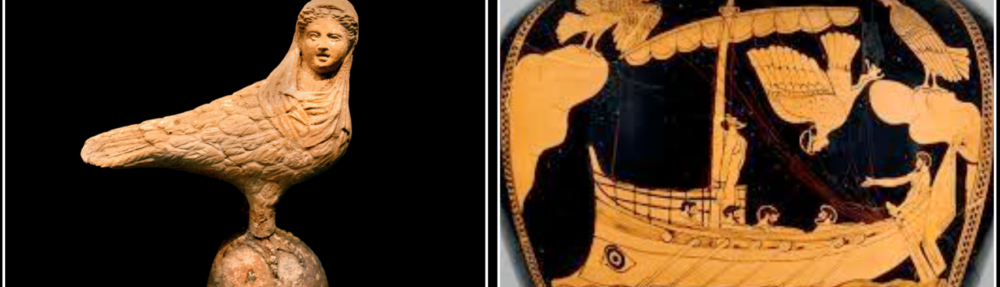
In this week’s readings, “The Penguin Book of Mermaids”, I was really interested to see that in some aspects women figures like sirens were not seen as sexual, where, as we finally are introduced to some male creatures, for lack of better word, and they are on that flipside of being dangerous and predatory. In the chapter regarding “Odysseus and the sirens“ Sirens were more regarded as having “the law and knowledge [they] Held in antiquity, had to do with life and death, or knowing The future beyond human ability— Not so much with sexuality” (Brown, 9). I thought the view of this siren was probably the first time I encountered a perspective where they put A woman like in a positive light. Many of our other readings are to say that women are sexual, deceptive, dangerous, and so on, whereas in this interpretation, they have much to give; Far more than just their outward appearances and pleasure. The same page even goes onto emphasize this perspective by explaining how Odysseus is “subject to erotic temptation more than once— But the sirens law is a different kind”. The next sentence goes onto explain how “Homer’s Sirens sing a song that promises knowledge— A wisdom that bridges world— Instead of pleasure.” As I mentioned, before, if the reader didn’t understand that the sirens were not meant to be put in the box of sexual desire or deception, but that The siren song was putting out more valuable promise. Another way to interpret perhaps, Put men in a better light that they don’t simply crave sex and physicality from women but instead, they crave knowledge and power; creating a new theme of lifting up men without putting down women for once.

Adding onto the Idea of gender swaps, in the chapter regarding “The Tuna (Eel) of Lake Vaihira”, the eel character is said to have raped his beloved, princess bride. In this case, and throughout the whole story, the female character seems to be a respectable character rather than the eel, who could be described as menacing, yet still powerful, but ultimately unfavorably dangerous. Although one may counterclaim and say, the princess is a damsel in distress, following tired gender-norm, I would argue that this is one of those few times in the stories where you can see how the strong desire for women can be harmful; teaching men to be respectable, rather than to paint women as these sex-crazed, dangerous monsters.

Reading Response week 4

Whilst doing this week’s reading, my attention was mostly concentrated on the stories of “Sedna” and “The Tuna of Lake Vaihiria”. This was particularly because of our class discussions of the christian misogyny that transformed the role of the mermaid. It is immediately noticeable, in both of these stories that women were held in a different regard across non Christian cultures. For example in “The Tuna of Lake Vaihiria” The authors of the text explain that in these stories the character of Hina is often represented as a woman of “High rank, and sometimes semidivine”. This is in stark contrast with schribner’s text which mentions in chapter 1 “churchmen adopted these pagan creatures in an effort to depreciate the feminine.”

I noticed that both of these narratives have to do with women and marriage. Hina runs away in order to avoid being forced to marry a monster and Sedna can only be made made to wed under conditions that she finds suitable. Already we see that women in Inuit and Pacific islander cultures are able to exert their autonomy without being condemned to be sinful monsters. Both Hina and Sedna contribute to the prosperity of their people, one by bringing about the coconut and the latter by providing Inuit people with their main food sources. Sedna becomes a deity and the Inuit people strive to honor and maintain a good relationship with her so that they can continue to enjoy the bounty of the sea.

Through these stories I noticed the connection that exists between women and the environment. Both of these characters are life-givers of sorts, to their people. It is interesting that even now a days we consider nature to be female in nature hence the term “Mother Earth”. In these stories both women exert disobedience of some sort. Hina runs away and refuses to marry the Eel and Sedna refuses to marry unless it is in her own terms. The Christian church, I imagine would focus on these acts of disobedience and punish them by turning them into sea monsters but both women in these stories are rewarded with respect by their people.

Week 4: Oannes and Sedna

I found both the stories of Oannes and Sedna fascinating this week. They both alter what we normally believe mermaids to be and their abilities. Oannes completely changes the modern concept of a mermaid from the start because he is a man rather than a woman and he is not a typical half-human half-fish hybrid. He is more fish than man and is more of what we would consider a “monster” to physically be. However, instead of fearing him and dreading the sight of him, the people in the myth are appreciative of him. Oannes gave the people order and a way to structure their society when they were lost. The myth clearly states that Oannes “instructed them in everything which could … humanise mankind” (p.4). This is so interesting to me because the myth hints that an animal being helped humans to become “civilized”. These actions are not what is normally portrayed of mermaids. They are normally seen as hybrid beings who lack humanity and can be animal-like, they are not seen as representations of civilization and the development of the world as we know it. Oannes completely challenges the perception of modern mermaids because he is an intelligent and giving creature.

Sedna, on the other hand, is close to what we think of as a modern mermaid. She is half-human on the upper part of her body with a tail like a fish on the lower half. Sedna differs from the expectation of a mermaid by taking on a more active role in the ocean. She is called the “mother of all sea creatures” (Lindeman) and is the one who allows sea creatures to be used by humans. She controls how fruitful hunts can be and what animals are available to humans which has historically not been an ability mermaids have. The role she takes in the sea is a much more protective and maternal role than I have seen of mermaids before. In nature, it is known that you do not mess with an animal cub because the mother could attack and to me, this is almost the role I understand Sedna is playing. She protects the sea creatures from being hunted like a mother would protect her cub from predators. 

Ancient Mythology

After reading the story about Oannes, I found him to have good moral and extremely helpful to the human population at Babylon. It sounded like he actually brought peace to the city since the book described Babylon as, “a great resort of people of various nations an lived without rule and order, like the beasts in the field.” Teaching these “beasts” about letters, science, construction, and how to gather food sounds like he helped civilize the population. The book also says he didn’t accept food and went back to his home (ocean) at nightfall, meaning he didn’t want anything in return for his teachings, signaling he did it out of the kindness of his heart.

The comparison between Oannes and the mermaid described in “Merpeople” is very different. Where Oannes seemed like a peace bringing and insightful figure, the mermaids are depicted as evil, deceiving, and sinful. I was not surprised because I remembered reading how misogynistic times were long ago and how mermaids were another tool used to degrade the image of feminism. One thing I found interesting was that although I was aware the Christian Church spent many years degrading a woman’s image that even Greek mythology followed the same practice, this can be seen with the Greek figure Scylla who was a female sea monster.

Week 4: Ancient Origin Myths

For this week’s reading I found it fairly interesting and quite fascinating because I really like the specific reading of “Sedna.” When starting the reading it already caught my attention because of the fact that the story was talking about a woman / mermaid having power and control over something, whereas in past readings mermaids were not given this much power and was seen as less than; “A young woman becomes the mother of all sea creatures. As the sea goddess, Sedna has dominion over her creatures and controls the availability of seal, walrus, fish, whale, and other sea animals to Inuit hunters” (Lenore Lindeman). This story particularly got my attention because it was talking about a woman being more self assured and strong as opposed to oppressing women / mermaids in previous readings. As well, in the reading I found some correlations between this story and some Disney princesses, and loving Disney so much I found it quite amusing seeing parallels in the story. For example Sedna reminds me of Pocahontas when the story says, “Many Inuit men desired Sedna for a wife and asked her parents for permission to marry her. But Sedna refused them all. Even when her parents insisted it was time for her to marry she refused to follow tradition and obey them” (Lenore Lindeman). Similar to Pocahontas, Sedna refused the hand of men and was not afraid to refuse tradition, which I thought was exciting to see women / mermaids having power over something and not needing to conform to others. Also when I continued to read, I saw a similar correlation to another Disney movie, specifically Moana and the Goddess Te Fiti because it says, “Sedna now controls all of the animals of the sea. The Inuit who rely on these animals want to maintain a good relationship with Sedna, so that she will continue to allow her animals to make themselves available to the hunters” (Lenore Lindeman). I particularly saw this connection because in the movie the island people are always talking about how they need to have a good relationship with Te Fiti so that their island can prosper, and seeing the parallel in this story about needing to have a good connection with Sedna to be able to have food reminded me of the movie Moana. My favorite part of the story is when it talks about men needing to do tasks to be able to please Sedna, “He or she will swim down to the bottom of the ocean to appease Sedna the Sea Goddess. The Shaman will comb the tangles out of Sedna’s hair and put it into braids. This makes her happy and soothes her anger” (Lenore Lindeman). I thought this part quite intriguing because it displays man praising Sedna, a women and mermaid, which we have not seen in past readings where all they talk about is warning others about mermaids and displaying such a negative connotation and trying to control them; where here in this story it conveys the opposite and talks about man trying to appease a mermaid and praising her, which I particularly liked because I’m always happy to see women thriving and in control.