Conclusion

This class has taught me so much and I do not think I will ever value a class as much as I do this one. When I first signed up for this course, I just wanted to improve my writing skills. But throughout the semester, I learned so much more than I could’ve hoped for. This class has helped me not only with my writing skills but also has helped me to grow my confidence in speaking in classes. 

I never knew how much literature can reveal about the views of the environment in different periods. It was amazing to be able to read such a variety of texts and be able to discuss them in class. I loved learning from my classmates by hearing their interpretations of the media we were talking about. The subject matter of the class was also so fascinating to learn about. I don’t think I will ever be able to read another book or piece of text and not think about how it discusses the ocean and whether it uses terracentric language. I am truly so grateful for all that this class has taught me and the skills I’ve gained from it!  

Conclusion

As a transfer student, especially coming out of Covid-induced online learning, I missed a lot of opportunities to meet people and interact with professors in classes. When I first came to SDSU, I thought most classes were going to be interactive the way this class has been. I was a bit disappointed when this was not the case, but I feel lucky that I took this class despite it not tying into my major directly. This class taught me to question what I would never think to question, as nothing is as it seems. In other english classes, I’ve learned to take an authors message and analyze it, but never have I learned to truly “close read” by considering every word, literary device, and grammar/punctuation as intentional. It was a fairly new concept to me but I believe it is an extremely useful analytical skill. On top of learning to close read, I have also learned to consider how different tellings of folklore and fairy tale can use the same story to teach things differently.

Overall, my favorite aspect of the class was my interactions with the class. When doing small group discussions, I felt like I was given completely new perspectives that I didn’t consider during my initial reading of the assigned reading for the week. Small group discussions also gave me the opportunity to see if people could build off of my ideas and help me further my understanding of the text. I have never been one to enjoy reading fiction, as I feel like I gravitate towards memoirs and non-fiction reading, but this class has taught me that I can learn a lot about the world through reading fiction. I like non-fiction because it is a clear indicator of history, but I never considered how fiction can also teach history. This is the last english class I ever have to take, and while it was challenging at some points, I am extremely happy that I got to end with this class, as I feel like it gave me an extremely important skill that is overlooked in a lot of other english classes.

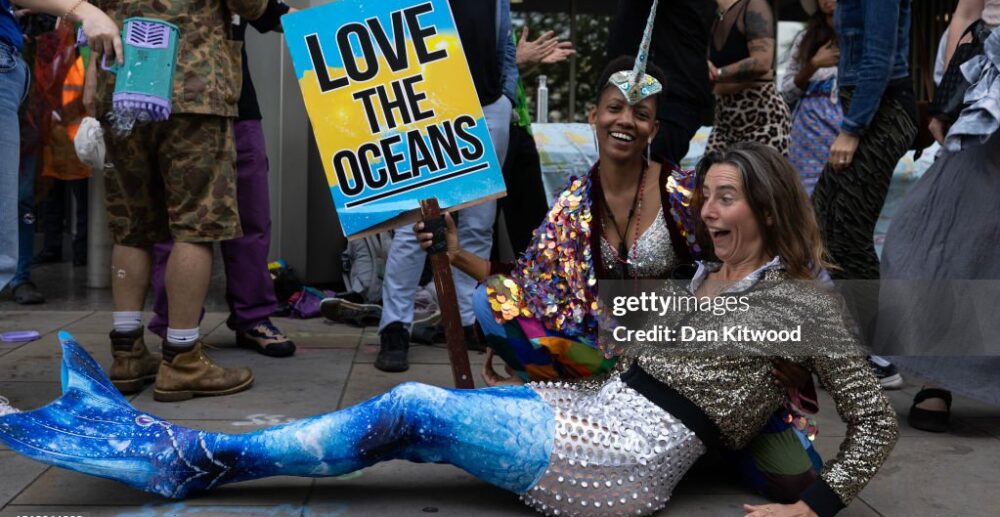
Week 15: We Are Mermaids

I enjoyed reading this poem, especially the ending because it made me reflect on the acceptance of doubt in my own life. It is comforting to recognize that doubt doesn’t necessarily have to be solved or fixed, but I can coexist and live with it. For part of my blog, I wanted to focus on the line, “You don’t have to be useful. You are not required to come up with something to say.” The author presents a powerful message here as it is okay to sit in silence sometimes and embrace those moments. It frees ourselves from constant need to impress or perform for other people. It speaks to the idea of releasing oneself from the societal pressure to always be productive or constantly feel the need to have something to contribute. It emphasizes the value of simply just existing and being present in the moment without feeling the need to justify yourself. One’s worth is not contingent on their ability to verbalize and I think embracing the idea that we don’t have to always be useful, we are able be more present in life.

The ending of the poem also caught my attention as it read, “You can live with your doubt, that’s why it’s yours. Some of us are going to be okay.” It’s possible to live with doubt and be okay. Doubt is not a weakness or flaw, but it is a natural part of being a human. Our doubts are unique to us and our experiences and we can learn to coexist with them. The ending offers a shimmer of hope as there is always room for growth and healing despite the challenges. The author sends a message of resilience and optimism when faced with uncertainty. Doubt is a difficult thing to just forget about or avoid, as it is something that lives in the back of our minds.

Conclusion

I have learned a variety of lessons and information from the ECL 305 course! When we first began this class I was not expecting to be learning about different mermaid tales each week. While it has been fun learning about these mythical creatures, I have also taken away many skills from this course. I am now much more confident in my close reading skills, essay writing, and thesis writing skills. The prompt of what, why, and how to write a thesis is something that I will always remember while writing it in the future. I have seen an immense improvement in my ability to close read since the beginning of the semester. I used to get confused while reading the passages and I can now analyze and understand the deeper meanings. I have also improved my speaking skills through this class. I am usually not the type to raise my hand in classes but this class brought that out of me. I have been able to express my thoughts and gain feedback which has been very helpful for me in not only this class but also other aspects of my life. Overall I really enjoyed this course and have learned a lot. I have made friends, learned real-life lessons, and learned academic skills that I will carry out through the rest of my time as a student.

Final Essay Thesis Proposal

”People of The Marshes Through ‘The Deep’”

Thesis: In Rivers Solomon’s “The Deep,” mermaids, through the experiences of the Wajinru, are a symbol and representation of the experiences endured by people of color. Through this representation, mermaids are a metaphorical mythical creature that shed light on issues regarding identity and the concept of belonging in a world where existence and agency is often denied to marginalized communities. Solomon’s portrayal of historical connections of the past and present, with the presence of oceanic mythical creatures, amplifies the sense of belonging drawn from understanding and knowing ones history. The themes present in this novel are prevalent to many modern marginalized societies. In this essay, I will focus on the major themes in “The Deep” and how the depiction of these themes through mermaids are a representation of the experiences endured by victims of the Human Rights movement in the village of Chibayish, Iraq between 1968-1988.

Explanation: For our final, I wanted to highlight how themes from Solomon’s “The Deep,” are prevalent today across many different categories. I specifically wanted to focus on how the themes present are symbolic to the experiences of the victims/survivors of the Human Rights movement in Iraq between 1968-1988. I wanted to draw connections between the Wajinru, being descendants of a tragedy, and the aftermath of the Human Rights movement, in which issues of identity, displacement, and a sense of belonging are very much prevalent.

Final Essay Proposal

For my final essay, I would like to write about song “Ize of the World” by the Strokes. The song is off of their album “First Impressions of Earth”, and the album as a whole criticizes behavior that has been normalized and touches upon how humanity has lost connection to nature by focusing on concepts like vanity, greed, and narcissism. The song itself, on the surface, asks where humanity went wrong. It touches upon the idea that humanity has chosen to sacrifice their instincts for the sake of order, but somewhere along the way, the order turned into a form of organized chaos.

Final Essay

The Water Will Carry Us Home in the “shellphones” scene shares that history has been lost and in order to find it it has to be searched for by using new perspectives. In this case listening instead of looking, by changing the way she understands the ocean a new side of history can be uncovered.

I really enjoyed this film and wanted to try and encapsulate the lesson I learned from it, and how history is not one truth and in changing perspectives we can see that. I am still making sure my thesis is strong enough so let me know if you have any advice!

final essay proposal + my thesis

tbh I don’t know where to post this because I forgot if it was better to either email you directly or just post it here so I’m posting it here.

The Pisces is an unconventional love story that turns the standard tropes in the mermaid story on their heads, displaying how the stereotypes and gender roles presented within the mermaid story are a product of their time, this one being more relevant to the modern day, and ultimately turn the traditionally patriarchal, misogynistic view of the mermaid on its head and upend that view. The unconventionality of The Pisces centers female sexuality, as opposed to stories such as The Little Mermaid and Melusine, who neglect the female. The Pisces is special because the woman is not the sexual object, but it also doesn’t objectify the merman. These two characters are allowed to mess up and be messy, and therefore portray more realistic experiences.

Conclusion: What I learned in class

I cannot believe how fast this semester went by, and I especially can’t believe that this is my last blog post before the final. I really enjoyed this class so much, this felt like a “real” University class like the type you see in movies where students are expressing their opinions on a topic and just students actually collaborating and being a part of the class. I learned a lot in this class, I took this class to keep my writing skills sharp since I have not written an essay for over a year before taking this class. As well I have such a deep love for literature and that aspect that I wanted to enroll in a class that will encourage my passions. I really learned how to put my thoughts into words and clearly convey them and make them sound very eloquent. I have become very proud of my writing skills because I have seen a big improvement with how I convey my ideas about a topic and making it sound very “intelligent.” Besides learning how to better my writing, I have also learned how to get over my fear a little of speaking in front of a class, and feeling more confident in myself and not being shy to share my thoughts on topics we have discussed in this class. I will truly never forget about this class and all that it has taught me this semester, and I am looking forward to use these skills in other classes and be able to correlate ideas we have discussed in class to other classes I take in the future. Thank you professor for such an amazing semester.

Week 15: We are Mermaids

For this weeks reading I found it fairly interesting because I really liked how the poem was written to use ocean wording and ideas to correlate to human life. This poem uses the ocean as a way to talk about life’s ups and downs. It starts by comparing the ocean’s salt to tears (which I thought was really intriguing to show that we are connected to the ocean in that way), showing how something that can be sad can also be essential for life, “The salt of the ocean is always the salt of tears, melancholy but at the right dilution, or concentration, life-giving”. The poem points out that life has always been a struggle, even from the very beginning, it uses ocean creatures, like thermophiles and zoarchids (bottom feeders), as examples of how different beings are capable of adapting and thriving in harsh conditions “Look down: the thermophiles sip at the fumaroles, whose sulfur steam would kill a human being. They love it here.” These creatures don’t need to prove their worth; they just exist in their own unique ways, this thus serves as a metaphor for how people don’t always have to be like others or validate themselves through others accomplishments. The poem ends on a hopeful note, saying that despite our doubts and struggles, some of us will find our way to be okay. It’s a comforting message that encourages accepting ourselves and finding our own path, just like the diverse life forms in the ocean. I really liked this correlation with the ocean and humans because even at our lowest moments, we can find comfort in knowing that we are each taking our own unique path in life and there is no wrong doing if we just take our own path and not be affected by what others are doing.