Week 9: Blue Humanities

In the blue humanities reading, the author showcased how Western attitudes towards the sea/ocean changed over time from disinterest and fear to one of fascination and awe. This mimics the attitudes that individuals held towards the “wilderness” as the cultural values associated with both these natural spaces changed to suit the desires of a western audience. I believe that the coast and sea shore itself became a kind of frontier myth for those living in the 19th century. In both the terrestrial and aquatic frontier myth, people looked back to these places as a romanticized version of the past. In the reading, the author states that, “pristine nature now in short supply in the industrialized heartlands, found a refuge in the oceans…Simultaneously, the sublime, previously associated with mountains and forests, came to be associated with the wild water.” In this quote, the author is mentioning how people are once again searching for a space that is untouched/unaltered by humans which is highlighted by the addition of the words ‘industrialized heartlands’. This phrasing positions the sea as something that people saw separate from them and because of their separation, there was a type of sacredness to it, which matches the sacredness that people felt towards national parks. The use of the phrase ‘wild water’ is interesting as well because the water is being personified and altered to fit this idea of untouched wilderness even though people had utilized the open ocean and other bodies of water for hundreds of years.

Humanities: The Journal of the National Endowment for the Humanities. Web. 2013

the construction of ‘wilderness’ in relation to indigenous people

In the essay, “The Trouble With Wilderness,” Cronon’s main gripe with the modern interpretation of wilderness is that it is seen as separate from humanity which assigns it a type of fetishistic purity. The problem with this modern interpretation is that people, particularly indigenous people, have actively lived in these ‘wild’ spaces for generations. All across areas of wilderness, people hunted for sustenance and not for sport. They also built homes and other living spaces out of the materials that they could get their hands on. For example, native people in northern California used fallen redwoods for their homes and canoes. This more modern construction of wilderness disregards the existence of indigenous people within these lands and actively erases them. This is seen in the language that American settlers held with the word frontier and the myths associated with it.  The author of the essay stated that the removal of indigenous people shows how constructed the American wilderness is (Cronon pg. 16) The use of the word constructed is important in this instance because it shows the human, particularly Western influence, that led to our modern interpretation of wilderness. Constructed also brings to mind the image of boundaries that are made to bar specific people from these areas. Although these boundaries are made to keep certain people like the natives separate from nature, European Americans have the freedom to cross the boundaries and indulge in a glorified past that has also been constructed. Because ‘wilderness’ as a title has been placed on national parks and other protected areas, indiegnous people struggle maintain their previous connection to the land.

The Little Mermaid Reading Response

Sophia Raya

ECL 305

Professor Pressman

March 3rd, 2024 

The Search for a Soul

In many stories involving mermaids and other aquatic creatures, the mermaid’s monstrous nature is highlighted by their lack of a soul and aversion to Christianity. During the 19th century, many people were concerned about the welfare of their souls and were still largely devoted to Christianity. In Hans Christan Andersen’s The Little Mermaid, the little mermaid yearns to have an immortal soul and will do anything in her power to obtain one. She decides to leave her watery home behind and rises onto land in search of a soul. As the story progresses, the little mermaid eventually transforms into an air spirit that inhabits the sky and will be eligible to obtain a soul in three hundred years. Within the structure of the text,  Andersen uses each section of the story to represent three different planes on the vertical scale: the aquatic plane, the terrestrial plane, and the aerial plane. This vertical ascension maps onto the biblical ascension of the soul to heaven. As the little mermaid travels through these different planes, she comes one step closer to obtaining a soul. 

Andersen begins the tale of the little mermaid in the depths of the ocean, far below any human development. This introduction is purposeful and places emphasis on where the initial physical setting occurs, and shows the placement of the mermaid world beneath that of the human world.  “Many church steeples need to be piled upon one another to reach the bottom to the surface. It is there where the sea folks dwell…” (Andersen, pg. 108). The use of church steeples as a unit of measurement adds a Christian layer to the setting, and the direction of these church steeples is purposeful as well. Instead of going from the surface of the ocean to the bottom of the sea, they are heading upwards. This upward motion paired with the steeples suggests that as one moves further away from the bottom of the ocean, they are getting closer to God which mirrors a soul’s upward motion to heaven. In some literary texts involving mermaids, the area below humanity’s domain is considered to be hell or the underworld. It is here in this place furthest from God’s reach where the little mermaid first inquires about obtaining an immortal soul. The little mermaid’s grandmother reveals that the only way to gain an immortal soul is to forfeit her life beneath the ocean and have a human fall in love with her (Andersen pg. 118-119). This information reveals that the direction that the little mermaid needs to go in order to obtain her soul is up which reflects in her transition from the aquatic plane to the terrestrial plane. 

When the little mermaid reaches the prince’s castle and undergoes a painful transformation to become human, she finally has the potential to gain a soul but she is not guaranteed it. In finally meeting the prince, there are only two directions she can potentially move to. If she wins the love of the prince and becomes his queen, she would be able to secure a soul and eventually move upwards to heaven when she died. If she didn’t win his affection, she would melt into sea foam where she would go down the vertical plane and forfeit any chance of eternal life. With these two options facing her, she attempts to win the princes favor and exists as a human being on land for some unspecified time. The prince and the little mermaid form a bond together and on one occasion, he takes her to the top of a mountain where they could see clouds rolling beneath them (Andersen, pg. 124). In this event, the little mermaid is still connected to the earth but she is also located in the sky due to how high up they are in the mountain, inhabiting both planes. At this point in the story, her potential for a soul is high due to the princes favor, and she is in arms reach of the heavens. As the story progresses, the prince and the little mermaid never go back to that high point together which marks the downturn of her probability of obtaining a soul through matrimony. 

The little mermaid’s transition from the terrestrial plane to the aerial plane did not go as smoothly as one would have hoped. Because she was unable to secure the princes love and by extension her immortal soul, she is faced with the choice of either killing the prince and remaining on the terrestrial plane, or sacrificing herself and dissolving into foam, leaving behind all possibilities of entering heaven. Because her love for the prince overpowers her desire to exist as a human, she decides to jump overboard and go back down to the aquatic plane, which would be akin to descending into hell. After this scene occurs on page 129, there is a large blank space before the scene continues, which is a point of transition for both the little mermaid and the text itself. This pause is purposeful and jolts the reader out of the story and may cause them to ponder the direction that their own soul is heading towards. After this space occurs, the little mermaid rises out of the water and slowly ascends high into the air like a soul going to heaven. It is here where she finally enters the aerial plane and becomes an aerial spirit. As an aerial spirit, it is here where her form more closely resembles a soul. In the Christian religion, souls are intangible and have no physical form despite being connected to the body. Once the body dies the soul is judged and may rise into heaven or descend into hell depending on the outcome of the soul’s judgment. This judgment depends on a number of factors including how closely one follows Christian values. One of these values includes loving one’s neighbor and doing good unto others. As an aerial spirit, the little mermaid has an actual shot at entering heaven by spreading good deeds across the world and following Christian teachings for the next three hundred years (Andersen pg. 130).  Despite the increased length of time it will take the little mermaid to gain a soul, her spot in heaven is essentially guaranteed. As an aerial spirit, the terrestrial plane and the aerial plane blend into one, there are no harsh boundaries that separate the two. As long as she continues to perform good deeds, she will not run the risk of losing her spot in heaven. Near the end of the story, the little mermaid mentions gliding into heaven (Andersen pg. 130). By using the phrase gliding, it implies that heaven is in the same plane as them. Because she’s an aerial spirit, she is already at the highest level vertically and doesn’t need to rise any higher to reach the Kingdom of God. 

Just as the soul ascends upward, so does the little mermaid herself also rise to the heavens. Despite some setbacks, the little mermaid rises into the aerial plane from the terrestrial and aquatic planes beneath her. Each vertical plane builds upon the previous one in both a textual sense and as a place where the little mermaid has learned to inhabit and explore. As she goes up through the ocean, terrestrial, and aerial planes, she displays care towards others and embodies Christian values which help to gain her a position in heaven in the future. 

Works Cited:

Andersen, Hans Christian. “The Little Mermaid.” The Penguin Book of Mermaids, edited by Christina Bacchilega and Marie Alohalani Brown, Penguin Books, 2019, pp 107-130.
Week 6

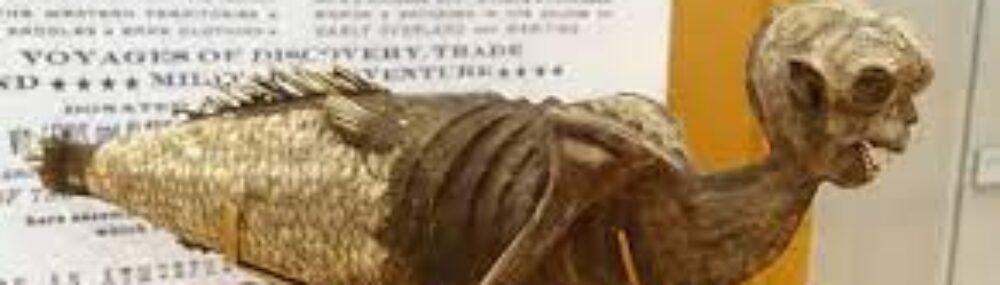
The Feejee Mermaid hoax showcases how mass communication like the newspaper can shift a cultural belief from being accepted as fact to being seen as fabricated. Oral narrations have been used for thousands of years and have been used to communicate ideas and stories across time and space. Another way that ideas have been communicated has been through the written word. Both are effective at spreading information, but with the development of the press, written communication has become much faster at communicating ideas with the public. In a previous class discussion, Professor Pressman mentioned that the act of writing and the information written down was seen as true and unshakeable. If we apply this knowledge to how the press wrote about mermaids in the early and midcentury 1800s, we can see why mermaids fell from scientific grace so quickly. Scribner states that within this time frame, a Westerner would read about merpeople in their newspaper around 4 times a year (Scribner 126). This consistency for several decades would help cement mermaids as a tangible part of the world, something to be seen and studied. Had stories about mermaids continued to have been spread by oral narration, mermaids might not have been treated with such scientific interest. Communication theorist Marshall McLuhan stated that “the medium is the message.” Written word is more likely to be treated more scholarly, which would communicate to the readers that the existence of mermaids is fact. The widespread discovery and publishing of the Feejee mermaid’s origins helped to dethrone mermaids from their spot as a scientific wonder. In both instances, media in the form of the press helped to shape the public’s perception of mermaids. Despite Western society implying that the written word is something unchangeable, it’s not stagnant and can bring about change towards previously cemented cultural beliefs.

Melusine and the Importance of Privacy and Personal Boundaries

In this weeks story, Melusine and her relationship with Raymondin highlight the importance of respecting someones personal boundaries and their privacy. When Melusine and Raymondin first meet, the two outline certain expectations and objectives for their relationship. This includes never seeing each other on a Saturday. In this scene, Melusine explicitly says, “You must swear by all holy sacraments as  a christian that on each Saturday, from sundown till the following day, never – and I will say it again so there is no doubt about it – never must you try to see me in any way whatever, nor seek to know where I am” (pg. 27). This isn’t a simple request or suggestion. Instead there’s a heavy weight of responsibility to Melusine’s words, especially through using the term ‘holy sacraments’. This implies that to break this oath is akin to breaking a promise to God, which usually carry severe punishments. She didn’t say this once, but twice in order to further emphasize this clause in their agreement. This statement is unbreakable and leaves no wiggle room for potential change in the future. With all this laid out, Raymondin agrees to marry her. The two share a prosperous life together and are deeply committed to each other which makes Raymondin’s betrayal of their promise and Melusine’s privacy all the more heart breaking. When Raymondin uncovered this secret, he didn’t bear it alone, but instead revealed it to all those who were in the castle. Because of this public spectacle and exposing of her secret, she would never again get to be with Raymondin as husband and wife. This reveal captures the nature of secrets: once revealed, the circumstances surrounding the secret will forever be altered. Had Raymondin kept the discovery to himself, Melusine would have been able to die as a mortal Christian woman besides him. By violating these boundaries, these actions lead to the downfall of both their happiness and contentment, which shows the importance of treating boundaries in relationships with respect and continued acknowledgement. 

Knight, G. The Romance of the Faerie Melusine. Skylight Press, 2011.

Knowledge as a Source of Creation and Destruction

The first few chapters of the Penguin Book of Mermaids introduced the reader to a variety of myths and stories about the deities and creatures that dwell in the ocean. These myths used these deities and creatures to highlight important values and beliefs of the culture it was being told from. One of the focal points within these stories was the power that knowledge held. This focus is seen in both the story of Oannes and the sirens in the Odyssey. However, these two myths take a different approach to how knowledge can be wielded; knowledge can be a source of creation and destruction. 

The tale of Oannes centers on knowledge as a source of creation. Before Oannes imparted knowledge to the people who lived in Chaldea, the author states that they lived like beasts in the field (p.3). By being likened to ‘beasts of the field’ the inhabitants of Chaldea are seen as unknowing and disorganized, living without a set way of life. Oannes taught them farming techniques, political organization, and introduced them to intellectual pursuits such as geometric knowledge. With Oanne’s teachings, this lack of rule and order changed into something more structured and created a society where the people were allowed to truly flourish. 

On the other hand, the Sirens and the Odyssey center around knowledge leading to destruction. In our previous class discussion, the professor mentioned that the Greeks believed that listening to celestial music would lead to a person’s undoing. When Odysseus hears the Siren’s music, he asks his crewmates to free him from the mast where he’s been bound. Instead of listening to his demands, his crew rows swiftly away from the area until the siren’s calls no longer affect him (p.11-12). If Odysseus hadn’t been strapped to the mast and if the crew didn’t have wax stuffed in their ears, Odysseus’ journey would have been cut short. Unlike the helpfulness from Oannes, the Sirens wanted to use their knowledge of the future to lead them men to their doom. These myths show that knowledge is a powerful tool that can be used to both uplift humanity and also demolish it.

Works Cited:

Bacchilega, C., & Brown, M. A. (Eds.). (2019). The Penguin book of mermaids. Penguin

Week 2: Mermaids and Sin in the Early Church

In ‘Merpeople: A Human History’, the author explores the connections between mermaids as symbols of sin in the context of the early Church, and how the notion of sin increased its power. Within this period, mermaids were transformed from their place as pagan symbols and were then turned into spiritual vessels for sin as a cautionary tale against temptation. Usually, this sin would be in the form of carnal sin; those who didn’t live piously and prioritized indulging in their sexual desires would not enter the Kingdom of Heaven. In this time when the early Christian church was the dominant religious and political power, engaging in sin was a very real spiritual and literal threat that hung over the heads of churchgoers. 

However, sin itself is abstract and varies from culture to culture; anything can be considered sin depending on the value system of said culture. Even knowledge can maintain a connection to sin. Within Homer’s Odyssey, a tale promoted by the Church, sirens didn’t promise sex but instead promised infinite knowledge to Odysseus and his men. This knowledge would in turn bring death and destruction unto them (Scribner p. 30). In the eyes of the Church, Ulysses (Odysseus) represented the Son of Virtue while the Sirens were the Incarnate Vice (Scribner p. 35). By being seen as the Incarnate of Vice, the infinite knowledge that they promised was also seen as wicked as well. What about knowledge would be seen as wicked and immoral? Why was Ulysses seen as righteous for rejecting it? Why did the Christian church promote the tale of the Odyssey in the first place? 

The quote “knowledge is power” may shed some light on these questions. The early Church wielded a lot of power, mainly through attempting to convert as many non-Christians as possible. By amassing such a large number of followers, the Church’s power and influence would continue to strengthen. Those in power are always concerned about maintaining it, and they want to keep wielding it through any means necessary. This is why the pursuit of knowledge as whole could be seen as dangerous, it may show alternate ways of existing that are outside of the realm of the church. If people stopped believing in the teachings of the Church, then its influence on society would diminish, leaving them vulnerable to other political and religious factions that may want to control medieval Europe. The story of the Odyssey is important to the Church because it sees itself in Odysseus fighting against a perceived evil. When that evil is paired with knowledge and sin through the form of mermaids, the early Church strengthens the belief that the only way to secure one’s eternal soul is by strictly following the teachings of the Church, further securing its place of power. 

Week 1 Introduction

Hello everyone! My name is Sophia, and I’m a sustainability major at SDSU. I’m also transfer student, so this will be my first semester on campus. One of my favorite subjects in school besides environmental science has been literature. One goal I have for myself is to improve my critical analysis skills and become a sharper writer. I think that this class will help me to achieve this certain goal. I also would really like to learn more about environmental humanities because writing and other art forms have the power to make people care about the different environmental crises that are occurring.

Although I like relaxing at home, I also enjoy being outside. When I’m able to, I volunteer at the Tijuana River Estuary and help with the upkeep of the area. I mainly remove invasive species like ice plants and chrysanthemums, which is a great stress reliever in my opinion. I also like going to the beach and watching the sea lions play in the water. In addition to the outdoors, I really like to read. I don’t really have a specific niche/interest that I firmly stick to, but I veer towards non-fiction essays, especially about the writers day-to-day life. Anyways, I’m really excited for this class and I hope to learn from everyone here 🙂