Touring the Wilderness and Claiming our Services from The Wild

I am an environmental science major, and one of the first things we learn about the ecosystems we seek to protect are the “services” they can provide us––because how can we make non-environmentalists care about the planet without coaxing them with what the planet can give them in return? These categories of services include provisioning services, regulating services, supporting services, and cultural services. Cultural services are, as defined by the National Wildlife Federation, a “non-material benefit that contributes to the development and cultural advancement of people…the building of knowledge and the spreading of ideas; creativity born from interactions with nature (music, art, architecture); and recreation.” (nwf.org, N.D). The “recreation” they reference is tourism. “Cultural services” are exactly what William Colton is addressing in his paper, “The Trouble with Wilderness”. The sublime beauty and innate inhumanity early explorers like Thoreau and Wordsworth described in the texts they made public is what the National Wildlife Foundation is referencing now as a “service”. Something “serving” of us, not untamed and terrifying like what Thoreau and Wordsworth described. The foundation is actively encouraging more human presence in the natural world as a way of furthering our intellectual discoveries and creativities, while also making the income they rely on to maintain the preserve with the influx of tourism to these places, as people seek out this “service” they are promised. Colton mentions this attitude at its birth, as following these popular works by explorers featuring The Sublime, “more and more tourists sought out the wilderness as a spectacle to be looked at and enjoyed for its great beauty, [and] the sublime in effect became domesticated.” (12). Just like some best-selling new book on the shelf at Barnes and Nobles or blockbuster movie everyone is talking about, the “wilderness” became a commodity to come get a look at for yourself, diminishing it’s obscurity and turning it into an anthropocentric novelty. Who wouldn’t want to get a taste of the novel Unknown (or rather, freshly broken in “Unknown”)? And in this mentality of everyone wanting to be an explorer, the unknown becomes known and we take hold of it. It is there where we claim nature but label it “other”, label it “wilderness”, though, since our invasion, it is anything but. It now exists in the maps made from clear-cut trees bunched up tightly in the fists of visitors that will inevitably end up on the ground of the trails they claim this “service” from. It exists in our hands, yet we comfort ourselves by naming it “wild” and clutching onto the idea that it is our escape. But there is no escape now; we are everywhere.

Close-Reading Midterm: Melusine and the Objectification of the Female Body.

Ranya Tobin

ECL 305

03/03/2024

Melusine and the Objectification of the Female Body.

In a time where the precedent depictions of mermaids were arbiters of folly and sin, that harbor ill-will and prey by means of manipulation and sexual depravity, The Romance of the Faery Melusine worked to turn the reputation of the mythical mermaid into an admirable, good-natured being—an empathetic character which humans could swoon over. Though Melusine is made to be a powerful, wise, and endlessly compassionate character, there is one aspect of her that the text takes care to highlight; Melusine’s false human body is made a main focus of the narrative. Every scene that features her vast displays of intuitive insight and selflessness is overshadowed by the descriptions of her form—a device used to point the reader in the direction of Raymondin’s focus. He is predominantly fixated on her body, more so than any other one of her more impressive traits. Once Melusine’s true form, her serpent body, is revealed to Raymondin, he rejects her not only coldly, but viciously. The scene in which Raymondin discovers Melusine’s true nature, while noting the text’s fixation on Melusine’s beautiful appearance and Raymondin’s immediate admonishment of her after her body is no longer pleasing to him, brings to light the hypersexualization of the female body in both intimate relationships and our greater society, promoting the societal norm of prioritizing physical beauty while diminishing inner qualities, ultimately misrepresenting women and holding their agency hostage. 

Melusine’s attractive appearance is what initially drew Raymondin in upon their first meeting, followed by her sweetness and care, she became the perfect picture of a wife; but this surface-level image did not work to glorify the woman inside. The story repeatedly objectifies Melusine’s false human body, filling the text with in depth descriptions of her chest, hair, and face. In the passage where Raymondin breaks into her abode and betrays her trust, the story takes care to describe the image he sees from the top-down, featuring “her bent back magnificent in profile, her breasts raised, as she combed her long golden hair…” (125). In this scene, her husband assesses the aspects of her he lusts after, a perverted act shrouded by the shadow of the room. Her body is commodified in a space that was meant to be sacred, where she should feel safe to release the binds the human world demands be placed on her body. Raymondin objectifies his wife to the point he feels warranted in his uninvited leering, which exemplifies the mindset that causes him to ultimately turn on her once her form does not meet his desires. Melusine is at home in her abode, able to appreciate her natural body in privacy, and “hold[ing] a mirror…smile[s] to herself.” (125). Melusine examining herself in the mirror and expressing pride in her natural body is a crucial moment of her self-actualization—emphasizing the importance of this time alone. This is her time to reclaim her agency lost within marriage. Under the constant pressure of living in a world that determines her worth based on a certain standard of outer appearance, Melusine’s expression of love and pride in her natural self is a revolutionary moment. Raymondin catches a glimpse of this natural form, her “tail of green scales stretched under the water…like that of a fish.” (125), and recoils, “He drew back…his face fallen into the fine sand, which penetrated his nostrils, his open mouth, and grated between his teeth…” (125). He is so repulsed by this image, his senses are overwhelmed with the abode that houses it. He willingly buries his head in the sand to shrink away from this reality, but feels as though the fine gravel of the sanctum he has sullied is attacking his senses—exemplifying how the offense he feels at Melusine’s “betrayal” of hiding her true form from him was, in actuality, his own immaturity. He himself is imposing and adhering to a beauty standard set for her, just as he himself is shoving his face into the sand, so when the body he had been objectifying throughout their marriage does not please him, he experiences it as a personal transgression. This scene depicts how regarding a woman as a purely sexual being not only overshadows the human within, but gives her worth an expiration date; one that Melusine had prematurely reached in her husband’s eyes. In the instant Raymondin lost attraction for Melusine, after seeing her for the complex creature she is, “he who had been Raymondin ceased to exist…glaring at her with a look of hatred” (138). She had done all that she could to hide the most foundational parts of herself from him in order to give him the life he desired, sacrificed all but one day of the week for him, yet once her image was unattractive, he turned on her—watching her like she was a detestable stranger and outing her most vulnerable secret. His instant loathing of her the moment her body was estranged from him exemplifies the harsh reality that once a woman is made to exist under a sexualized lens, the human inside of her is lost, no matter how hard she strives to be greater than just the body she was born into. 

The Romance of the Faery Melusine offers a powerful criticism of the objectification of women and the consequences of prioritizing physical beauty over inner qualities. Melusine’s initial allure, her beautiful outward appearance, sets the stage for her eventual objectification and betrayal by Raymondin. The text takes care to highlight her physical attributes in depth in order to express how Raymondin reduces her to a mere object of desire. Raymondin’s eventual invasion of Melusine’s private day, betraying their agreement, further exemplifies this objectification, as he feels no shame for his breaking of their contract and momentarily revels in voyeuristically assessing her. When Melusine’s true body is no longer pleasing to Raymondin, his immediate expression of loathing mirrors the harsh reality of objectification women are made to endure; once their physical beauty wanes, they are discarded and dehumanized. Melusine’s story has us recognize the societal attitudes that enable such objectification, and asks readers to reevaluate the value placed on women beyond their physical appearance.

Citation:

Lebey, André. The Romance of the Faery Melusine. Trans. by Gareth Knight, Skylight, 2011.
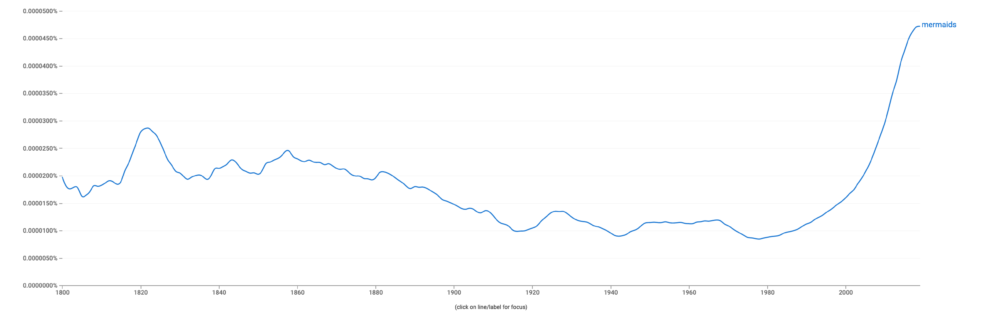
From Demons to…Angels?

After reading the story of Undine, it is abundantly clear that Melusine’s impact on the image of the mermaid in historical literature has turned the once-damned creatures into pious women, desperate to be ever closer to God.

Undine’s sweet nature and her devotion to Huldbrand directly mirrors that of Melusine to Raymond, giving both mermaids an innocent and pure aura about them. This demeanor is of course further emphasized by both mermaid’s decrees of holiness.

Just as Melusine declares to Raymond that she “is as faithful a Christian as [he is]” (The Romance of Melusina, 25), Undine “entreated [the priest] with an agitated tone to pray for the welfare of her soul” (Undine, 101). Undine is also described as “mild and gentle as an angel” (103), which is a stark contrast to the stories of sinful and villainous sirens that were pedaled by the church in it’s past. In this way, it is clear the iconic influence Melusine had on shaping the newfound saintly view of mermaids that were once used as a comparison to debauchery. These mermaids are good Christians, who are concerned with obtaining and protecting their immortal souls, serving as a means for the church to further maintain control of women’s place in society.

Melusine and Undine together promote messages that women are not entitled to their secrets, as Melusine is punished for keeping hers and Undine rushes to reveal her own. They also communicate that to earn the privilege to be loved, a woman must be serving to both God and to her husband.

By twisting and warping the image of the mermaid, and therefore, the image of women as an obscure species, the church maintains control of how women are to exist—what they will be punished for, and what they will be rewarded for. These stories serve as an underscored warning to women about how they must act if they are to be seen as anything but deranged monsters.

Melusina, The Christian Siren

In this week’s reading of The Romance of The Faery Melusine, I found myself surprised by the empathy and warmth the story showed towards the female belonging to the natural world. In the stories of sirens/mermaids we’ve examined that were told through a Christian lens, not only the creatures, but women as a species, have been scorned and made to be seen as inherently wicked or “the world’s most imperfect creature(s)…” (Merpeople, a Human History, Scribner). The female visage was exposed and warped by the church into a symbol for debauchery and sin, and the stories they peddled of feminine monsters were anything but kind.

However, Melusine’s story is the first exception we’ve come across in this course.

Melusine is a holy woman, asserting multiple times in the text that she “is as faithful a Christian as you are” (25), that she “will conduct [herself] honestly and in a Christian manner.” (26), and even claims that she, “next to God,” (25), can help Raymondin best out of his precarious situation.

In this way, Melusine goes from a wicked woman to be wary of, to a lady who acts under the watchful gaze of God, deserving of empathy and love. The story makes emphasis of this piety to fashion a bridge between mythical scaly women and Christianity; once made to be the antithesis of one another, now taken into acceptance—conditionally.

Melusine’s heed of God’s will is what makes her acceptable, otherwise, she would be just another siren.

But this begs the question: Why did the author seek to design a derivative of a mermaid that is now deserving of reverence and sympathy?

Week 4: Reverie, Not Repulsion. Sedna, a piece of Mother Nature.

One of the kinds of stories that never fails to move and deeply impact me are those revering a woman’s ability to give life.

 In not only many works of literature, but also in disgusting, widely held beliefs, a woman’s fertility is seen as something to be dominated, used against her; that the ability to give birth makes her weak, the lesser sex, and inherently characterizes her existence as one meant to be lived in service to a man—bearing his children. This degradation of a woman’s existence and objectification of her body is prevalent in the historical summaries of the western/Christianized works of mermaids we’ve examined in this course so far. We’ve learned about the various tales told of sea women being ripped from their homes and forced to marry their assailants, having children they didn’t want and couldn’t comprehend loving—as they were not only born of suffering, but estranged from her nature as a sea creature, or maybe even used as a means of chaining her to land by leveraging a mother’s need to be with/protect her children (if the mermaid is even capable of feeling any love for the life they were brutally forced to create). The Inuit story of Sedna circumvents this pattern in a refreshing, glorious way.

 Firstly, in this tale, the “mermaid” (though Sedna was a human before she was cheated first out of her freedom, then out of her life) is the victim of abuse, not the men she interacts with. The suffering imposed on her was not justified by the story, but scorned—unlike the tales that regard mermaids as inherently sinful creatures that deserve their cruel treatment. The story is about a man’s deception and not a woman’s; deviating from the western belief perpetuated by the church that women are inherently untrustworthy and predatory. This makes sense, as the Inuit were not touched by Christianity, and therefore, did not absorb their beliefs. Not only was Sedna betrayed by the man who married her, but she was betrayed by her father as well. One of the most disgusting and stomach-turning events to watch or hear is a parent turning on their own child; It is a corruption of the title “parent”, an adulteration of nature. This brutality incites a feeling of heartbreak and disgust, serving to scorn the maltreatment of women—to empathize with a woman’s pure love being used against her. 

But although Sedna’s love was leveraged as a means of harming her, or betrayed by the one man whose love she was promised she could rely on (her father), she does not turn to cruelty, nor morph into a creature symbolic of her anguish. Instead, beautiful, innocent life is born from her blood and pain; she fills the sea with creatures that exist as the lifeblood of her people, that they rely on to nourish them. In this way, Sedna becomes a form of Mother Nature, both revered and depended on for her fertility. She has the power to control what she allows others to take, and she is worshiped for it. When she becomes angry and refuses to send life to her people, Shamans turn themselves into willing sacrifices to go provide the care she desires so that she may be satisfied and return such care. It is almost an act of appreciation for her work. 

Sedna’s ability to give life is not regarded as something to be taken from, but to be blessed with. In a divergence of cultures, some worship Mother Nature, and some see her as something to be dominated; a fact made very apparent by the difference of the Inuit story of Seda and the predatory illustrations of Christianity’s mermaids. The very cultures that abuse mermaids moved on to abuse and take from Mother Nature, whereas those that celebrate the creatures live in reverie of the environment. I’m excited to read more stories such as this one, that fill me with joy and not heartbreak; that share in the appreciation of women and their blessed connection to Mother Nature.