There is no doubt that humans and their relationship with the wilderness and environment is constantly changing both positively and negatively. These relationships throughout time demonstrate different connections and approaches to the way this relationship will function which is influenced by the people and their motives at a given time. Something that stood out to me in this reading is these transitions how we as humans apply morals to the wilderness, and how we justify conquering and destruction towards the environment. Humans tend to excuse behavior, especially when it comes to something that they believe ¨had¨ to be done or went along with their morals. It is human nature to justify behavior with the mindset of superiority; when it comes to the wilderness some individuals believe that it is our right as superiors to dominate the wilderness. The text specifically states, ¨-We as humans tend to excuse our behavior and attempt to justify it. By imagining that our true home is in the wilderness, we forgive ourselves for the homes we inhabit.¨ (Page 12) With this in mind, I wanted to look into the psychology behind justification and how we use self-justification to permit us to harm the environment continually. The psychological theory behind this is cognitive dissonance, which causes us to justify regardless of the severity of our actions when experiencing two inconsistent cognitions. Cognitive dissonance is particularly felt when inconsistent beliefs and behaviors are pressurized and conflict with our ¨self-image, positive view of self, or worldview.¨ ( Psych Central) Humans will develop a way to ignore and dismiss data that dismisses their beliefs as a way of maintaining and strengthening their thought process. We do this when it comes to the environment when we are completely aware of our harmful effects in terms of carbon emissions, deforestation, biodiversity extinction, etc. Being aware and staying aware is extremely important in improving our relationship with the wilderness.
Author Archives: Mikena Palumbo
Close Reading Assignment-Sedna the Sea Goddess
The Legend of Sedna the Sea Goddess is a story told all throughout the Arctic region, where it experiences new interpretations, names, and details depending on the region. The Inuit tale is an origin and creation tale that details the story of a young girl and the trials she faces in her young life. The story follows, Sedna, who is promises herself into a potential loving marriage; she later discovers that her husband is a bird dressed up as a man and that he cannot fulfill the promises he had previously made, causing her to flee with her father. When fleeing, her father murders her husband out of anger, to which the husband´s friends seek revenge against Sedna and her father in response. During their escape on the boat, the friends who are also half human-half birds, fly above their boat and viciously cause a storm to kill her and her father. Sedna´s father throws her off the boat in hopes that they will stop but they do not. Sedna clings onto the boatside for her life after being thrown overboard, yet her father cuts off her fingers one by one to prevent himself from drowning as well. She sinks to the bottom of the sea where the segments of her fingers turning into sea mammals, and she becomes the Sea Goddess, who has the power to control these animals and their abundance to man. The specific scene of Senda’s fingers being cut off joint-by-joint by her father is a pivotal scene that may be interpreted to represent the trauma she experiences as a transformational experience of her soul and strength to persevere. There is both a literal detachment through her father cutting off her fingers and her figurative detachment from family, comfort, and social constraints. Spurring from her fingers are marine animals, which exhibits Sedna´s strength against her life that was holding her back from her soul´s transformation. For Sedna to experience her true soul in the form of a goddess, it was necessary for her to both figuratively and literary detach from her past constraints. Through the close examination of the cutting of the fingers scene, it is evident that transformational growth is only possible if one detaches from past trauma/ties. Whether the detachment is forcible or voluntary, individuals must disconnect and dissociate from their constraints in the form of comfort, family, societal ideals, etc. to experience a full transformation of the soul and body.
First and foremost it is important to understand the content of the story and understand the initial traumas that Sedna´s growth spurs from. Sedna is a defiant girl who leads herself by her self-determined laws, which is communicated directly in the story where it states, ¨She liked the comfort of her parent’s home and refused to marry.” While she is defiant of the idea of marriage, she does so for the betterment of her people and family, which later on benefits no one involved. This is the traditional suffering that she experiences in the form of the societal expectations of being a woman and a woman’s role to marry. It is clear that Sedna is a woman of choice and leads her life intending to make independent choices, although she is not given the opportunity to choose when it comes to the boat scene. Following the idea of trauma, a key part of the boat scene is Sedna’s father and that it is him who throws her overboard into the icy water to prevent his boat from filling with water. It is no mistake that the boat is her father´s boat and that she is physically cut from the side, after grasping on to save her life. The father´s boat serves as a representation of her family as a whole and he is the sole controller of her fate, just as he was in her life. Typically fathers are modeled as a family´s protector, dedicating themselves to the safekeeping of their family’s life; yet the situation is entirely upside down in this scenario. Her father is the perpetrator and betrays her just as her husband does, causing a strong traumatic experience between Sedna and her father. All the trust is lost in their relationship as she is sacrificed to the ocean at the hands of her father who is supposed to be the one man who dedicates himself to her protection. This is a literal and figurative detachment that is forced upon her by her father´s choices, as he sentences her to death and attempts to prevent her from being able to swim to the surface. There is a strong importance in the fact that he does not simply push her off, but chooses to individually cut each one of her fingers off, ¨one joint at a time.¨ This action would inflict the most physical and emotional pain to her body and mind cruelling detaching her from this familial and societal trauma in a literal and figurative sense. Although only after these forms of dissociation and her body sinking to the very bottom, is Sedna able to fully transform herself. The cutting of her fingers prevents her from reaching back to grab onto the boat or in a figurative sense her past comfort abilities, she is unable to save herself and is forced to the very bottom of the ocean to transform herself. It is important that after this action Sedna ¨sank to the bottom of the ocean ̈ and established hesr new self and home on the ¨ocean floor.¨ Sedna is forcibly pushed into the detachment that allows her to grow, as she is sent to the deepest part of the ocean where she is required to think in the deepest of thoughts. She is not only mentally at her lowest point but she is physically at the lowest point on Earth, due to the deep trauma she experienced in her life. As for society, people often fear deep thought and detachment from a comfortable life, but in Sedna’s case, the choice is not for hers to make. She is only able to experience her highest potential as a Sea goddess once she is released from the torment and trauma that held her back. The cutting of the fingers scene holds importance through its presence in the text, through its situation, length, etc. Observing not only the content but also the presentation of the content is key to understanding how the story follows the argument that literal and figurative detachment is a fearful necessity. The word fearful is key in this statement, as detachment is a fearful concept and people are often extremely uncomfortable when they are forcibly removed from the comfort of their lives. The only details the reader is given about the scene are a mere eleven words long, ¨ the father cut her fingers off, one joint at a time.¨ This length is intentional and provides the reader with little to no details on the exact scene before it progresses to the next scene in the story. The story avoids the uncomfortable but is a story entirely about embracing and pushing back against being uncomfortable and pressured. The shortness of the scene allows the reader to apply their own imagination and perspective to the scene, making the lesson/story more personable to the reader and the reader´s experiences. Details and complexity can act as limiting factors to creativity, which is a huge factor in this story to understand its deeper meanings. This short scene is also situated in the center, not the beginning and not the ending of the story. It is perfectly in the center with exactly four paragraphs above and three below, making this scene the most central part of the text. This is the main climax and placing it in the middle allows for there to be a background to her life and the future of her life after her psychological and physical transformation. Her story does not have a happy ending and this scene is not intended to be anything less than pain and torture. In Inuit culture death is viewed as rebirth and the transformation of the soul, which is the exact experience of Sedna in her story of transformation. She becomes the Sea Goddess, and is no longer controlled in life, and rather is turned into the controller of animals and man. Sedna is no longer a woman who must rely on people for comfort, rather people rely on her to obtain life and sustenance. The specific scene of Senda’s fingers being cut off by her trusting father is a pivotal scene that causes this drastic change from having to rely on people to being relied on. This transformation stems from her literal and figurative detachment from her past traumas, which gives Sedna the strength to experience transcendence. To experience her soul´s transformation, she needed to dissociate from her past constraints. Although Sedna’s disconnection was not voluntary it was important in her journey of detaching from her former constraints in the form of comfort, family, societal ideals, etc., and was necessary for her to experience a full transformation of the soul and body.
Coming of Age-The Little Mermaid
The main thing that I wanted to focus on for this week’s post is the concept of, “Coming of Age” and what that means for a woman. The story follows that all of the sisters can visit the seashore at the age of 15. Fifteen is a transformational age, especially for young girls who experience personal events that expose them to becoming a “woman.”
In this blog post I wanted to explore the ways in which cultures honor the age of fifteen, what fifteen means, and how that aligns with the little mermaids, coming of age story.
I first started with angel number, because I think it is important to understand the philosophical side before diving into the concrete representations. The number 15 is said to represent positive change, which is either already in progress or soon to be in progress. As a spiritual number, 15 means that we possess the wisdom and skills to pursue or life missions, reminds us to make positive choices, and most importantly to manifest our personal desires through action. This is extremely important for the Little Mermaid as she is a 15 year old who is going through a transformational period and leads herself through through her personal desires.
In hispanic culture, the Quinceanera, is a traditional coming-of-age celebration on a young woman’s 15 birthday. The purpose of the Quinceanera is to put an emphasis on religion, family, friendships, music, culture, etc. As a prequel to this instance, Aztecs would be considered for marriage when they turned 15 years old. This celebration of “coming of age” began to become a celebratory event for young girls developing into woman. This tradition later developed into the Quinceanera that is practiced all over the world, and developed fully in Mexico.
In general coming of age and puberty is celebrated/ honored in many cultures. I found the selected age important in this story and believe that it is an intentional piece to the story itself.
The Transformation of the Mermaid: Race, Culture, Influence
After reading through The Feejee Mermaid Hoax, I came across a description that heavily intrigued me. It was the description of an African American mermaid showcased at a fair in France, the sight of this mermaid was translated into art by M. Gautier. I decided to dive deeper into this art and found M. Guatier’s representation depicted in a hand-colored engraving from 1817 created by the artist John Pass, titled, “Mermaids Exhibited Successively in the Years 1758, 1775, & 1795”. ( pictured first). I then found more representations similar to these, in Gahagan and Godby’s, ” A Mermaid, situated on a Rock.” ( pictured second)
I’m not the best at artistic analysis and would love for people to add to my observations in this piece. What I found interesting about these mermaids is how different they all are, and how their time period and the focuses of the people at the time, influenced them. These images completely defied my previous knowledge of mermaids as beautiful, golden-haired, skinny, stunning beasts. Here the image is completely reversed, as they have huge ears, protruding stomachs, bulk arms, messy hair, etc. I find it interesting how society has developed these images into our current idea of mermaids and wonder what events shaped mermaids into the current adapted images we have today. I included an image of the original “The Little Mermaid” which is where I think a lot of our minds go when thinking about mermaids, and the difference between the 3 is completely different and uncanny. I would like to dive deeper into the criticism of the new “Little Mermaid” movie for its “misrepresentation, ” as these images prove that maybe the movie wasn’t so wrong after all, and maybe it is the most accurate representation. I think that this could be a possible discovery project for me, where I could analyze these past images of mermaids and analyze how our current representations tie back to medieval and industrial representations.
Melsuina and Shrek Crossover?
When reading this story I saw different themes tied to the environment, religion, power, and women as demonic and as beautiful. I may be wrong or childish to interpret such a deep story with such deep meaning in an immature way but I see correlations to Dreamworks Shrek and “The Legend of Melusina” story.
To summarize, Shrek is a story of an ogre who rescues a supposed damsel in distress due to the command of a wretched king who desires the prince. However, the most beautiful princess Fiona, possessed a secret that no one knew and no one could figure out, for the sake of her safety. The story goes on and it is revealed that when the sun sets, the beautiful princess turns into an ogre from dusk to dawn. The curse followed that once Fiona found true love and received a true love’s kiss she would be able to take the form of her true love. The story goes on but those details are not as relevant as the ones I have previously discussed.
When reading this summary I hope that you also make the connections that I made to the Melusina story. After researching I was not able to find a definite explanation for these connections but I believe it is important to understand, that there is a possibility for adaptations and interpretations. Here are the connections I found:
- Like Fiona, Melusina was cursed to possess “monster-like” qualities. These qualities earn them titles of fearful, horrific, etc.
- Melusina is cursed to reveal a half-snake and half-human body every Saturday and Fiona is cursed to transform into an ogre after every sundown.
- Both females struggle with their curses and fail to conceal them from their lovers.
- The revelation of their bodies of duality stunts the relationship between Melusina and her love as well as Fiona and her lover. This is due to both of the woman’s concealment of their curse.
- Both females derive from places of power, as Fiona is a princess and Melusina derives her power from her faery ties.
- The story of Melusina can go two ways, with her husband being sad by her appearance or being disgusted by it. In the Shrek story, Shrek accepts Fiona for her appearance yet is saddened that she concealed the truth, and Lord Farquad ( her other possible husband) is disgusted by her and her appearance.
This may seem like a far reach but I found it interesting to investigate both of these stories and attempt to find their connections to one another.
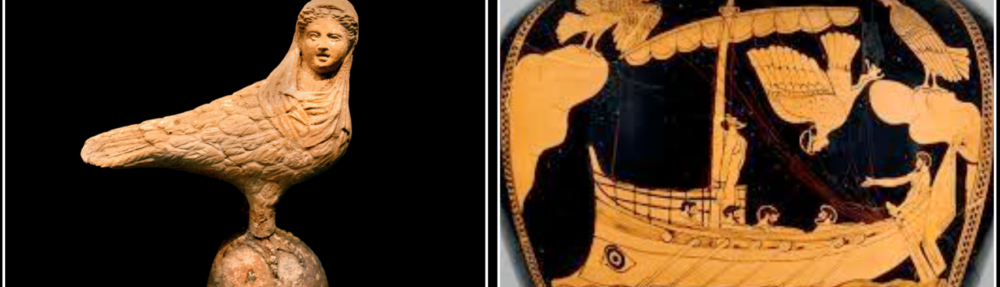
The Beauty of Mermaids vs. The Fear of Sirens
The topic I want to explore in this week’s blog post is the power of the sirens’ knowledge in unison with humans’ dying quest for knowledge. To my previous knowledge, sirens lured men through their beauty and men’s sexual desires, as the men were unable to resist the temptation of such beautiful women. After reading, I learned this perspective wrong and sailors were attracted to the knowledge the sirens had to share. I have long thought of sirens as monsters rather than well-versed beings of the universe and have perceived the mermaid as a hierarchical figure.
Why is it that the sirens who share knowledge, have developed the reputation of monsters, but the beautiful mermaids are renowned for their popularity? What does this belief say about a human woman and the response when they possess complex knowledge versus simple beauty? I honestly find this relationship difficult to investigate because there are so many implications and questions embedded within it.
On page 9 of Odysseus and the Sirens, it states, “Sirens deduce: lead astray, diver, lead elsewhere, persuaded to desert one’s allegiance, corrupt.” I found this quote interesting because of the Siren’s representation as deceitful and “corrupt” which may still be interpreted as so. The Siren is meant to tempt men with their knowledge, so far that it leads them men to their deaths. We have talked about the correlation between Adam and Eve with this similar temptation, and human’s natural reaction to falling for temptation.
“The lure and knowledge the Sirens held in antiquity had to do with life and death, or knowing the future beyond human ability so much with sexuality” ( page, 9). Sirens are the ultimate possessor of knowledge which is why they are so enticing. Since the dawn of time, humans have strived for knowledge and even killed to obtain it, yet we fear it and those who possess it. Although their possession of knowledge is feared ( which makes sense because it kills you), I think this has a possible tie to the fear of human women “knowing”. Over centuries woman have been suppressed to limit their knowledge, as they have been boarded for the workplace, education, etc. Yet these siren’s knowledge is limitless and they are represented as monsters because of their knowledge. When we look at the typical depiction of a mermaid and their beauty they are looked up to, in the church in society, etc. for their sexual representation and beauty. This is the same for woman as woman with beauty are praised and looked up to as idols, their lack of knowledge is what people hope for.
Why is it that a woman possessing knowledge is feared but a woman possessing beauty is expected?
The Human Woman and Mermaids-A degration
One of the major themes that I found when reading Vaughn Scibner’s, Merpeople: A Human History, was the degradation and defamation of feminity and womanhood as a whole. This stood out to me because my personal beliefs revolving around mermaids focus solely on their beauty and praise of feminity, not on their negative associations. Keeping this in mind many questions arose when thinking of this concept, how does the role of mermaids attempt to tame and train women? What do depictions/ texts about mermaids reveal about women’s relationships at the time? How did a mermaid’s sexual appeal build over time” And What does the depiction of mermaids and mermen express about genre roles, specifically opinions on women? I would love to touch on every one of these specifically but I want to dive into the overall concept and think of all of these questions under one bubble.
On page 41, he states the idea that medieval church men had the “ultimate goal remained tethered to decentring the feminine. Hence the repeating image of mermaids as dangerous, passionate, sexual beings…”(Scribner, 41) Mermaids were often depicted to be enticing representations of sin and deception, which I believe was to scare human women. Depictions and stories constantly disrespect the mermaid figure and blatantly say that their depictions were intended to tear down the representation of women. A similar concept continues with the idea of “equating femininity with inferiority. Renaissance woman accordingly experienced a fringe existence in public society” (Scribner, 61) where one can truly see the connection drawn between mermaids and women. The intention behind this quote is a negative, and attempts to degrade/ oppress not only the mermaid but the woman as a whole.
“Nevertheless, mermen remained clear reflections of the Church’s ability to merge the wondrous and the religious sin in an effort to denigrate femininity while vaulting men to positions of prominence and piety ” ( Scribner, 53) Rather than focus on the mermaid, this quote focuses on the depiction of the mermaid to express the concept of opinions on women and taming the woman figure. The words hold negative connotations and denotation, using the words, ” denigrate feminity” yet the “prominence” of the male figure. These phrases juxtapose each other in the most clear way, showcasing a revelation about women in literature and art in a negative light.
While I focused on the negative depictions/relationship between womanhood and mermaids, mermaids can be depicted to signify beauty, strength, and popularity. Throughout the book, one can clearly see the changing attitudes and depictions, from beauty to fear to sin, etc. This is the duality of the mermaid in the most pure form and represents a tie between womanhood and the depiction of mermaids.
Introduction- Mikena Palumbo
Hello everyone! My name is Mikena Palumbo and I am a second-year Business Administration major, and am debating switching to Management Information Systems. I am originally from Long Beach, California, and I love the culture of SoCal. I chose San Diego State because it was the perfect distance away from home and allowed me to be in Southern California. I am obsessed with the warm California weather and am far from being built for cold weather.
In my personal life, I love to go to the gym as well as train my friends in the gym, play volleyball, go to the beach, explore new places around San Diego, etc. Most of my hobbies are focused around friends and fitness, which are two things I place heavy importance on. I have two twin sisters who are younger than me and love teaching them about my hobbies and learning about theirs.
In my school life, I am involved in a professional co-ed business fraternity. I have been involved in this organization for the past year and am currently the Senior Vice president. This is my biggest academic endeavor currently and is something that is very very important to my life. I live on campus with eight girl roommates which can be quite chaotic but also keeps my home very active and fun.
Looking forward to meeting you all!!


