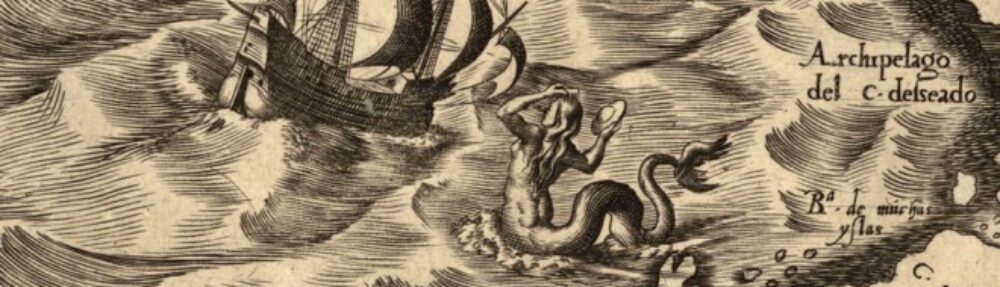
While reading Undine, it is evident that there are some parallels between human and non-human relationships amongst various mermaid stores. It is interesting to me that most of these tales of love pertain to a female mermaid and a male nonhuman and their attempt at romance. If we are supposed to be learning a lesson from the patterns, it is understood they don’t mesh well. I am curious to know how dynamic character development will be surrounding these relationships. Will human non human romance always fail? Don’t mean to make a generalization, but from analyzing the texts we have already read and the films we have watched we can gather this as a common theme. Having talked about the idea of love and the different perspectives we create that come from influence, I am eager to see if these ideas connect. To be even more abstract, does the love fail in order to prove Undine’s connection with the natural world is too strong? She exclaims how the natural world is and “wonderful salamanders glitter and sport in the flames: lean and malicous gnomes dwell deep within the earth: spirits, belonging to the air, wander through the forests: and a vast family of water spirits live in the lakes and streams and brooks”(p. 104).
Author Archives: Kayla Poland
Week 5: Legend of Melusina
“The Legend of Melusina” seems to be the first tale we have studied this far where a hybrid only takes its shape one a week, in this case on Saturday’s. Not only did that surprise me, but so did Raymond’s reaction when uncovered Melusina’s secret. I honestly expected a more negative reaction because of her ability to shape shift into various forms. It is said that “It was not horror that seized him at the sight, it as infinite anguish at the reflection that through his breach of faith he might lose his lovely wife forever”(p. 88). This story is the first time a mermaid has been seen for her true self by a man, and it seems as if the relationship between them is more genuine than in what we have studied in the past. I bring this up based on my original curiosity surrounding the idea of gender roles and femininity. I am interested to see how dynamics change through different works of literature and what this has to do with the type of hybrid creature, or the fact that she is mostly human? By that I mean if it was more than just Saturday that she became hybrid, would that change the way the story goes?
Week 4: Gender Roles in Penguin Classics
This week I am focusing on gender roles with context from the stories in the Penguin Book of Mermaids, particularly in comparison to the mermaid stories we have already read. I would like to add on to what we discussed in class previously, about the gender roles that were exemplified in various texts. We understand that mermaids are sought after my men because of temptation, fertility, etc., but in the story of Oannes we learn that this part fish man is knowledgeable in “many fields and “he taught them to construct houses, to found temples, to compile laws, and explained to the principles of geometric knowledge”( P. 4). This just goes to show that the man was historically seen as higher, more powerful even in the from of a hybrid beast.
Similar ideas are demonstrated in “Odysseus and the Sirens”, while all these creatures are similar in physical abilities they male versions always seem to be the ones in charge. I can connect this idea to the maritime community, as sailing is a very male dominated world, and even to this day the boats are referred to as “she”, as in “I cleaned er up she looks real nice”. This to me is a tell tail of the culture behind ocean myths, at least in the the culture I have been involved in. This is all brought up not to repeat same conversation, but to ask when will these perspectives change. Of course we understand the recent phenomenons of mermaids, but is there a turning point?
Week 3: Penguin Book of Mermaids
The The Penguin Book of Mermaids begins by discussing the history of mermaids from various perspectives. I found this information to be necessary as a precursor to our studies, especially for us who have a lack of knowledge on the subject. I thought it was interesting that we discussed the human views of nonhuman and monstrous beings in class, and that it was demonstrated again in the idea that “There is something deeply unsettling about a being whose form merges the human with the nonhuman”(p. xi). This made me wonder what direction the stories in this book will lead towards, whether they will admire the nonhuman or not. What is so unsettling? Is this just human opinion or do these creatures have evil traits? I am curious to uncover the truth from each culture.
Another point I find fascinating, is the course of a story and how “stories move about in the world in ways that are comparable to ocean currents, following a course as they move”(xv). First off, I think this is a fantastic metaphor to describe the constant evolution of story telling and it brings up a great point. How do we know what began in these stories and what has shifted through storytelling? I am eager to keep reading to uncover these mysteries.
Merpeople
In Merpeople “A Human History” the historical background of mermaids is discussed and has brought a great amount of new perspectives. Prior to this my understanding of mermaids was slim to none, sure I have enjoyed fictional works with mermaids, but I have never questioned the history behind these creatures. After studying this I am fascinated but also not surprised as the traditional views of women remain similar to the historic understanding mermaids. The way that mermaids are perceived as sexual and objective is similar to the way that women were, and still are, viewed in life and various fictions. Similarly, stereotypes between mermen and man linger simultaneously. The idea that they are with “lust for sex and power”( Scribner,11) does not fall short of how they are perceived in a non-mermaid world. With that being said, there are ways were I can connect the two and reiterate that merpeople are used “to gain a deeper understanding of one of the mysterious, capricious and dangerous creatures on Earth: humans( Scribner, 7).
On the contrary, there are surely some ideas that have come to my surprise. Specifically, the fact that religion plays great a role in the history of mermaids. What specifically caught my attention is how the Christian Church typically encourages a modest, more reserved lifestyle yet the mermaid was deemed such a sexual creature. Considering my lack of previous study on this topic, I am interested to see how mermaids are perceived and understood in different religions apart from the Disney films I have seen. I guess my knowledge also comes from a very specific type of mermaid film, and one thats audience is much younger. I am excited to broaden my understanding and learn more about this character.
Introduction
Hi my name is Kayla and I just transferred from Santa Barbara City College. I was born in Virginia and lived there until I moved to Santa Barbara when I was 15. Not sure how I lived away from the ocean, because now most of my hobbies revolve around the water. I am studying communications here but pondering declaring a major in sustainability. I figured this was a good major for someone like me, who changes my mind quite often. I was drawn to this class because I love literature and the environment separately and am interested in studying the correlation between the two. I also love mermaids so that is a plus!
Outside of school I try to keep myself busy, and enjoy pretty much any activity outside. This past year I got super into sailing and surfing and I plan to get my captains license after I graduate. As of right now my dream is to do sailboat deliveries and travel the world via the water. Until then, I am excited to expand my knowledge and grow my mind.