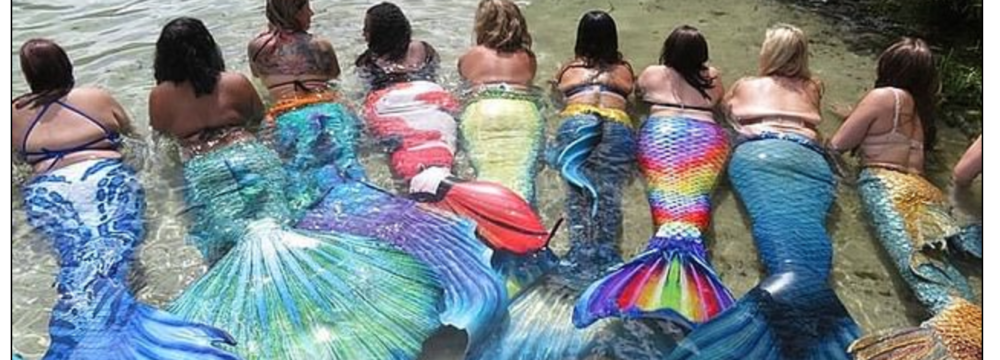
For this week’s reading, I really enjoyed learning the story of the “The Little Mermaid.” Being such a big fan of the original 1989 movie, I found it quite interesting reading the story for the first time and seeing the continuous theme from both the movie and the original story about the fascination of the unknown from both the merpeople and humans. Being such a big theme in a lot of the past readings we have done, the fascination of the unknown was definitely prevalent in the reading, “What struck her as the most beautiful was that the flowers of the earth should shed perfumes, which they do not below the sea; that the forests were green, and that the fishes amongst the trees should sing so loud and so exquisitely that it must be a treat to hear them” (Penguin, page 110). Not yet being able to go above the water till she is fifteen the little mermaid throughout the whole story, “Longed after all these things, just because she could not approach them,” I am very fascinated by this idea because humans as well do this in attempts to understand certain things (Penguin, page 111). As well, their fascination is conveyed the constant use of similes and metaphors when describing the land above which furthers the idea of the fascination of the unknown. Humans and Mermaids, since they are half human, share this quality of curiosity which can thus continue the argument that mermaids ( and thus the environment) should be treated equally as they are part human as well. But a quote that stood out to me, that can argue as much as mermaids are half human, they yet are still not seen or treated as equal because “Mermaids have no tears, and therefore suffer all the more,” and this emphasis that though the upper half of their bodies are of human description, they do not carry the emotion or “soul” that humans contain since they are not able to display their emotions fully because they cannot abide on land (Penguin, page 113).
Author Archives: Emmanuel Alvarez
The Modern Era: 19th C Industrialism & Capitalism
For this week’s reading I found it to be a fairly easy to understand and straightforward reading. I really enjoyed reading the story of Undine, and its parallels to the story of The Little Mermaid. Being such a big fan of the film and the story of The Little Mermaid it was interesting to see kind of similarities and origins of that story in the reading this week about Undine. “In both stories, a beautiful mermaid is loyal to her human love object and inspired by the prospect of acquiring a soul,” although in Hans Christian Anderson’s version we don’t see that side of acquiring a soul and more of giving her voice to be able to be with her love (Penguin, page 101). As well we saw a parallel with Undine and how she portrays her true form to Huldbrand and how although she is not human he still loves her, similarly to Hans Christian Anderson’s version. But the part of her story that stuck out to me is when she says to Hulbrand, “Our condition would be far superior to that of other human beings, – for human beings we call ourselves, being similar to them in form and in culture, – but there is on evil peculiar to us. We and our like in the other elements, vanish unit dust, and pass away, body and spirit” (Penguin, page 105). I thought this quote stuck out to me because it reminded me a lot of what the Bible says about humans, “For you are dust, and to dust you shall return” (Genesis 3:19). I think this is important and connects to point of the class because as much as people want to separate humans from mermaids and other beings and argue that they are different, they are still half human and because of that they as well like us return back to dust; and thus we have to be able to respect them and treat the idea of mermaids (and to an extent the environment) with equality as we do with people.
Week 5: Medieval Melusine
For this week’s reading I found it fairly interesting in regards to” mermaids” finally being incorporated into the lives of individuals. As well as finally having that sense of a fairytale story and falling in love. In past week’s readings it has been more based on individual stories about mermaids and their own individual stories but not really intertwined with the lives of regular people and their connection. I particularly liked the sense of romance in this week’s reading with the legend of Melusina. I think this will now open the door for how we see, “Mermaid stories that focus on a water being’s life in the human social world” (Bacchilega, page 85). Although the story of Melusina and Raymond was not lengthy, their interaction can still be discussed, I particularly thought that their love for one another was almost superficial. For one, Raymond didn’t even know Melusina’s name after their interaction; as well during their interaction Raymond was paying fairly close attention, “From her beautiful breasts his gaze descended” (Knight, page 26) conveying him focusing more on her exterior and not paying attention to her and what she’s saying. Their love and eventually their marriage seemed very transactional, since Raymond was going to be able to hide his crime of murdering his uncle and Melusina would be able to get married, so their whole interaction seemed very fictitious and occurred very quickly. But I am excited to finally get into reading with individuals’ direct interactions with mermaids. Also, I did not see the deeper understanding or themes in this story so I hope to come more enlightened and be able to see the deeper meaning.
Week 4: Ancient Origin Myths
For this week’s reading I found it fairly interesting and quite fascinating because I really like the specific reading of “Sedna.” When starting the reading it already caught my attention because of the fact that the story was talking about a woman / mermaid having power and control over something, whereas in past readings mermaids were not given this much power and was seen as less than; “A young woman becomes the mother of all sea creatures. As the sea goddess, Sedna has dominion over her creatures and controls the availability of seal, walrus, fish, whale, and other sea animals to Inuit hunters” (Lenore Lindeman). This story particularly got my attention because it was talking about a woman being more self assured and strong as opposed to oppressing women / mermaids in previous readings. As well, in the reading I found some correlations between this story and some Disney princesses, and loving Disney so much I found it quite amusing seeing parallels in the story. For example Sedna reminds me of Pocahontas when the story says, “Many Inuit men desired Sedna for a wife and asked her parents for permission to marry her. But Sedna refused them all. Even when her parents insisted it was time for her to marry she refused to follow tradition and obey them” (Lenore Lindeman). Similar to Pocahontas, Sedna refused the hand of men and was not afraid to refuse tradition, which I thought was exciting to see women / mermaids having power over something and not needing to conform to others. Also when I continued to read, I saw a similar correlation to another Disney movie, specifically Moana and the Goddess Te Fiti because it says, “Sedna now controls all of the animals of the sea. The Inuit who rely on these animals want to maintain a good relationship with Sedna, so that she will continue to allow her animals to make themselves available to the hunters” (Lenore Lindeman). I particularly saw this connection because in the movie the island people are always talking about how they need to have a good relationship with Te Fiti so that their island can prosper, and seeing the parallel in this story about needing to have a good connection with Sedna to be able to have food reminded me of the movie Moana. My favorite part of the story is when it talks about men needing to do tasks to be able to please Sedna, “He or she will swim down to the bottom of the ocean to appease Sedna the Sea Goddess. The Shaman will comb the tangles out of Sedna’s hair and put it into braids. This makes her happy and soothes her anger” (Lenore Lindeman). I thought this part quite intriguing because it displays man praising Sedna, a women and mermaid, which we have not seen in past readings where all they talk about is warning others about mermaids and displaying such a negative connotation and trying to control them; where here in this story it conveys the opposite and talks about man trying to appease a mermaid and praising her, which I particularly liked because I’m always happy to see women thriving and in control.
Week 3: : Mermaid as Metaphor and Paradigm for Understanding Culture, History, and the Environment
For this week’s reading I found it fairly interesting in regards to the idea that through the different stories of mermaids and how humans have always had a fascination towards them, we are able to understand the history at the time and the beliefs at the time. The fascination of mermaids and the stories being told were not of fairy tales or fiction, “But as myths and legends,” with that being said individuals, “believed or believe in the material and/or symbolic truth of the tale” of mermaids (Cristina, page 16). Along with this idea of our constant fascination with mermaids throughout the years, it brings up the question of “What does our fascination with this dangerous yet desirable other suggest about us” (Cristina, page 14)? To answer this question one can look back to past stories where it is said that, “Beauty can be a powerful weapon – a lure that draws us nearer, a temptation that we are unable to resist … They (as in mermaids) reflect our fascination with and fear of female bodies” (Cristina, page 14). These misogynistic views of mermaids have been used in the past during times when women were associated with such a negative connotation, and it aids in conveying the history of how women and mermaids were thought of and treated, “The appellation of prostitutes as “mermaids” in early modern British culture likewise attests to how a woman who oversteps the boundaries of gender propriety has, over centuries risked being defined as monstrous” (Cristina, page 13). But as time goes by and looking at a different location, individuals are able to see the growth of what mermaids are representing and viewed in a more positive light, for example in hawaiian stories, “There are no tales of men who try to tame their mo’o (mermaid) partners because the mo’o like the features of water they embody; cannot be contained or domesticated. Thus, the confluence of anthropocentrism and misogyny often found in European tales is absent” (Cristina, page 20). The idea of mermaids thus is seen as more an embodiment of nature and beauty and not in a negative sense as seen in early British culture. The hawaiian stories of mermaids in a sense uplift mermaids, and in a way women, and in the stories turn the tables to the men to control their desires because these beings are beautiful, “Rather than cautionshing men against the dangerous power of powerful female beings in the European tales, these tales enjoin respect for nonhuman life and divine power” (Cristina, page 20). So as the years go by the idea of mermaids has grown to be more of an uplifting idea and a way to express oneself and the reimagined figure allows for, “ Fluid feminine self-possession or playful queerness. If the mermaids overstepping the boundaries of gender or sexual propriety is transgressive, it is embraced as such, and not punished” (Cristina, page 22). Thus again, through the foretelling of stories throughout the years and in different cultures about mermaids, individuals are able to see the timeline and progress of society that was occurring.
Week 2: Human History through Mermaids
For this week’s reading I found it fairly interesting in regards to getting to know the origin and history of the mermaid and how the fascination came about. While reading the text I found that the origin began from the idea of trying to “cultivate the largest following possible” for the early christian churches by trying to embrace a mix of pagan and christian beliefs; thus introducing the idea of mermaids and merpeople to the church (Scribner, page 15). The first introduction of mermaids from the church began with Atargatis, when comparing mermen and mermaids the church often would depict mermaids as the more dangerous type. So in regards to the female prototype for mermaids, “Atargatis symbolized the danger of love and lust an association which christians would later embrace wholeheartedly,” and that is a theme that I saw when doing the reading this week that the church men would depict only female merpeople as the more threatening type (Scribner, page 10). Again men degrading women for their own selfish needs, in this case trying to grow a religion. Even with the origin story of mermen and mermaids the difference was very much there, “Mermen found their origins in a greek god, mermaids largely originated from hideous beasts who only intended to bring man to destruction through his own lust for sex and power,” this clear distinction of men again making women seem less than or even a danger was all because the “christian churchmen were on a mission to dethrone femininity” (Scribner, page 11). With making these female creatures seem like a threat to men, church men also overly sexualized mermaids to again emphasize the lust and the only purpose that these mermaids had, which was another theme I recognized. “Churchmen especially adopted these pagan creatures in an effort to depreciate the feminine – hence the overtly sexual representation of mermaids in church carvings, bestiaries, illuminated texts, and artwork” (Scribner, page 11-12). With creating nude art and carvings of mermaids and putting them in churches, churchmen were further emphasizing the purpose of these beings and just the female body for only sexual purposes. Thus again the idea and pattern of men exploiting women and creating narratives to only benefit themselves.
Introduction
Hi Everyone,
My name is Emmanuel Alvarez and I’m sophomore here at SDSU. I am majoring in marine biology and am minoring in interdisciplinary studies through the honors college. Even though I am majoring in a very science based field I have always had a special place for anything to do with literature, as well being a marine biology major and loving anything to do with mermaids I became very interested in joining this class and it would be cool to be able to correlate tops that we study in class to my major.
When I am in San Diego I love to take advantage of this wonderful weather so I try to be outside as often as possible. I love exploring the different beaches and going swimming in the beautiful water, as well I love to collect seashells while on the beach. I also really like to try new cafes, go on walks, hang with friends, and reading books. Right now I’m reading Emma by Jane Austin and its so interesting. I am excited to meet everyone in this class and hope we can have a good semester.