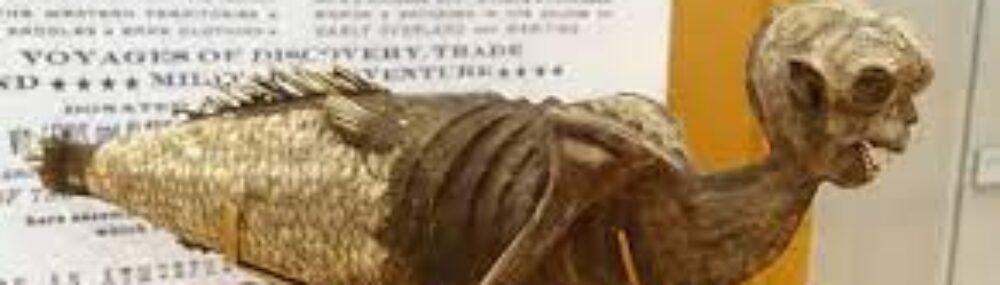
At first glance, “ The Legend of Sedna the Sea Goddess” appears to be a cautionary tale which warns about the consequences of deviating from the traditional norms of marriage. Sedna didn’t want to marry and when she finally does she is betrayed and ends up with the “ head and torso of a woman and the tail of a fish.” Yet, upon deeper analysis, the story allows for the exploration of Inuit culture through the hybrid body of Sedna in order to explore what this story entails about Inuits’ relationship to sacrifice, spirituality, and nature.
To start, Sedna allows for the exploration of sacrifice in Inuits culture. Fearing the unsteady nature of their kayak during a storm, Sedna’s father makes the choice to sever her fingers, joint by joint. On one hand, it symbolizes the sacrifice made to restore equilibrium to the kayak, emphasizing the immediate need for balance in the face of danger. However, the story takes a turn as each severed finger transforms into sea creatures like “fish, seals, walruses, and whales,” Sedna’s sacrifice ultimately becomes a resource for the entire Inuit community and she beholds the power over them. The emergence of varied sea creatures therefore shows that sacrifices, no matter how painful, contribute to the balance of nature and the prosperity of the community.
In addition, Spirituality is a crucial part of Inuit culture that is further explored through Sedna. After being thrown from the kayak, Sedna is described as having transformed into a spirit, “Sedna sank to the bottom of the ocean and there became a powerful spirit.” In this sense, spirits transcend life and are depicted as something eternal. They believe this spirit has power over the animals in the sea which is an important resource to them. This goes to show how strong their belief in spiritual powers are. Their belief in this spirit is so deep that they even have taboos they follow to show their respect for her, like “when a seal is killed it must be given a drink of fresh water, not salt water” giving the seal fresh water adds to this respect and the appreciation of the sacrifice of the seals life. To add onto this, it is said that “ If the hunters do not catch anything for a long time, the Shaman will transform himself into a fish” and “appease Sedna.” The idea that the Shaman can transform themselves to meet Sedna in the case she becomes upset and their access to sea creatures becomes threatened, strengthens the belief that having a good spirit and following taboos and rituals are crucial and can affect the balance of nature.
Furthermore, the harmonious relationship that the Inuit have with Sedna serves as a reflection of the relationship they have with nature, specifically with the sea. As detailed in the story, “The Inuit who rely on these animals want to maintain a good relationship with Sedna, so that she will continue to allow her animals to make themselves available to the hunters.” Since Sedna is what stands in between the Inuits and their access to the sea creatures, a harmonious relationship is important. The sea creatures Sedna controls is a crucial resource to Inuit hunters as it provides them with “food, clothes, and shelter.” As mentioned in the previous paragraph, the Shaman transforms themselves to make Sedna happy which is interesting and adds to the relationship between the Inuit and nature, “ The Shaman will comb the tangles out of Sedna’s hair and put it into braids.” Rather than approaching Sedna with fear, the Inuit have respect, nurturing, and care for her. On the same note, this also depicts the Inuits relationship to the sea and how they don’t exploit it for its resources but instead appreciate it and have gratitude.
Overall, “ The Legend of Sedna the Sea Goddess” transcends its initial appearance as a cautionary tale and becomes an in-depth examination of Inuit culture, particularly when it comes to sacrifice, spirituality, and nature. Sednas sacrifice reinforces the Inuits belief that sacrifice can contribute to the greater good, spirituality shows how a good spirit can have an influence towards the natural world, and the Inuits harmonic relationship with Sedna embodies their relationship with nature.
Works Cited
Lindeman, Lenore. “The Legend of Sedna the Sea Goddess.” Sedna or Sanna the Sea Goddess of the Inuit, www.palomar.edu/users/scrouthamel/ais100/sedna.htm. Accessed 1 Mar. 2024.