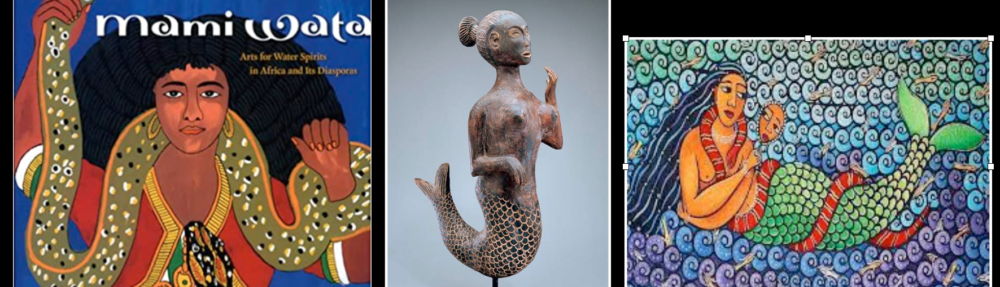
While reading the article published, “The Mermaid” I was interested in how the depictions of the mermaid change so radically when race is added to the mythology. The mermaid stories we have read so far are always explicit in stating the beauty of the mermaid’s human half. So beautiful as to seem ethereal and other worldly. The source of evil and ugliness is always relegated to their animalistic lower half. On Page 234 of the text we get two completely different depictions of non-white/western mermaids. On the first one the article says, “It was a female with, with ugly negro features. The skin was harsh, the ears very large, and the back parts and tail were covered with scales.” This stands in such stark contrast with the previous descriptions we have previously encountered. The text explicitly state that this mermaid is not beautiful because of its ethnic features. Where the mermaid’s skin was previously pearlescent and so transparently white as to almost seem spirit like, this mermaid is described as having harsh skin. Though the description is brief it also gives the sense that it focuses more on how far from humanity this creature is. It struck me that it mentions the position of the mermaid when at rest. The text says “It’s position, when at rest, is always erect”. I don’t know if this is intended to be sexually suggestive but I am also considering that there is a history of Black bodies, particularly women’s bodies, being highly sexualized by the western world.
The second mermaid description that I noted is on the same page and it is describing a mermaid found in the Archipelagos of the Aegan Sea. This mermaid is described in fuller detail and it the text immediately zeroes in on its similarity to a young female human. Already this mermaid is placed in closer relation to humanity than the first mermaid. That being said she still has enough of that “exoticism” that the western world was so fascinated by in relation of Asian countries. She is not afforded the mythical flowing hair of western mermaids. Instead this one has “gills for respiration, which appear like curls… this one only has rolls which, at a distance, might be mistaken for short curls.” After this the article also mentions that she seems to have fins and her temples as if she was wearing a headdress. Here we see that this mermaid does not have the typical human head and torso and fish tail. It’s animal-like properties are distributed across her entire body.
Hi Lixia! I think that your analysis really helped to capture how racist viewpoints/language affect the way mermaids are presented.
Hi Lixia, I found your blog post so interesting! I had noticed how race had influenced the descriptions of mermaids, but your explanation made me realize just how large of a role race played. Your post has inspired me to pay a lot closer attention to the language used when describing mermaids.