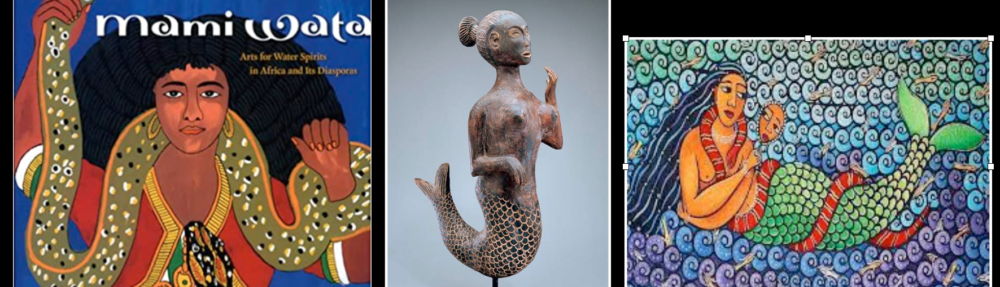
Even though in this weeks’ reading we have learned about different water beings or other half-human half-animal monsters from different cultures, I liked the first reading about Oannes the most. Through the text I gained a better understanding of the relationship between humans, nature and half-human beings. Oannes was described as an amphibious being which had the form of a fish with the head of a man under his fish’s head and the feet of a man under its fish tail that allows him to exist on land and interact with humans (p.3). Apart from that Oannes was able to articulate and communicate in a human language.
When I first read about that I was thinking about what we discussed in class. We came up with the conclusion that every monster figure has human characteristics. It was striking to me to see how this time with Oannes it is not a water being which is split into half but that it rather has the whole body of a fish and then a whole body of a human conjoint into one figure. Through that we can see that the fish body represents Oannes’ deep connection to the aquatic life through a special focus on the fish’s body
I have tried to look up further information on the value of water in Mesopotamia and found it highly interesting that the name itself is a Greek word meaning “between rivers” which according to my research means that the region itself is in between the two rivers Tigris and Euphrates (Soden 2023). Undoubtedly that already shows that Mesopotamians valued water. But what I found even more interesting is how it is emphasized that water was used not only for drinking but also for irrigation, construction, and trade, which emphasizes that water and especially the environment Mesopotamians found themselves in are a source of life. Oannes is in my opinion like an intermediator between spirit and earth and can bridge between the human world and everything which goes beyond that.
What I thought even more interesting is that Oannes is the keeper of knowledge who gave men “an insight into letters, and sciences, and every kind of art” (p.4). But not only that. Oannes also “taught them to construct houses, to found temples, to compile laws […] and showed them how to collect fruits” (p.4). Oannes was thus humanizing mankind and helped the humans. When I thought about that statement a little bit longer, I was pleased to finally say that we found a water being which is not only shown as something dangerous or sinful. The Mesopotamians have looked up to Oannes as someone who is God-like and as someone who has a lot of wisdom. Reading the story made me realize that the people have a deep appreciation for the nature and especially for the ocean, as they actually recognize and value what it has to offer. Through the help of Oannes, you can learn to work with the nature and to even stay alive through the nature in difficult times. That makes Oannes’ work wholesome to me!
Works cited:
Bacchilega, C., & Brown, M. A. (Eds.). (2019). The Penguin book of mermaids. Penguin.
Soden et. Al (2023). history of Mesopotamia. Encyclopedia Britannica. https://www.britannica.com/place/Mesopotamia-historical-region-Asia
Great post that shows you reflecting and developing your thoughts, even doing further research as you explore. Eager to hear more from you in class!
Wow Lena! I love how you did outside research and tied it back into the story that you found the most interesting. I also found this story interesting, and was able to get a lot of information from your blog post. I love how you brought in the idea of appreciation for nature and the ocean as it is used to sustain the Mesoptamians life and their life systems. I like how you include the world wholesome because I think that these stories can have hidden “wholesomeness” to them, especially if the stories can be associated back to our morals and childhood roots.