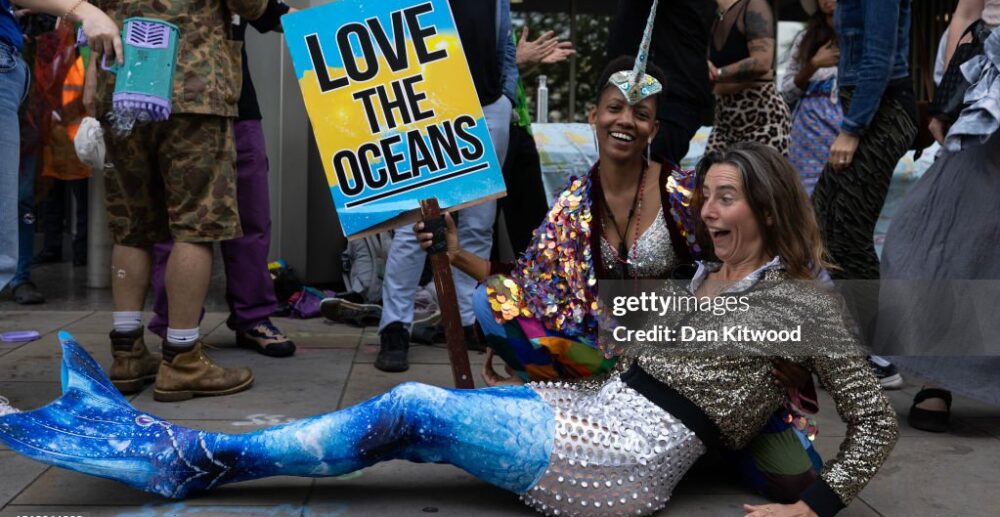
For this week’s reading I found it fairly interesting in regards to the idea that through the different stories of mermaids and how humans have always had a fascination towards them, we are able to understand the history at the time and the beliefs at the time. The fascination of mermaids and the stories being told were not of fairy tales or fiction, “But as myths and legends,” with that being said individuals, “believed or believe in the material and/or symbolic truth of the tale” of mermaids (Cristina, page 16). Along with this idea of our constant fascination with mermaids throughout the years, it brings up the question of “What does our fascination with this dangerous yet desirable other suggest about us” (Cristina, page 14)? To answer this question one can look back to past stories where it is said that, “Beauty can be a powerful weapon – a lure that draws us nearer, a temptation that we are unable to resist … They (as in mermaids) reflect our fascination with and fear of female bodies” (Cristina, page 14). These misogynistic views of mermaids have been used in the past during times when women were associated with such a negative connotation, and it aids in conveying the history of how women and mermaids were thought of and treated, “The appellation of prostitutes as “mermaids” in early modern British culture likewise attests to how a woman who oversteps the boundaries of gender propriety has, over centuries risked being defined as monstrous” (Cristina, page 13). But as time goes by and looking at a different location, individuals are able to see the growth of what mermaids are representing and viewed in a more positive light, for example in hawaiian stories, “There are no tales of men who try to tame their mo’o (mermaid) partners because the mo’o like the features of water they embody; cannot be contained or domesticated. Thus, the confluence of anthropocentrism and misogyny often found in European tales is absent” (Cristina, page 20). The idea of mermaids thus is seen as more an embodiment of nature and beauty and not in a negative sense as seen in early British culture. The hawaiian stories of mermaids in a sense uplift mermaids, and in a way women, and in the stories turn the tables to the men to control their desires because these beings are beautiful, “Rather than cautionshing men against the dangerous power of powerful female beings in the European tales, these tales enjoin respect for nonhuman life and divine power” (Cristina, page 20). So as the years go by the idea of mermaids has grown to be more of an uplifting idea and a way to express oneself and the reimagined figure allows for, “ Fluid feminine self-possession or playful queerness. If the mermaids overstepping the boundaries of gender or sexual propriety is transgressive, it is embraced as such, and not punished” (Cristina, page 22). Thus again, through the foretelling of stories throughout the years and in different cultures about mermaids, individuals are able to see the timeline and progress of society that was occurring.
Literature and the Environment: Mermaids
Professor Jessica Pressman. Spring 2024
You are definitely understanding the larger point of our study– the use mermaid stories in order to read and understand changes in culture(s). I will be eager to hear more from you in class on this meta-critical perspective. Nice blog!