Introduction

Hi all, my name is Casey Meyer and I am in my last semester at SDSU. I am a marketing major with a sustainability minor and have a strong passion for the environment and keeping it safe. In my free time I love to surf or at the very least be outdoors. I was born and raised near the beach in Los Angeles and after moving down here I realized I could never get away.

In all honesty, I had no idea this class was centered around mermaids until the syllabus came out, but all things considered I am pretty stoked to better my writing and analytical skills through the scope of mermaids. On top of that, I have a strong connection with the ocean and all of its creatures, which furthers my excitement for starting this class!

Introduction

Hello, everyone! My name is Ana, I am an English major, and I am a transfer student from Southwestern College. I’m technically in my junior year here at SDSU, but this is my second semester here. I was born in the Philippines but moved to San Diego with my family when I was 10 years old. I live in the South Bay area of San Diego, super close to the city of Imperial Beach, so it’s quite a commute from there to this campus.

Because I’ve never lived in a place where a beach wasn’t too far away, mermaids had (and will always have) my heart since I was a kid (can you guess what my favorite Disney movie was and still is?). Since hearing about this class, I practically jumped at the opportunity to take it. Mermaids and literature? That’s two of my favorite things in the world! Can you tell I’m excited to take this class and see what the semester brings?

Week 2 – Merpeople : A Human History

After reading this week’s chapter of “Merpeople: A Human History” I learned a lot of new information I had never known before. I don’t have a large background on the history of mermaids and how they were involved in human history, so I did not know that they correlated to Christianity or any religion at all. I found it interesting how the church learned, appreciated, and believed in mermaids through art, sculpture, and myriad texts after such a long time of the Christian church and churchgoers in Europe overly sexualizing mermaids. While I do have the knowledge that mermaids have been sexualized over time, I did not know how the true belief and appreciation of them started.

As Scribner elaborated on the involvement of mermaids in the Christian Church, I was also intrigued by the fact that the Christian Church bridged “the gap between the supposedly ‘savage’ and the civilized,” (Scribner, 16). It is surprising to me that mermaids were accepted because of how the Christian Church portrayed them after it contributed to such extreme sexualization of them. Stories about mermaids today, that I have personally read or seen myself, typically do not have a religious belief tied to their background. The history of mermaids is much different than what is depicted in some popular media today.

While the beliefs and depictions of mermaids have been different throughout history, the Christian Church belief is one that intrigued me most. Comparing how mermaids were seen in different periods gives us a good idea of how we got to where we are today. It helps explain how mermaids are seen now in literature, media, and real-life beliefs. I am excited to expand on this topic through more research and discussion in class.
introduction

My name is Karina Garcia and I’m a social work major. I decided coming in SDSU that I was going to pursue a degree in that field since I’ve been interested in the many different topics that go within one field but also the sense of urgency I have to help people in any way I possibly can. I thought the title of the class was interesting while I was deciding to enroll in it but now knowing that it is more of a focus on mermaids it has caught my attention as I have always questioned if mermaids and other creatures existed outside of the “mythical creatures” category.

I am originally born and raised in a city outside of Los Angeles and moved to San Diego right before I started high school and have been here ever since. I’m currently a full time student and also work at a car dealership. Outside of both school and work I enjoy spending most of my time with my dog, listening to music or spending time with my family.

Introduction- Mikena Palumbo

Hello everyone! My name is Mikena Palumbo and I am a second-year Business Administration major, and am debating switching to Management Information Systems. I am originally from Long Beach, California, and I love the culture of SoCal. I chose San Diego State because it was the perfect distance away from home and allowed me to be in Southern California. I am obsessed with the warm California weather and am far from being built for cold weather.

In my personal life, I love to go to the gym as well as train my friends in the gym, play volleyball, go to the beach, explore new places around San Diego, etc. Most of my hobbies are focused around friends and fitness, which are two things I place heavy importance on. I have two twin sisters who are younger than me and love teaching them about my hobbies and learning about theirs.

In my school life, I am involved in a professional co-ed business fraternity. I have been involved in this organization for the past year and am currently the Senior Vice president. This is my biggest academic endeavor currently and is something that is very very important to my life. I live on campus with eight girl roommates which can be quite chaotic but also keeps my home very active and fun.

Looking forward to meeting you all!!

Week 2

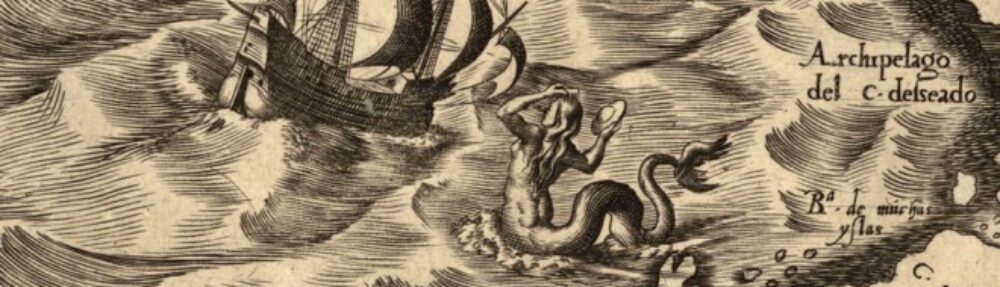
While reading this week’s chapters, I found it very interesting how the discovery of the Americas relates to mermaids. Because the concept of mermaids had already been well established in the Medieval period, when explorers ventured west, they brought their beliefs along with them. Those beliefs led to “mermaid sightings” that then led to images of mermaids being physically distributed more and more through maps. The interaction between the images on those maps and the motivation to explore the world is fascinating. The author explains that “representations [of mermaids] only further primed explorers to find mermaids” (Scribner, p. 19) which encouraged cartographers to keep including mermaids. It makes me wonder how many discoveries that we discussed in school were made because the person initially wanted to find mermaids. 

At the same time, it is intriguing to me that putting mermaids on these maps also indicated a new environment filled with unknown animals, people, etc. In this way, it seems to me that mermaids had an important and impactful role in the colonization of the Americas. There were more motivators during this time than just seeing mermaids, however to the public, it was probably something that made a difference in whether or not they supported these ventures. Mermaids in this sense represent exploration and new opportunities. They were a physical manifestation of the new environments that the Western countries were uncovering.

I also found it interesting that Scribner mentions that the way that each country understood mermaids was a representation of the way that they tried to understand the new worlds that they were discovering. It shows how culture plays an important role in a person’s relationship with the environment. I question if the way that different cultures viewed the mermaid impacted the way they interacted with the ocean. For instance, if a culture feared the mermaid, did they see the ocean as something to conquer?  

Islam and Mermaids

Reading the introduction to “Merpeople” was so insightful because it contained a lot of information and history on the perception of Merpeople, especially from a Christian point of view. First and foremost, I thought it was interesting to read about human fascination with these creatures because when you think about it, mermaids are everywhere! They exist in books, movies, shows, and even toys for children; they also exist in many mediums for adults as well. In my opinion, human fascination with merpeople has a lot to do with animalistic urges that humans have that may not all be understood and/or celebrated. Merpeople are a reflection of a half-human and half-animal creature, but they are depicted in beautiful forms for the most part. Even when they are vicious creatures, they are depicted as beautiful.

Moving forward, the Christian depiction of mermaids was used to “depreciate the feminine” and correlate women with the idea of vanity (pgs. 11-13). As time progressed, eventually mermaids were used almost as a tactic to attract religious acceptance. Reading this was interesting to me because it made me think of what the Islamic perception of mermaids is (I am Muslim). I remember when I was younger, I was told that mermaids exist in heaven, and when men live a “pious” life on earth, they are rewarded with mermaids in heaven. Now, this isn’t a legitimate Islamic belief, but the idea is that it shows how mermaids were used as an incentive for the afterlife, illustrating hope in the form of reward. In Islam, it is also said that creatures that exist on land also exist in different forms in the sea, suggesting the possible belief of the existence of merpeople. This topic is very fun to dive into because it is encouraging me to research deeper into the Islamic perception of mermaids.

About Me

My name is Lixia Peña. my pronouns are she/her/hers I am a transfer student and this is my junior year at San Diego State University. I am an English major and am particularly interested in the art of translating texts. I’m very excited about this class as mermaids have always been one of my favorite mythological creatures. My favorite hobby is reading (of course) and my resolution for this year is to improve my Spanish literacy since it is my first language. I’m excited about all of the discussions that will come out of this class.

On Mermaids, Beowulf and Christianity

One of the aspects that I found most interesting in this week’s reading, was how the Christian church utilized and in some ways adopted the pagan figure of the mermaid in order to convert people to Christianity. It is common knowledge, I believe, that the church often employed this form of appropriation to convert worshippers of pagan religions. One of the topics that most interest me is how Beowulf is another story of pagan origins that was used and re-contextualized by Christian monks in order to promote Christianity. So much so that, the story as we know it today was adapted to the written word and visibly altered by its translator. It is interesting to read the account of Beowulf and see how the author is unable to avoid the staunch paganism of the story yet also makes the contradictory effort to condemn said paganism. A lot of scholarly work also examines the role of Grendel’s mother. She is commonly portrayed as a horrific monster within the narrative and is shunned and treated as a horrific other for being a woman that displays the characteristics that so many men within the story are admired for. It is therefore interesting to me that early concepts of this fish and human hybrid was originally conceived as a male creatures “of knowledge and improvement” (Schribner 30), and when the focus shifts to mermaids they are turned into monsters who often lure people by means of lust, and promises of knowledge. To bring in one more point of connection I recently read an essay of Toni Morrison titled “Unspeakable Things Unspoken” and she mentions how when the Western romantics where creating the cannon of Greece as the pinnacle of western civilization they chose to ignore the role that Egyptians and Semites played in shaping the idea of Greece. To me it seems that Christianity and Racism operate in similar ways to create their systems of power. It will be interesting to me to consider these topics as we go forward in the semester and I would like to consider the role of the environment with the text as we continue on.

Introduction

My name is Rigo De Leon, I am a transfer (junior) here at San Diego State, and I am originally from the Bay Area. I am an economics major, but I love reading and writing as well. Economics was not something I initially wanted to major in, but once I started taking economics classes, I was very happy I ended up with that. Even though I like reading and writing, it is something I only really do when I have to. This is why I am taking this class, but I am working on getting into the habit of reading and writing more on my own. I have only been in San Diego for a few months, but I am loving it so far.

Back in the Bay, I was working full time. Since I have arrived, I have not needed to find a job just yet, which has given me a lot of time for my hobbies. I like making and listening to music, training, cooking, and exploring. My main goals for this semester are landing an internship for the summer and reading at least 2 books a month. I look forward to meeting you all!