Week 2 Merpeople: A Human History

After reading Chapter 1, I was intrigued by the growth of mermaid mythology, which revealed that these enigmatic beings underwent a tremendous shift over the medieval and Renaissance periods. These mythical creatures were diverse, representing both beauty and danger across cultures. As the story evolved into the medieval era, I became interested in how the Church Christianized mermaids. The deliberate use of mermaids in Christian imagery shows a complicated interplay between church power and society narratives. Christianity merged with old pagan ideas, ushering in a new era of mermaid symbolism. The Church’s use of mermaids to communicate ideas about masculinity, femininity, wonder, and danger became an intriguing component of medieval art and sculpture. Moving on to the medieval interpretation, Pliny the Elder’s “Natural History” and later bestiaries depicted tritons and nereids vividly. It was fascinating to see how medieval historians, influenced by Pliny’s descriptions, regarded these beings as half-human, half-fish. The following sexualization of mermaids in illuminated manuscripts was a fascinating look at the junction of religious symbolism and artistic freedom. The contrasted images of mermen, frequently dressed in monk’s robes, emphasized the Church’s emphasis on piety and self-discipline. The recorded encounters with merpeople during medieval times helped to bridge the gap between myth and reality, supporting the Church’s vision. Folktales depicting mermaids as terrible sirens capable of causing men to suffer and die added another layer to the unfolding storyline. The journey through the evolution of mermaid mythology was more than just a chronological progression; it was also an engrossing investigation of the relationship between mythology, religion, and societal attitudes. From ancient myths to Christianized emblems, the mermaid’s transformation reflected larger transformations in cultural perceptions and religious power relations, finally ingraining these mythical figures profoundly into Western folklore and society.

Week One: Introduction

Hi everyone! My name is Elise and I am a second-year Marketing major. I’m from Pennsylvania so I am really grateful to be studying in San Diego. I love spending time outside so San Diego’s weather has been extremely refreshing. Whenever I have free time, I love to bring a book to the beach and read. My time spent reading by the water is what initially sparked my interest in this class. I was unaware that our discussions would focus on mermaids, but I am eager to learn more. I have always found mermaids extremely fascinating but was never given the opportunity to explore this phenomenon. Overall I am extremely excited for this upcoming semester!

Week 2 or 3: Noah as a Merperson

I had a very Catholic/Christian upbringing, so the name Noah and terms like “the Great Deluge” ring a bell or two. I know the gist; God gets angry and wants to essentially factory reset the world. He makes an exception for Noah and his family. He bestows upon him the responsibility of gathering two of every living animal and putting them on a big boat to survive the flood. I’ve seen movies and countless illustrations showing that big boat and the grumpy old man of God who built it – but I’ve never seen or witnessed Noah portrayed as a Merperson.

In Chapter 1 of Merpeople: A Human History, Scribner mentions Noah being depicted as half-man, half-fish. He also mentions that Early Christians saw Noah as “The second father of the human race, and the preserver and teacher of the arts and sciences as they existed before the Great Deluge” (third page of Chapter One). This is super interesting because while mermen symbolize knowledge and religion, Mermaids weren’t held in such high regard by Early Christian leaders. According to Scribner’s book, women were symbols of “lust, weakness, and man’s fall from grace.” But with Mother Mary being a symbol of purity and faith, they had to get creative – and thus, they borrowed the mermaid to make it clear that there’s no correlation between Mary and all the other evil women in the world. While this drastic generalization of women is, on all accounts, silly – nobody can deny that both the mermaid and the merman share a trait -power. Mermens’ power inspires Early Christian men. It almost seems like they are a representation of what man should strive to be—master of men and sea. The power mermaids hold is meant to be interpreted as something to be cautious of. Women tempt men on land; mermaids tempt men at sea? I don’t want to speak too confidently about this, as I am still learning, but I find this line of thought fascinating.

Luckily, my Catholic/Christian upbringing was very loose, and I’m able to freely think for myself. That being said, I read the first chapter out loud to myself and thought the Early Christian interpretations of women and mermaids were wild.

Week 3: Merpeople Reflecton

While reading through the assigned chapters in Merpeople, I was continuously making connections with last class discussion about the image that was presented. A few things I remember that were brought up about the image were the comb and mirror the mermaid was holding and the vegetation the mermaid was surrounded in. In the book Merpeople, it states, “A mermaid’s accessories also revealed deeper symbolism, with her mirror and comb representing vanity…” (pg 13). As for the surrounding vegetation, it wasn’t uncommon for Pagan artwork to include foliage (pg 33, 42), I remember the image was pulled from a religious text so I assess that the religious text had some Pagan background.

Another topic I found interesting were the difference of views between mermaid/merman.  “Westerners, from their very origins, have looked to mermen as arbiters of knowledge, civilization and religion.” (pg 30) While mermaids were viewed as “…hideous beasts who only intended to bring man to destruction through his own lust for sex and power” (pg 11). I was curious as to why they kept denigrating mermaids even though the mermen were of the same species, at least have the mermen possess their own negative traits. Obviously, this was a jab towards the feminine population. I found it funny how in one illustration they even depicted a merman as a monk where instead of having an exposed upperbody, he was wearing a monks robe, “demonstrating men’s proclivity for piety and religious self-control” (pg 51).

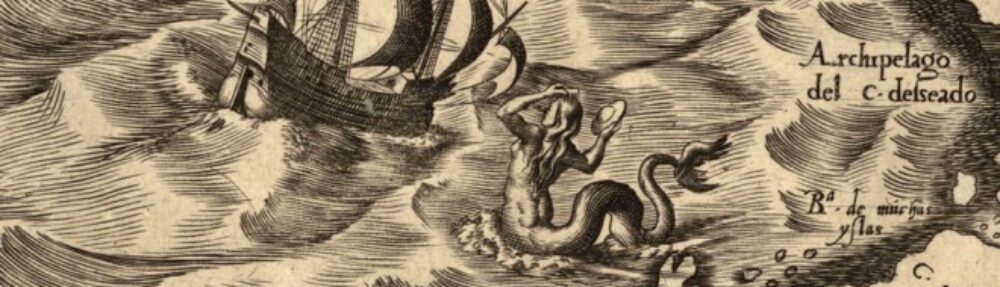
One thing I find interesting was how something so prominent that was included in Church’s decor, bestiaries, folklore all around the world, and even charts used for navigation is rarely spoke about today. Sure there are films being made like The Little Mermaid, but I feel like now it has just become a childhood fantasy. It will be interesting to learn at what time in history did the “hype” around merpeople begin to dissolve and why.

Week 2/3: Merpeople: A Human History

In Merpeople: A Human History, Chapter 1, Medieval Monsters, discusses how the mermaid evolved throughout the Medieval period. During this period, the mermaid defined and reflected Western ideas of religion, sex, and power. This chapter specifically focuses on the Christian churches use of the mermaid. The Christian church and its symbols adapted from the ones of pagan, including mermaids. Similarly, the representation and appearance of Jesus was as well. Because many pagan Gods were both male and female “many early Christian images of Jesus appeared androgynous, with Jesus boasting feminine hips, suggestions of breasts and a beautiful face” (36). The image of a male Jesus we recognize today was created in the Middle Ages as the church tried to distance itself from pagan pasts. 

Mermaids became a symbol of the church and evolved from a more hideous creature to an enticing and female creature. Mermaids became overly feminine, for the church women representing lust, weakness, and mens falling from grace, and now so did mermaids. But why would illustrations of mermaids be present in a church? As the book says “What better way to demonstrate the titillations of the flesh than to display an enticing image in the holiest of spaces?” (39). The beautiful, female mermaid served as a warning against flesh and desire in the church, which derived greatly from some of the oldest images of mermaids as sirens or half birds. Still, both were made to remind men “of her ability to steal their souls” (41). Like many symbols, the representation and meaning of them changes depending on who controls them, or obtains the “power”. 

Before reading, I was unaware of the history behind how mermaids were represented, and how we’ve come to know them today. I was even shocked at how the image of Jesus was changed and used, similar to the mermaid. 

Week 3: The Penguin Book of Mermaids Introduction

After reading “The Penguin Book of Mermaids” introduction, I got a deeper understanding of the topics we spoke about in class on Thursday. The introduction dives into the idea of mermaids being monsters and what that really means. The introduction also speaks on the feminity of mermaids and how that was perceived differently by different groups throughout time.

This reading intrigued me greatly because it explains beauty as a dangerous or even monstrous trait. Mermaids are typically depicted as gorgeous women on the top half of their bodies. This beauty is something that has been said to allow them to lure men in and take power over them, which in return makes them dangerous. The reading refers to the definition of a monster as “a portent or prodigious being that defies what is commonly found in nature and thus elicits both fear and awe” (Bacchilega and Brown, xii). This definition derives from the Latin language and sparked a personal interest for me. Monsters are typically thought of as something that is only scary and insights fear. This definition helps explain that a monster, such as a mermaid, can also be looked at in awe.

The reading elaborated on the idea of the fear of mermaids through their environment. Mermaids are creatures of the ocean, an environment humans don’t know much about. While one might think we know a lot about the ocean, only 5% of it has been discovered. Humans tend to fear the unknown, making a creature who is part human and inhabits an environment we don’t know much about scary. I find this extremely interesting and it is a topic I hope to dive deeper into. It intrigues me how we do not know if these creatures are real or what is real about them because we truly know so little about where they reside.

Week 2 or three reading: Mermaids in different cultures

After this weeks reading, in the Penguin Book of mermaids, I noticed the different types of representation of Mermaids in different cultures. I noticed this when reading about sirens versus mermaids, and how they used to be two different distinct creatures that now are sometimes meshed as one. Specifically I can see this difference when they were talking about how the British saw mermaids, and were compared sometimes to prostitutes and sexual symbols instead of monsters. Mermaids had anew definition of what it was to be feminine or sexual, instead of a monster, which what other cultures had seen them as. We can see this with the Greek, who saw them more as Sirens and monsters, who lured men to their death and demise with their song. When contrasting how these two different cultures saw Mermaids/Sirens, I can clearly see the distinction between monsters and humans. Mermaids innately are human-like, human upper body and fish tail, which is why they are seen as creatures. A lot of different cultures have different representations, but most of them are sexualized and objectified in some way. This was quite interesting to read about, and how Mermaids/Sirens are the same and different all at once. There are stories about Mermaids being tamed, mainly in British culture, where they have been more objectified as sex symbols than other cultures. They have been seen as monstrous and sexual at the same time. I found these different cultural representations of the Mermaid to be quite interesting, since I had only really seen the girlish version of the Mermaid, like in Emily Windsnap, which I read as a child, so seeing these more monstrous and sexual representations was quite a different perspective. This view on mermaids and how gender and sexuality comes into the perspective also was an interesting take, and how in different cultures some tired to “tame” mermaids, while some could not. Humans have always had a fascination with mermaids, but different cultures have different takes on this.

Kiersten Brown

Week 2? 3? Reading Post (59 – 99)

I had read that first two chunks of reading last week so I decided to do the third chunk of reading. It opens up with the Renaissance and how discovering the New World had influenced how the Old World saw and interacted with mermaids. Somewhere in the beginning there was a tidbit about how Old Worlders were interacting with the New World environments and how they found opossums. “Though hindsight relegates these creatures
to fantasy, other animals proved very real and just as terrifying to early modern Europeans. The female opossum, for instance, was a strange New World ‘composite creature’, combining parts from Old World animals and humans to create ‘an inorganic multiplicity’.” (page 61, ch 2) I think it really feels like grappling with the strange creatures bolstered the otherness of the mermaid. Especially given what their modern society was, and their modern ideas.

It also, weirdly enough, makes the mermaid feel more natural. When you have creatures like the opposum and maybe even the platypus (dont know if it was named in this portion specifically but it is a mishmash creature), then mermaids by proxy are natural- a mishmash creature. Funnily enough there was also a mention that Old Worlders expected to see mermaids and tritons everywhere (its early in the chapter), I thought that was really interesting. They were going off the opposum and whatever other animals they had found, or maybe perhaps their perception of the New World.

Week 2: Mermaids and Sin in the Early Church

In ‘Merpeople: A Human History’, the author explores the connections between mermaids as symbols of sin in the context of the early Church, and how the notion of sin increased its power. Within this period, mermaids were transformed from their place as pagan symbols and were then turned into spiritual vessels for sin as a cautionary tale against temptation. Usually, this sin would be in the form of carnal sin; those who didn’t live piously and prioritized indulging in their sexual desires would not enter the Kingdom of Heaven. In this time when the early Christian church was the dominant religious and political power, engaging in sin was a very real spiritual and literal threat that hung over the heads of churchgoers. 

However, sin itself is abstract and varies from culture to culture; anything can be considered sin depending on the value system of said culture. Even knowledge can maintain a connection to sin. Within Homer’s Odyssey, a tale promoted by the Church, sirens didn’t promise sex but instead promised infinite knowledge to Odysseus and his men. This knowledge would in turn bring death and destruction unto them (Scribner p. 30). In the eyes of the Church, Ulysses (Odysseus) represented the Son of Virtue while the Sirens were the Incarnate Vice (Scribner p. 35). By being seen as the Incarnate of Vice, the infinite knowledge that they promised was also seen as wicked as well. What about knowledge would be seen as wicked and immoral? Why was Ulysses seen as righteous for rejecting it? Why did the Christian church promote the tale of the Odyssey in the first place? 

The quote “knowledge is power” may shed some light on these questions. The early Church wielded a lot of power, mainly through attempting to convert as many non-Christians as possible. By amassing such a large number of followers, the Church’s power and influence would continue to strengthen. Those in power are always concerned about maintaining it, and they want to keep wielding it through any means necessary. This is why the pursuit of knowledge as whole could be seen as dangerous, it may show alternate ways of existing that are outside of the realm of the church. If people stopped believing in the teachings of the Church, then its influence on society would diminish, leaving them vulnerable to other political and religious factions that may want to control medieval Europe. The story of the Odyssey is important to the Church because it sees itself in Odysseus fighting against a perceived evil. When that evil is paired with knowledge and sin through the form of mermaids, the early Church strengthens the belief that the only way to secure one’s eternal soul is by strictly following the teachings of the Church, further securing its place of power. 

Week 3: Penguin Book of Mermaids

The The Penguin Book of Mermaids begins by discussing the history of mermaids from various perspectives. I found this information to be necessary as a precursor to our studies, especially for us who have a lack of knowledge on the subject. I thought it was interesting that we discussed the human views of nonhuman and monstrous beings in class, and that it was demonstrated again in the idea that “There is something deeply unsettling about a being whose form merges the human with the nonhuman”(p. xi). This made me wonder what direction the stories in this book will lead towards, whether they will admire the nonhuman or not. What is so unsettling? Is this just human opinion or do these creatures have evil traits? I am curious to uncover the truth from each culture.

Another point I find fascinating, is the course of a story and how “stories move about in the world in ways that are comparable to ocean currents, following a course as they move”(xv). First off, I think this is a fantastic metaphor to describe the constant evolution of story telling and it brings up a great point. How do we know what began in these stories and what has shifted through storytelling? I am eager to keep reading to uncover these mysteries.