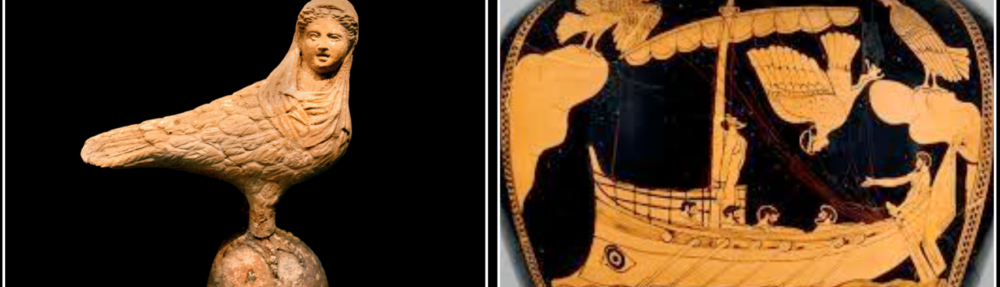
The Beauty of Mermaids vs. The Fear of Sirens

The topic I want to explore in this week’s blog post is the power of the sirens’ knowledge in unison with humans’ dying quest for knowledge. To my previous knowledge, sirens lured men through their beauty and men’s sexual desires, as the men were unable to resist the temptation of such beautiful women. After reading, I learned this perspective wrong and sailors were attracted to the knowledge the sirens had to share. I have long thought of sirens as monsters rather than well-versed beings of the universe and have perceived the mermaid as a hierarchical figure.

Why is it that the sirens who share knowledge, have developed the reputation of monsters, but the beautiful mermaids are renowned for their popularity? What does this belief say about a human woman and the response when they possess complex knowledge versus simple beauty? I honestly find this relationship difficult to investigate because there are so many implications and questions embedded within it.

On page 9 of Odysseus and the Sirens, it states, “Sirens deduce: lead astray, diver, lead elsewhere, persuaded to desert one’s allegiance, corrupt.” I found this quote interesting because of the Siren’s representation as deceitful and “corrupt” which may still be interpreted as so. The Siren is meant to tempt men with their knowledge, so far that it leads them men to their deaths. We have talked about the correlation between Adam and Eve with this similar temptation, and human’s natural reaction to falling for temptation.

“The lure and knowledge the Sirens held in antiquity had to do with life and death, or knowing the future beyond human ability so much with sexuality” ( page, 9). Sirens are the ultimate possessor of knowledge which is why they are so enticing. Since the dawn of time, humans have strived for knowledge and even killed to obtain it, yet we fear it and those who possess it. Although their possession of knowledge is feared ( which makes sense because it kills you), I think this has a possible tie to the fear of human women “knowing”. Over centuries woman have been suppressed to limit their knowledge, as they have been boarded for the workplace, education, etc. Yet these siren’s knowledge is limitless and they are represented as monsters because of their knowledge. When we look at the typical depiction of a mermaid and their beauty they are looked up to, in the church in society, etc. for their sexual representation and beauty. This is the same for woman as woman with beauty are praised and looked up to as idols, their lack of knowledge is what people hope for.

Why is it that a woman possessing knowledge is feared but a woman possessing beauty is expected?

Week 4: Water Deities and Sirens from Olden Times

For week four, we read about water deities and sirens from olden times. I found all of these stories interesting as they varied in culture, time, and type of aquatic being. The one that intrigued me the most was the first one, about Oannes. Unlike most modern day representations of aquatic life, Oannes is depicted as a being with more intelligence and knowledge than his human counterparts. As the author states: “Oannes educates humans… hybrid creatures associated with the sea are holders of knowledge” (p.3). This is significant because it is similar to the idea of the Sirens, who also possess knowledge that humans crave. However, Oannes does not have a deviant plan like the Sirens; his mission seems to be solely to help humankind. On page 4: “This Being…used to converse with men… and he gave them an insight into letters, and sciences, and…art. He taught them to construct houses, to found temples, to compile laws, and explained to them the principles of geometrical knowledge.” This passage reveals Oannes’ superior knowledge to humans. This idea of an aquatic being with higher levels of intelligence than our species touches on a point we discussed last week in class–that some merpeople or aquatic beings have the ability to transform into humans and walk among us. While reactions to this idea may vary from fear to fascination, it does mean that these aquatic beings know more of the world than humans, and have more freedom with their ability to choose their world. I think that this fear vs fascination reaction can be determined by what this being chooses to use its intelligence for–a character like Oannes may not induce as much fear as one who plans to use their knowledge for sinister means. Not only is Oannes depicted as one with more practical intelligence, but he also seems to have better social intelligence, and perhaps morals: “He instructed them in everything which could tend to soften manners and humanise mankind” (p.4). What I found interesting in this quote was the phrase “humanise mankind”. An aquatic being being the one to humanize the humans is an unnatural concept, but not one that is impossible. With the harm and hurt humans do to one another, a mediator is often what is needed. In addition, it leans further into the idea that Oannes and other aquatic beings have superior knowledge to humans, in scholastic and social aspects. 

Another part of this story I wanted to touch on was Oannes’ ability to return to the sea in the night, as it was his home. Last week, someone talked about the Selkies, and how their return to the sea was restricted by men taking their shedded pelts and holding them hostage, since these women could not return to their seal forms without the pelts. I find it interesting that Oannes is a male sea creature, and I wonder if this freedom has something to do with his gender. While human men, in many of these mermaid stories, want to tame and conquer aquatic women, not as many aquatic men are subject to being conquered in the same manner. 

Week 2: Merpeople

My first reaction to the reading is surprise; by the unexpected ubiquity of the presence of mermaids across popular culture and religious texts. I think it’s also interesting to see that The Church attempted to manipulate the perception of mermaids and use it as a sort of symbol for their interests.

I think it’s fascinating that we can use mermaids and merpeople to learn about the hybridization of humans, and how it can be a metaphor for some of our own characteristics. I also think it’s interesting how something that was manipulated to degrade the feminine can be warped and changed over time to hold a completely different message.

Week 2/3 Reading Anaylsis

When I walked out of the first day of class I was left wondering how I got myself signed up for a college course centered on mermaids and thought to myself I was either going to love it or hate it. After our initial discussion on Thursday and reading through the first few chapters of Vaughn Scribner’s “Merpeople” I have already begun to take an increased interest in the variety of lenses with which we can approach the subject of mermaids to explore what they symbolize and the importance of their persistence throughout generations of many different human societies and cultures. The in-class analysis of the etymology of certain words such as environment, nature, and monster sparked some ideas in my head about the way humans have defined themselves in relation to the “natural world.” I found it incredibly interesting that nature was first defined in terms of human nature as a description of people and later amended the definition to what is commonly known today. This sequencing of these definitions leads me to believe that people initially considered themselves to be separate from the natural world and later realized that the relationship is much more complex.

The word that has stuck in my head the most throughout our first classes and readings, as it pertains to mermaids, is hybrid. The mermaid, being a hybrid mix of human and animal is the perfect symbol to represent how human beings are a part of nature while also separate. The fact the upper half of the mermaid is human is also symbolic in a sense that the familiar human characteristics that supposedly set humans apart from animals such as the potential for conscience thoughts and the ability to use our hands in contrast with the lower half which binds the mermaid to the ocean and natural world. The way humans defined nature creates a hybrid situation similar to that of the mermaid, as much as our human qualities separate us and make us different there is no way to separate ourselves from nature, we are a part of it regardless of our greater potential to alter the natural world.

My parting question for the week pertaining to etymology that I am interested to explore more throughout the semester is: “How we define what it means to be human?” People have mimicked animals in their creations, and we have witnessed certain animals mimicking human behaviors. For example, we designed airplanes with birds flight as a model and we have taught chimpanzees and gorillas to communicate in human sign language, which in my mind leaves a lot of grey areas for defining how we could possibly be 100% separate from nature. A final note in regard to my “man-made” comment in class on Thursday, I thought a lot about this since that class and one thing that initially I thought of as a defining difference was the way we build structures and homes, however this is evident for animals as well in bird nests, beaver dams, burrowing communities, etc.

Week 1 Introduction

Hello everybody! My name is Richie, and this is my first year attending San Diego State after transferring from community college in the area. I was born and raised in North County near Encinitas and Carlsbad, and I spent most of my time as a kid outdoors playing baseball or at the beach, which has led me to my passion for environmental sciences and my major, sustainability, because I would like to preserve our resources in order to allow future generations to have the same sorts of experiences that I was able to growing up. I recently adopted a kitten, my first pet, her name is Rosie and she is 5 months old and spending time with her has been my number one hobby lately. I was a little skeptical about the whole mermaid thing after the first day, however I loved the first classes and readings and I’m looking forward to a great semester with everyone and excited to have a passionate professor to teach the subject matter. Ya’ll can reach out whenever I’m always happy to meet new people!
-Richie

Week Two: Merpeople: A Human History

Chapters one through two of Vaughn Scribner’s Merpeople: A Human History discuss the origins of mermaids and how these creatures became a cultural phenomenon. As someone unfamiliar with the history behind mermaids, I found it fascinating to learn how Christianity impacted their perception.

Initially, churches used images and sculptures of mermaids to “remind followers of the infinite power of God” and force onlookers to confront their “relationship with their faith” and “sinful nature” (Scribner 43). From a modern perspective, I found this particularly interesting as I never considered mermaids to be overtly monstrous. However, as I consider the era in which these images were created, I can understand how these creatures may be jarring. In the medieval ages, women were demonized and expected to be subservient to men. Early depictions of mermaids reflect this as they describe these women as “a monstrosity” and “suggestive reminder of the dangers of feminity” (Scribner 51). Essentially, mermaids were thought to be destructive, “vengeful creatures” who would lead men “to their misfortune” (Scribner 55).

Growing up, I only ever thought of mermaids as strong, independent women navigating the difficult nature of the ocean. I looked up to mermaids and would often daydream about a life where I was one. So, upon reading this week’s chapters, I was shocked to learn that this perspective was entirely different from those in the medieval ages. I can only imagine what it would be like to be a woman at a time when these stories were believed to be fact. To men, women were purely figures of fear and desire. I am curious to see if the book discusses how the perception of mermaids evolved to become the symbol of female empowerment I associate them with today.

Week 3: The Mer-Wife Plot and How Women Are Perceived

It was interesting to see the difference between Western European and precolonial societies’ attitudes and beliefs towards women. It was equally interesting to see those attitudes reflected in how they viewed mermaids. The patriarchal ideas held within European Christian doctrine stand stark against the more egalitarian precolonial views of gender, reflected in how European mer-wife plots tended to be tales about female infidelity or served as implicit calls to action for their male audience to control the women in their lives, (Bacchilega, et. al., xix) whereas precolonial societies like precolonial Hawaiian myths of human men and their mer-wives (mo’o) found no need to control their otherworldly spouses. (Bacchilega, et. al., xx) 

In my personal and cultural experience, we also have a mermaid equivalent called the sirena, but the name itself and its associating facts are borrowed from the Spanish. The sirena has a reputation for using their beauty and their enchanting voices to lure sailors to watery deaths, similar to the way Europeans paint mermaids as temptresses. However, in precolonial Philippine myths, sirenas are seen as protectors of the waters, sea life and the gods themselves. In one myth, a sirena stayed loyal to their human lover, who earned the sirena’s trust and loyalty after performing multiple feats, till they died and spent the rest of their immortal life still very much in love with their lover.

Week 2 – Reading Post

In this weeks reading of “Merpeople: A Human History” by Vaughn Scribner, I was completely fascinated by the Catholic Church’s involvement in the use of mermaids to manipulate the general public. When I began reading, I mostly expected the reading material to mainly feature the evolution of mermaids throughout different cultures. I had no idea that mermaids were instruments of manipulation for the Catholic Church, which intended to use mermaid imagery to “dethrone femininity” (Scribner 12). Painting mermaids in an overly sexual light, the church used mermaids to symbolize seductive beings that made men fall into their lustful desires. Ultimately, the Church was using these creatures to spread their propaganda about sinning.

The Catholic Church benefited from the globalization of mermaids in Western, Eastern, and African folklore, because it further pushed their agendas. Sailors across the world would make claims about interacting with mermaids, and their “encounters resonated with the Christian Church’s imagery” and further pushed the Church’s “efforts to denigrate the feminine” (Scribner 56). My focus on the Catholic Church with these chapters comes from the idea that mermaids could not possibly be the only things that the Catholic Church used to manipulate people. By studying how effective the use of mermaids was, it gives me the ambition to look into what else the Church has used to maintain relevancy. Science has only been a generally accepted concept for a couple centuries, yet society has existed for thousands of years. Even in modern media that I can recall, mermaids are still commonly sexualized, which could still subconsciously push the old agendas of the Church.

I grew up going to Catholic Church, and I cannot recall ever seeing any mermaids, or any mythical creatures besides angels and demons in paintings inside of the church. It is extremely fascinating to me to see how the same Church I grew up attending used manipulation tactics to push their agenda. It is also interesting to me to see what the church’s agendas were as the church was developing. It makes me wonder if this type of behavior is still happening in the Church, but with more modern methods.

Introduction

Hello! My name is River, I am a third-year student from a town near San Jose CA. I am studying Sustainability, and I am passionate about urban planning. Outside of working and my academic life, I enjoy spending my time outdoors. I also like to bowl and play spikeball. My most expensive hobby is traveling. Last week I got back from a backpacking trip to Japan.

Week 3: Merpeople and Penguin

After completing both readings, I have a much better understanding of the origins of mermaids and the application of studying mermaids to our course. The first thing that stood out to me in “Merpeople: a human history” by Vaughn Scribner was on page 62 when it stated that people of the new world were fearful of female opossums. I think it is crazy that the discovery of an opossum was considered to be a ‘hybridized’ blend of Old World animals and humans… I would’ve thought that about bears or some bigger, top-of-the-food-chain, type of animal. After that thought however, I tried to take the perspective of the first person to encounter a new animal species without the internet and I could see how an opossum would come across that way. What would your thoughts be if you were the first person to encounter an opossum in the 1500s? Would you think it is simply another animal? Or would you consider it to be a monster? I think this same concept/question reflects the difference in thought between the 1500s and present day in that in an older time period, people sought a religious, spiritual, or monstrous answer to their questions, whereas today people turn to science (or the internet) for something they don’t understand/can’t explain. 

In the second reading, “The Penguin Book of Mermaids” by Cristiana Bacchilega and Marie Alogalani Brown, the first thing that stood out to me was the description and explanation of the concept of vanity demonstrated through the mirror that we discussed in class on Thursday. The next thing that stood out to me was on page XIII when the authors reference gender propriety being overstepped and linked that with being ‘monstrous’. This would explain the overuse of mermaids in religious ideologies in that mermaids are a tempting beast that would lead to someone committing a sin. I find this interesting because it also later states Odysseus’s story with the sirens. His ability not to succumb to their temptations was deemed “manly” and “heroic”, both of which are words I would not use to describe their encounter. With this said, I am curious as to what the double-standard will be when we start discussing mermen. Will they be sexualized as heavily and possess similar symbolic meanings? Or will it be another patriarchal interpretation and reflect male dominance? The main merman that comes to mind is Poseidon, who is a god and is depicted as a dominant protector of the ocean. Without much background or understanding, mermen seem to have different symbolic meanings than that of their female counterparts, but I guess we will find out when as we get further into the course!