Week 4: Oannes

Reading about Oannes was really insightful because it gave me perspective on the role that “hybrid” half-sea-half-human creatures played in Babylonian history. The myth of Oannes is a beautiful one because in my opinion, it teaches us to view and respect other creatures in a more positive light compared to how these creatures were depicted in Western history. To go deeper into this idea, we are taught to fear anything that is “foreign” and may have more power than what we humans do. The depiction of Oannes as a knowledgeable teacher of all things and wisdom, teaches us to have a more positive perception on creatures that are more powerful. Instead of fearing them, we can accept and embrace them to learn more and gain higher access to knowledge.

To compare, we learned from the first few readings that we did that the church used the concept of these hybrid creatures as a way to attract a larger following. The depiction of these creatures reflected misogynistic views of women being associated with sin, seduction, vein, and death. On the other hand, the depiction of Oannes is associated largely with wisdom, knowledge, and godly stature. This reflects the role that literature plays in our environment because it shows the different cultural, political, and social standing that existed by how these two time periods portrayed this hybrid creature.

Week 4: Gender Roles in Penguin Classics

This week I am focusing on gender roles with context from the stories in the Penguin Book of Mermaids, particularly in comparison to the mermaid stories we have already read. I would like to add on to what we discussed in class previously, about the gender roles that were exemplified in various texts. We understand that mermaids are sought after my men because of temptation, fertility, etc., but in the story of Oannes we learn that this part fish man is knowledgeable in “many fields and “he taught them to construct houses, to found temples, to compile laws, and explained to the principles of geometric knowledge”( P. 4). This just goes to show that the man was historically seen as higher, more powerful even in the from of a hybrid beast.

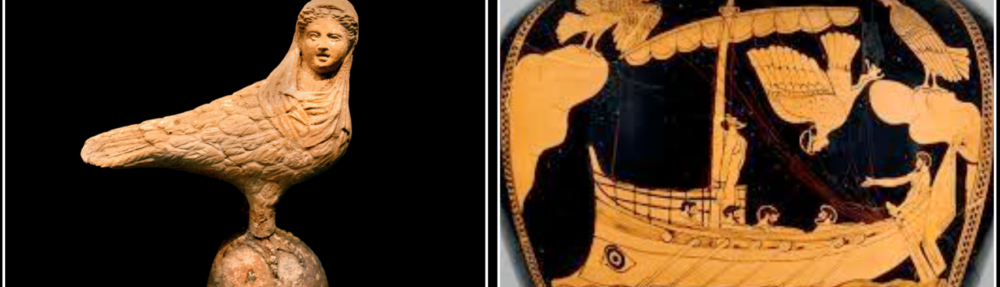
Similar ideas are demonstrated in “Odysseus and the Sirens”, while all these creatures are similar in physical abilities they male versions always seem to be the ones in charge. I can connect this idea to the maritime community, as sailing is a very male dominated world, and even to this day the boats are referred to as “she”, as in “I cleaned er up she looks real nice”. This to me is a tell tail of the culture behind ocean myths, at least in the the culture I have been involved in. This is all brought up not to repeat same conversation, but to ask when will these perspectives change. Of course we understand the recent phenomenons of mermaids, but is there a turning point?

Week 4: Water Beings of Pacific Islands, Inuit, and North America

Many of the Indigenous tales from around the world depict water beings in many different ways. Whether the beings are male or female, obliging or obstructive, their appearance closer to human or other, and if they are perceived by the people as benign or malevolent. These cross cultural bodies appear in many different ways. Though in some tales I found similarities.

In “The Tuna (Eel) of Lake Vaihiria”, the young princess Hina is expected to marry the King of Vailhiria, whose physical appearance is that of an “immense eel”. With help from the spirit-like man Maui, the head of the eel provides a coconut tree for her. In Sedna, a mistreated and wronged woman becomes a water spirit with the “head and torso of a woman and the tail of a fish”.

In these two tales, the water beings provide for the people through resources such as food and even shelter, though the tales are from different parts of the world, Pacific Islands and Inuit people. The stories may reflect what the people needed most at the time, resources. In the Tuna story, the eel is the malevolent being promised to a beautiful young girl, however, his cut off head provides food for her and her new-found family. This is done through the form of a bountiful coconut tree. In the Sedna story, she is taken advantage by a bird-man, and later betrayed by her father. However, after becoming a powerful sea spirit, she provides food for the Inuit ” who rely on these animals want to maintain a good relationship with Sedna” by keeping her happy with “certain taboos” or traditions. These ancient origin myths might serve as an explanation for environments, resources and knowledge. Though different in many ways, they are also similar.

Week 4 – Oannes (The Penguin Book of Mermaids)

Now beginning all the stories that have to do with mermaids, I felt the one of Oannes left me with the most questions. I thought it was interesting how Oannes was a figure of both human and non-human who came to give guidance to the people of Babylon since they were “like beast” (page 3). The specific part that stood out and left me with so many questions was “he instructed them in everything which could tend to soften manners and humanise mankind” (page 3). It was intriguing to read about how through one “thing” who was considered both human and non-human that many humans were able to believe in what he said, guided them through impactful things from life, and essentially gave them the basics to everyday living without any sort of questioning, so why overtime did this stop? Oannes was both fish and human, and yet humans were able to confide and trust every word he said without hesitation. The story of Oannes shows that at some point in the history of humanity, us humans were able to trust the unknown and fully believe in hybrid and mythical creatures as a guide to our living, what during our history did we stop believing in this? It’s a bit surreal to see the change in how at some point in life humans were very open to new things, and now the history of hybrid and mythical creatures are all being taught as a myth to generations now and making life a bit more sheltered to life outside of human kind.

After searching up Oannes and seeing how he was depicted, I thought it was interesting to see how they made it known he was both fish and man. In some pictures he was presented more as a merman but in others they make a clear distinction between a man almost looking like he was wearing a fish coat. The picture below shows Oannes as a mixtures of the two most common pictures, he is shown as a mermaid with a fish head like coat, walking up from the ocean and almost showing himself as a friend to men so they wouldn’t be alarmed with his physical being.

Week 4 (Penguin Book)

The first few myths of the book are so far, pretty interesting. It was really neat to see how some elements of the mermaid have stayed the same (the fish features and the connection to water, for example). But I think the one that really spoke to me this time was the sharing of information, particularly with Oannes, the first myth we had to read. He seemed very fun, but his description boggled and intrigued me. (here is my mspaint interpretation of Oannes, bless his heart. I drew this with my fingers) “…the whole body of the animal was like that of a fish;and had under a fish’s head another head, and also feet below, similar to those of a man, subjoined to the fish’s tail.” (pages 3-4)

You’re telling me THIS CREATURE MAN was giving people advice and sage wisdom?

Real talk, I think this connection of water and knowledge is interesting. “…and he gave them an insight into letters, and sciences, and every kind of art”. (page 4) So were all of their cultural advancements solely centered around the ocean? Around Oannes? Or did Oannes know of things beyond the ocean? From his section in the book, he doesn’t come off as malevolent. Perhaps the people of Babylon had a very beneficial relationship with their ocean. Or maybe Oannes had Good Vibes ™.

Kaliya, Week 4

The main reading that stood out to me this week was the story of Kaliya, the snake. I think it’s powerful that in this variation, unlike many others, the snake is let free to return to the ocean with its family. This draws out the overarching message of humbleness (regarding the snakes’ ability to admit that it was wrong) and forgiveness in that the man didn’t slay the sea serpent. A powerful quote that I was attracted to from this portion was that, “Destruction becomes the catalyst for creation” (Penguin, page 5). This part stood out to me because it also reflects the relationship between the people and the snake in that they broke out into this huge battle (destruction) that resulted in a relationship in which the snake later protected the people and river. The battle ultimately resulted in a mutually beneficial relationship built on respect, another prominent theme across merpeople stories. I think there are also a couple of real-life applications from this reading, like the pollution of the snake rendering the water useless for the people and their livestock, which ultimately was a problem solved by a confrontation with a water being. More importantly, when the snake says, “I am not at fault in this matter, Acyuta, for it is you who pour fourth and absorb the world; classes, forms, and natures […]” (Penguin, page 8), the serpent is drawing attention to the anthropogenic views being imposed upon the world. Not too long ago the world didn’t have humans, and all other beings freely roamed the earth. What I believe the serpent is trying to say is that we (as humans) have a responsibility to respect nature and the environments around us and to live in unison, opposed to being in opposition with the beasts that inhabit the same lands as us. 

Week 2: Merpeople

Reading chapter one of Merpeople by Vaughn Scribner was eye opening. I would’ve never thought how much mermaids were associated with religion during the Medieval period. I can’t seem to understand how “denigrating the feminine” (Scribner 29) brought more people to Christianity and why it worked. Chapter one continues by explaining the first depiction of mermen around 5000 BCE. Acadians worshipped a mermen named Ea, who was adopted by Babylonians as a god of light, wisdom and civilization by the name Oannes. How and why did Oannes become a deity of wisdom? As mentioned in page thirty, Oannes “gave men an insight into letters and sciences, and every kind of art…” (Scribner 30) In opposition to the well intended wise mermen, mermaids were seen as creatures that emerged from ugly forms “seeking to bring human men to agonizing deaths”. (Scribner 31) It’s no secret that with the help of these ancient myths of mermen being good hearted leaders and mermaids/sirens being wicked beings looking for men’s demise helped the Christian church to belittle the feminine as “females symbolized a carnality linked to vice”. (Scribner 35).

As I mentioned to my peers in past class discussions I believe that even thought the image of mermaids has changed, unfortunately, the meaning behind it has not. Mermaids are still to this day seen as a symbol of lust and demise or straight up vile monsters (as seen in Hollywood movies). This image of fault and evil is sadly not limited to mermaids, for example, in Christianity, Eve is seen as the one at fault for the expulsion of the Garden of Eden by commiting the act of sin. In the Greek pantheon, if not all, most feminine deities are depicted as extremely jealous and evil towards humans if crossed. On the bright side, in today’s world the mermaid aesthetic has been claimed by women all over the world, giving mermaids a new and empowering meaning which I’m looking forward to learning how the evolution to today’s modern world came to be.

Knowledge as a Source of Creation and Destruction

The first few chapters of the Penguin Book of Mermaids introduced the reader to a variety of myths and stories about the deities and creatures that dwell in the ocean. These myths used these deities and creatures to highlight important values and beliefs of the culture it was being told from. One of the focal points within these stories was the power that knowledge held. This focus is seen in both the story of Oannes and the sirens in the Odyssey. However, these two myths take a different approach to how knowledge can be wielded; knowledge can be a source of creation and destruction. 

The tale of Oannes centers on knowledge as a source of creation. Before Oannes imparted knowledge to the people who lived in Chaldea, the author states that they lived like beasts in the field (p.3). By being likened to ‘beasts of the field’ the inhabitants of Chaldea are seen as unknowing and disorganized, living without a set way of life. Oannes taught them farming techniques, political organization, and introduced them to intellectual pursuits such as geometric knowledge. With Oanne’s teachings, this lack of rule and order changed into something more structured and created a society where the people were allowed to truly flourish. 

On the other hand, the Sirens and the Odyssey center around knowledge leading to destruction. In our previous class discussion, the professor mentioned that the Greeks believed that listening to celestial music would lead to a person’s undoing. When Odysseus hears the Siren’s music, he asks his crewmates to free him from the mast where he’s been bound. Instead of listening to his demands, his crew rows swiftly away from the area until the siren’s calls no longer affect him (p.11-12). If Odysseus hadn’t been strapped to the mast and if the crew didn’t have wax stuffed in their ears, Odysseus’ journey would have been cut short. Unlike the helpfulness from Oannes, the Sirens wanted to use their knowledge of the future to lead them men to their doom. These myths show that knowledge is a powerful tool that can be used to both uplift humanity and also demolish it.

Works Cited:

Bacchilega, C., & Brown, M. A. (Eds.). (2019). The Penguin book of mermaids. Penguin

Week 4: Oannes

Even though in this weeks’ reading we have learned about different water beings or other half-human half-animal monsters from different cultures, I liked the first reading about Oannes the most. Through the text I gained a better understanding of the relationship between humans, nature and half-human beings. Oannes was described as an amphibious being which had the form of a fish with the head of a man under his fish’s head and the feet of a man under its fish tail that allows him to exist on land and interact with humans (p.3). Apart from that Oannes was able to articulate and communicate in a human language.

When I first read about that I was thinking about what we discussed in class. We came up with the conclusion that every monster figure has human characteristics. It was striking to me to see how this time with Oannes it is not a water being which is split into half but that it rather has the whole body of a fish and then a whole body of a human conjoint into one figure. Through that we can see that the fish body represents Oannes’ deep connection to the aquatic life through a special focus on the fish’s body

I have tried to look up further information on the value of water in Mesopotamia and found it highly interesting that the name itself is a Greek word meaning “between rivers” which according to my research means that the region itself is in between the two rivers Tigris and Euphrates (Soden 2023). Undoubtedly that already shows that Mesopotamians valued water. But what I found even more interesting is how it is emphasized that water was used not only for drinking but also for irrigation, construction, and trade, which emphasizes that water and especially the environment Mesopotamians found themselves in are a source of life. Oannes is in my opinion like an intermediator between spirit and earth and can bridge between the human world and everything which goes beyond that.

What I thought even more interesting is that Oannes is the keeper of knowledge who gave men “an insight into letters, and sciences, and every kind of art” (p.4). But not only that.  Oannes also “taught them to construct houses, to found temples, to compile laws […] and showed them how to collect fruits” (p.4). Oannes was thus humanizing mankind and helped the humans. When I thought about that statement a little bit longer, I was pleased to finally say that we found a water being which is not only shown as something dangerous or sinful. The Mesopotamians have looked up to Oannes as someone who is God-like and as someone who has a lot of wisdom. Reading the story made me realize that the people have a deep appreciation for the nature and especially for the ocean, as they actually recognize and value what it has to offer. Through the help of Oannes, you can learn to work with the nature and to even stay alive through the nature in difficult times. That makes Oannes’ work wholesome to me!

Works cited:

Bacchilega, C., & Brown, M. A. (Eds.). (2019). The Penguin book of mermaids. Penguin.

Soden et. Al (2023). history of MesopotamiaEncyclopedia Britannica. https://www.britannica.com/place/Mesopotamia-historical-region-Asia
Week 1: Introduction

Hello everyone, my name is Daniella Sanchez and I’m a transfer English student from Imperial Valley College. My plan is to apply to the teaching credential program once I acquire my B.A next year. I commute everyday from Calexico to SDSU, it’s tough work but I manage. I was intrigued with this class when I first read the reviews in “rate my professor” on how there is a huge focus on mermaids and it’s effect on society, I was hooked. This feeling of curiosity grew once I stepped foot in class. Mermaids had always been a fairytale for me, however, after hearing everyone’s take on mermaids throughout different points of history my gears began to turn. I’m eager to be in this class and learn more about mermaids/mermen and their position/purpose in society.