How were both readings relevant to the course? Well we are learning about Mermaids and what it entails about the environment. In the Readings about Oannes and Sedna we see how their stories play a role in their environments. For Sedna, it’s said she has control over the animals of the sea and the hunters depend on those animals as a source of food. So in this story, Sedna affects the environment because the people believe the sea animals appear when Sedna is happy and disappear when she is upset. This belief leads people to try and make Sedna happy and even feed the animals fresh water before eating them. In comparison, Oannes comes from the water onto earth to help the human environment progress. He helped around with food, infrastructure, and other helpful knowledge for further advancements. So both Sedna and Oannes are sea creatures (merpeople) with human and fish features who affect their environment.
Week 4
The Legend of Sedna the Sea Goddess
I’m not sure how to describe the tone or diction of the translation of this legend, but it seems somewhat pedestrian or matter-of-fact. After our discussion in class last week, I started thinking about the difference between the Western tradition of writing things down (like the Bible), and a collection of chronological and organized stories into a whole book that is cemented in physical writing. The tone of this text helped me realize the distinction because it’s a legend that isn’t necessarily part of a larger work of texts. It’s also a story that “varies from one region to the next” (Moore 9). I like that Moore added this detail because it lets the reader know that there isn’t one exact version of the story. That variety is cool because it adds some diversity and individuality to the storyteller. For example, maybe some descendants of the Inuit describe the story differently from others. I think that’s pretty cool to think that there are people with their own interpretations and ideas about a similar story. To me, this juxtaposes the ideas from Western culture that are somewhat rigid, without much room for individual interpretation. For example, as a member of the Roman Catholic Church, I was taught the same (or likely very similar) things that the confirmation candidates were taught in Kansas. Somehow this rigidity creates a weird comfort for some people, but to me it’s boring. After backpacking around 11 different countries over the last 2 years, I noticed something similar. In the US, there are many common restaurant chains and other types of stores (hardware, grocery, etc). When I visited other countries, especially the less Western ones, I noticed that there was a tendency to have more variety in the restaurants and stores. I’m not sure if it’s a product of capitalism, but I think there are some similarities between the ways Western religion spread and somehow stayed relatively homogenized, and how less Western people have diversity in their stories as well as other parts of their culture. I think that this story teaches us more than just what’s written on the page about Sedna. There’s even a significance in the fact that it can be called Sedna OR Sanna.
Week 4: Ancient Origin Myths – Rigo De Leon
In this weeks readings, I couldn’t help but notice how respectful and optimistic myths were towards nature. In the story about Oannes, Oannes is a fish and human hybrid that is well respected by the people of Chaldea. He shares his knowledge with people in order to “soften manners and humanize mankind” (Bacchilega 34), which is interesting because his actions imply that humans are not civil beings, but are animalistic and hostile. People respect Oannes and he respects them back, despite potentially being a fish god. This type of respect is again seen in Kaliya, the Snakes story, which takes place in a completely different part of the world. Despite being an evil snake, Kaliya is given another chance after being defeated. He genuinely reforms, pleading that it is his proper nature as a snake, which he was born into (Bacchilega 39). Meanwhile, Krishna receives love and praise from the cowherders and their wives. I found it really interesting how Krishna was able to unite everybody while giving Kaliya the opportunity to seek redemption.
The story of “The Tuna of Lake Vaihiria” differs from the previous two stories by showing a different side of nature and beasts. The Eel that wants to marry Hina is evil, unlike the two dieties in the other stories. I found it incredibly interesting that the only story with a female protagonist showed the protagonist going through a lot of trauma, such as being forced to marry the evil eel, and accidentally setting down the Eels head. I am not sure if this is intentional to add to mermaids symbolism towards feminism, or if it is just a coincidence. Although she experiences a lot of trauma, she still has a happy ending and grows old with her coconut tree. Overall, these stories were extremely insightful as to how nature and the ocean were tied to Gods and other powerful beings. It is fascinating to see how different cultures respected nature so similarly despite being so different.
Week Three: Does the hybrid body of mermaids dehumanize women?
One thing I found particularly interesting after completing the first couple weeks of reading was the different interpretations of the mermaid’s hybrid body and how each depiction dehumanizes women. Vaughn Scribner’s Merpeople: A Human History discusses the Western perception of the maiden’s “part woman, part fish, part animal” figure (Scribner 76). The alluring bodies of these women are explained to be “strange” but “wonderful”— emphasizing the mystery surrounding mermaids (Scribner 76). As we have discussed in class, the Catholic Church used the appeal of mermaids to emphasize the dangers of femininity. The church made it clear that when men encounter a mermaid, they must not fall victim to their intrigue because it will bring “personal grief” and “humans to horrible ends” (Scribner 55).
The Penguin Book of Mermaids by Cristiana Bacchilega and Marie Alogalani Brown also considers the Western interpretation of the hybridity of mermaids. They explain that the “single fishtail [marks mermaids] as having some control over their bodies” while the “bare-breasted top” suggests her “duplicitous nature” (Bacchilega, Brown xiii). However, Bacchilega and Brown also discuss the Rene Magritte painting “The Collective Invention.” In Magritte’s depiction of the mermaid’s hybrid body, the top and bottom are switched. So, the woman is pictured with a “fish head” while the lower body is “human and naked” (Bacchilega, Brown xiii). There is nothing sensual about “The Collection Invention.” This painting takes away the beauty surrounding mermaids and makes them look frightening. Magritte’s painting dehumanizes these creatures and, I believe, shows the misogyny present in early tales and depictions of mermaids. Men took women’s bodies and made them something to be afraid of. This further shows how demonized women were at this time and the imbalance of power between women and men.
I am curious to see if other cultures’ stories regarding mermaids are as misogynistic as the Western’s. Colonialism has impacted many cultures around the world, so I wonder if the Western influence has impacted mermaid myths and legends more than we think.
Week 4: Gender roles slightly reversed
In this week’s readings, “The Penguin Book of Mermaids”, I was really interested to see that in some aspects women figures like sirens were not seen as sexual, where, as we finally are introduced to some male creatures, for lack of better word, and they are on that flipside of being dangerous and predatory. In the chapter regarding “Odysseus and the sirens“ Sirens were more regarded as having “the law and knowledge [they] Held in antiquity, had to do with life and death, or knowing The future beyond human ability— Not so much with sexuality” (Brown, 9). I thought the view of this siren was probably the first time I encountered a perspective where they put A woman like in a positive light. Many of our other readings are to say that women are sexual, deceptive, dangerous, and so on, whereas in this interpretation, they have much to give; Far more than just their outward appearances and pleasure. The same page even goes onto emphasize this perspective by explaining how Odysseus is “subject to erotic temptation more than once— But the sirens law is a different kind”. The next sentence goes onto explain how “Homer’s Sirens sing a song that promises knowledge— A wisdom that bridges world— Instead of pleasure.” As I mentioned, before, if the reader didn’t understand that the sirens were not meant to be put in the box of sexual desire or deception, but that The siren song was putting out more valuable promise. Another way to interpret perhaps, Put men in a better light that they don’t simply crave sex and physicality from women but instead, they crave knowledge and power; creating a new theme of lifting up men without putting down women for once.
Adding onto the Idea of gender swaps, in the chapter regarding “The Tuna (Eel) of Lake Vaihira”, the eel character is said to have raped his beloved, princess bride. In this case, and throughout the whole story, the female character seems to be a respectable character rather than the eel, who could be described as menacing, yet still powerful, but ultimately unfavorably dangerous. Although one may counterclaim and say, the princess is a damsel in distress, following tired gender-norm, I would argue that this is one of those few times in the stories where you can see how the strong desire for women can be harmful; teaching men to be respectable, rather than to paint women as these sex-crazed, dangerous monsters.
Reading Response week 4
Whilst doing this week’s reading, my attention was mostly concentrated on the stories of “Sedna” and “The Tuna of Lake Vaihiria”. This was particularly because of our class discussions of the christian misogyny that transformed the role of the mermaid. It is immediately noticeable, in both of these stories that women were held in a different regard across non Christian cultures. For example in “The Tuna of Lake Vaihiria” The authors of the text explain that in these stories the character of Hina is often represented as a woman of “High rank, and sometimes semidivine”. This is in stark contrast with schribner’s text which mentions in chapter 1 “churchmen adopted these pagan creatures in an effort to depreciate the feminine.”
I noticed that both of these narratives have to do with women and marriage. Hina runs away in order to avoid being forced to marry a monster and Sedna can only be made made to wed under conditions that she finds suitable. Already we see that women in Inuit and Pacific islander cultures are able to exert their autonomy without being condemned to be sinful monsters. Both Hina and Sedna contribute to the prosperity of their people, one by bringing about the coconut and the latter by providing Inuit people with their main food sources. Sedna becomes a deity and the Inuit people strive to honor and maintain a good relationship with her so that they can continue to enjoy the bounty of the sea.
Through these stories I noticed the connection that exists between women and the environment. Both of these characters are life-givers of sorts, to their people. It is interesting that even now a days we consider nature to be female in nature hence the term “Mother Earth”. In these stories both women exert disobedience of some sort. Hina runs away and refuses to marry the Eel and Sedna refuses to marry unless it is in her own terms. The Christian church, I imagine would focus on these acts of disobedience and punish them by turning them into sea monsters but both women in these stories are rewarded with respect by their people.
Week 4: Oannes and Sedna
I found both the stories of Oannes and Sedna fascinating this week. They both alter what we normally believe mermaids to be and their abilities. Oannes completely changes the modern concept of a mermaid from the start because he is a man rather than a woman and he is not a typical half-human half-fish hybrid. He is more fish than man and is more of what we would consider a “monster” to physically be. However, instead of fearing him and dreading the sight of him, the people in the myth are appreciative of him. Oannes gave the people order and a way to structure their society when they were lost. The myth clearly states that Oannes “instructed them in everything which could … humanise mankind” (p.4). This is so interesting to me because the myth hints that an animal being helped humans to become “civilized”. These actions are not what is normally portrayed of mermaids. They are normally seen as hybrid beings who lack humanity and can be animal-like, they are not seen as representations of civilization and the development of the world as we know it. Oannes completely challenges the perception of modern mermaids because he is an intelligent and giving creature.
Sedna, on the other hand, is close to what we think of as a modern mermaid. She is half-human on the upper part of her body with a tail like a fish on the lower half. Sedna differs from the expectation of a mermaid by taking on a more active role in the ocean. She is called the “mother of all sea creatures” (Lindeman) and is the one who allows sea creatures to be used by humans. She controls how fruitful hunts can be and what animals are available to humans which has historically not been an ability mermaids have. The role she takes in the sea is a much more protective and maternal role than I have seen of mermaids before. In nature, it is known that you do not mess with an animal cub because the mother could attack and to me, this is almost the role I understand Sedna is playing. She protects the sea creatures from being hunted like a mother would protect her cub from predators.
Week 4: A Collection of Observations – Kāliya, the Snake
I took some notes during my reading of ‘Kāliya, the Snake’. I don’t know a super coherent way to organize my thoughts here, so I am going to separate them by bullet points.
- “Serpent worship is among the world’s oldest and most widespread religious practices.” This surprised me. Maybe it’s because I was raised, and the snake is a symbol of the Devil in Christian/Catholic ideologies. It might be because my dad has an ungodly fear of snakes, so I’ve always seen them as something to avoid and not to worship. Maybe I’ve been living under a rock – either way, it’s cool. The only snake-like God or deity I can imagine is Geb from Ancient Egypt.
- “Then he came upon the river Yamunā, whose waves were tossing about as if she were laughing, throwing patches of foam on the banks.” I really like the use of personification to describe the river Yamunā. I firmly believe one of the fundamental problems with us as a species is how we stopped looking at the natural world as its own being. I don’t know if that makes any sense. To most people words like ‘lake’, ‘river’, ‘tree’, ‘mountain’, etc. are just that – words. They are void of personality and I’d be willing to bet for a lot of people, placing humanlike behaviors on these words would be considered weird or hippy-esque. As a species, it almost seems like we stopped trying to understand the natural world – we replaced that connection with the hellbent desire to conquer it. We stopped adapting to Earth, now Earth has to adapt to us. Unfortunately I think its too late to turn the tides on humanity (singular) we view our planet.
- “How can I, a mere woman, describe you? . . . Since silly women and miserable creatures are to be pitied by the virtuous, please forgive this wretched creature, you who are eminent among the forgiving!” Once again, gross gross GROSS. It’s so crazy to write a story and have a woman just blatantly say this. I’m assuming this story was passed down orally in Hindu for centuries, so for centuries these ideals were fed to young boys and girls. I know that this note isn’t very constructive as its saying somethings thats already been said and will probably be said for the rest of our course from time to time – but golly, this undisguised degradation of women as an entirety is so baffling and strange.
Ancient Mythology
After reading the story about Oannes, I found him to have good moral and extremely helpful to the human population at Babylon. It sounded like he actually brought peace to the city since the book described Babylon as, “a great resort of people of various nations an lived without rule and order, like the beasts in the field.” Teaching these “beasts” about letters, science, construction, and how to gather food sounds like he helped civilize the population. The book also says he didn’t accept food and went back to his home (ocean) at nightfall, meaning he didn’t want anything in return for his teachings, signaling he did it out of the kindness of his heart.
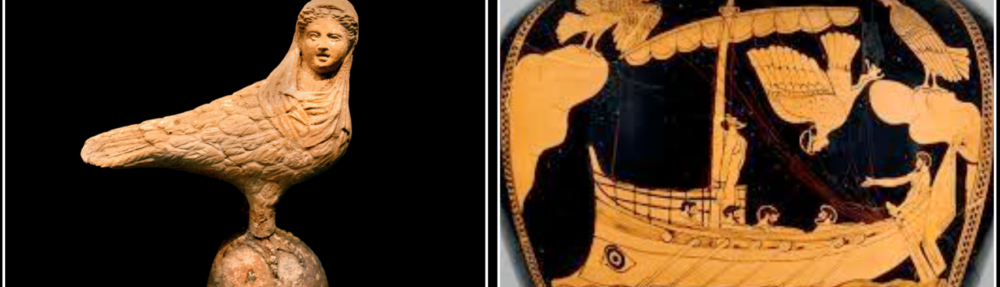
The comparison between Oannes and the mermaid described in “Merpeople” is very different. Where Oannes seemed like a peace bringing and insightful figure, the mermaids are depicted as evil, deceiving, and sinful. I was not surprised because I remembered reading how misogynistic times were long ago and how mermaids were another tool used to degrade the image of feminism. One thing I found interesting was that although I was aware the Christian Church spent many years degrading a woman’s image that even Greek mythology followed the same practice, this can be seen with the Greek figure Scylla who was a female sea monster.
Week 4: Ancient Origin Myths
For this week’s reading I found it fairly interesting and quite fascinating because I really like the specific reading of “Sedna.” When starting the reading it already caught my attention because of the fact that the story was talking about a woman / mermaid having power and control over something, whereas in past readings mermaids were not given this much power and was seen as less than; “A young woman becomes the mother of all sea creatures. As the sea goddess, Sedna has dominion over her creatures and controls the availability of seal, walrus, fish, whale, and other sea animals to Inuit hunters” (Lenore Lindeman). This story particularly got my attention because it was talking about a woman being more self assured and strong as opposed to oppressing women / mermaids in previous readings. As well, in the reading I found some correlations between this story and some Disney princesses, and loving Disney so much I found it quite amusing seeing parallels in the story. For example Sedna reminds me of Pocahontas when the story says, “Many Inuit men desired Sedna for a wife and asked her parents for permission to marry her. But Sedna refused them all. Even when her parents insisted it was time for her to marry she refused to follow tradition and obey them” (Lenore Lindeman). Similar to Pocahontas, Sedna refused the hand of men and was not afraid to refuse tradition, which I thought was exciting to see women / mermaids having power over something and not needing to conform to others. Also when I continued to read, I saw a similar correlation to another Disney movie, specifically Moana and the Goddess Te Fiti because it says, “Sedna now controls all of the animals of the sea. The Inuit who rely on these animals want to maintain a good relationship with Sedna, so that she will continue to allow her animals to make themselves available to the hunters” (Lenore Lindeman). I particularly saw this connection because in the movie the island people are always talking about how they need to have a good relationship with Te Fiti so that their island can prosper, and seeing the parallel in this story about needing to have a good connection with Sedna to be able to have food reminded me of the movie Moana. My favorite part of the story is when it talks about men needing to do tasks to be able to please Sedna, “He or she will swim down to the bottom of the ocean to appease Sedna the Sea Goddess. The Shaman will comb the tangles out of Sedna’s hair and put it into braids. This makes her happy and soothes her anger” (Lenore Lindeman). I thought this part quite intriguing because it displays man praising Sedna, a women and mermaid, which we have not seen in past readings where all they talk about is warning others about mermaids and displaying such a negative connotation and trying to control them; where here in this story it conveys the opposite and talks about man trying to appease a mermaid and praising her, which I particularly liked because I’m always happy to see women thriving and in control.