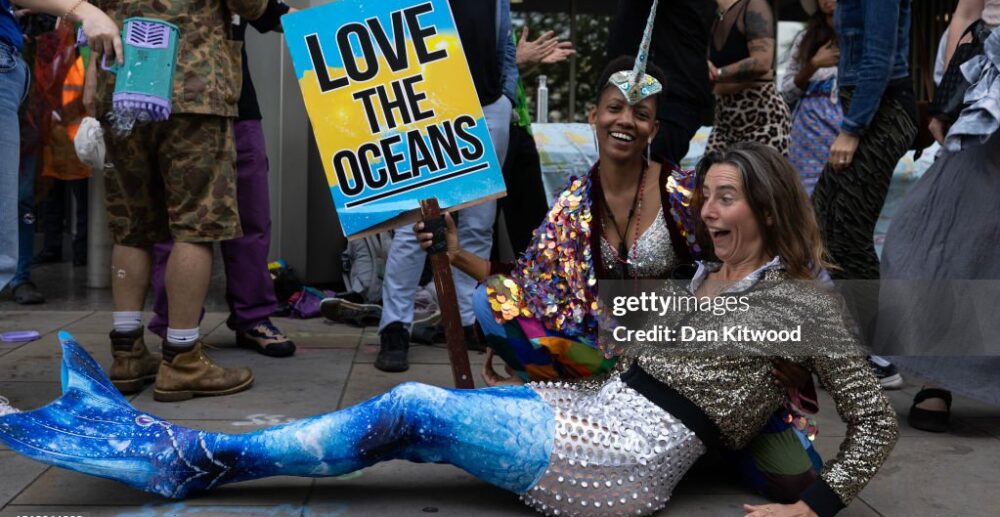
Week 6: Undine

This week’s excerpt on Undine reminded me of the tale of Melusine from last week’s class. In both stories, the husbands are in charge of either accepting the women’s secret/ otherness or not. On the one hand we have Melusine, whose secret is only revealed through her husband not giving her her space which leads to her flying away from the castle, and on the other hand we have Undine, who openly shares her origin of being a water princess that was only given a soul by marrying Huldbrand. Undine in the end transforms into a body of water surrounding the grave of her husband. Both Undine and Melusine are described as being beautiful. But the biggest difference I saw is the following: Melusine was able to flee and live her life, whereas Undine had to vanish into the sea which leads me to the following:

Undine has given her husband the choice of accepting her origin or not: “Such as we are, however, can only obtain a soul by the closest union of affection with one of your human race. I am now possessed of a soul, and my soul thanks you, my inexpressibly beloved one, and it will ever thank you, if you do not make my whole life miserable. For what is to become of me, if you avoid and reject me? Still I would not retain you by deceit. And if you mean to reject me, do so now, and return alone to the shore” (p.105). While reading that I thought that I must be reading a tragedy. Undine seems to be highly dependent on her husband. I thought that her being dependent on her husband might be an aspect worth a discussion. Even though Undine is a half-human-half-water being, she is almost craving to become a human that has a soul. Why would she want to do that? Does that mean, that all water beings are inferior to humans? In the last weeks we often learned that half water beings have the power to allure men by their sinful creature. Where does that shift now come from, that it is a WOMAN that is dependent of a man? Why does she even have to vanish if her husband does not stay by her side? I would be glad if we can discuss that in class!

The Transformation of the Mermaid: Race, Culture, Influence

After reading through The Feejee Mermaid Hoax, I came across a description that heavily intrigued me. It was the description of an African American mermaid showcased at a fair in France, the sight of this mermaid was translated into art by M. Gautier. I decided to dive deeper into this art and found M. Guatier’s representation depicted in a hand-colored engraving from 1817 created by the artist John Pass, titled, “Mermaids Exhibited Successively in the Years 1758, 1775, & 1795”. ( pictured first). I then found more representations similar to these, in Gahagan and Godby’s, ” A Mermaid, situated on a Rock.” ( pictured second)

I’m not the best at artistic analysis and would love for people to add to my observations in this piece. What I found interesting about these mermaids is how different they all are, and how their time period and the focuses of the people at the time, influenced them. These images completely defied my previous knowledge of mermaids as beautiful, golden-haired, skinny, stunning beasts. Here the image is completely reversed, as they have huge ears, protruding stomachs, bulk arms, messy hair, etc. I find it interesting how society has developed these images into our current idea of mermaids and wonder what events shaped mermaids into the current adapted images we have today. I included an image of the original “The Little Mermaid” which is where I think a lot of our minds go when thinking about mermaids, and the difference between the 3 is completely different and uncanny. I would like to dive deeper into the criticism of the new “Little Mermaid” movie for its “misrepresentation, ” as these images prove that maybe the movie wasn’t so wrong after all, and maybe it is the most accurate representation. I think that this could be a possible discovery project for me, where I could analyze these past images of mermaids and analyze how our current representations tie back to medieval and industrial representations.

Discovery Blog: Fortunio and the Siren

For my preparation of next week’s class, I did not read the right/ the assigned tale. Nevertheless, as I found it highly interesting, I thought that I could write my discovery blog and share my findings:

This reading focuses on Fortunio. Fortunio was adopted as an orphan by a loving family, who could not have children on their own. Due to his secret power, he has wished for a sibling, so that his mother got pregnant. Years later, in a fight, Fortunio’s brother Valentino tells Fortunio that he is not the legitimate son of their parents. In his sorrow, Fortunio decides to leave his home, when his mother comes up to him and curses him to be swallowed up by sirens if he ever went on an adventure on the sea. Fortunio ignores his mother’s curse and travels to the west, where he encounters a dispute between a wolf, an ant and an eagle, that were discussing over eating a deer. Fortunio helps them dividing the food properly and they gift him the power to turn into each of the animals whenever he needs to and they part ways. On his adventure, he sees the Princess Doralice of Polonia, who is now promised to a bad looking man called Saracen that won Doralice as a bride. In the following days, he uses his power to transform into the different animals to get to know Doralice better. Doralice and Fortunio thus fall in love with each other and they marry. After they have married, Fortunio decides to travel the sea, where he gets caught by a siren’s song and gets swallowed by the sea, just as he his mother predicted it. After two years of her husband being gone, Doralice and their son decide to look for him to get him out from the siren. Doralice manages to free her husband from the siren’s hostage, when he suddenly uses his power again to turn into an eagle to escape to the ship. Back home, he lastly turns into a wolf to devour his mother and brother. (cf. Penguin, pgs. 89-100).

Reading this tale especially caught my interest, because it made me aware of the deep connection humans and the natural environment have that we now lost. Besides of the fact that the “dangerous” siren caught Fortunio and held him into hostage (and that he was too greedy to accept that he has everything he has ever dreamed of and did not want to stop), I found it even more interesting to see how deeply connected humans and animals can be. Fortunio never, not even a second, thought about the danger of approaching dangerous animals such as a wolf or an eagle. By helping them and approaching them with curiosity, he got to be a part of their world and could understand better, how both humans and animals can coexist together without harming one another. He even cares about a smaller animal such as the ant to get a fair share of the food. It is, as if Fortunio was able to recognize everybody’s existence in this world. Through respect, they become part of one world and there is no us-vs-them society. When I thought about that a little bit more, I got aware that we humans have lost the mutual respect to our nature. If we were a little bit more respectful towards our environment, we would be able to all live in peace together. Instead, humanity’s greed causes severe effects on our natural surroundings. Deforestation which causes the loss of the natural habitats of animals or anthropological natural disasters were only a few of the examples that directly came to my mind. We should all be a little bit like Fortunio and appreciate our coexistence with other living beings on this world.

Week 4: Water Beings and Betrayal

In the readings assigned for week four, I couldn’t help but notice the reoccurring themes of betrayal of the female gender. Starting with the myth of Sedna, the Sea Goddess of the Innuit. Even though the logic behind the creation of a sea goddess and its creatures out of two cold murders committed by the same man who is the father of Sedna doesn’t make that much sense to me or why she would help men after being betrayed and lied to by the two most important ones in her human life. At least she had sort of a happy ending with the help of shamans combing and braiding her hair to appease her. I would also like to add a thought about this story, Sedna’s father threw her off the boat due to thinking the birds wanted her, but let’s be real, the birds were seeking the father’s blood. This could be a representation of the male gender in history always assuming that when consequences for their actions are catching up or something goes wrong it’s because women had something to do with it, which has resulted in many women having the same fate as Sedna (except turning into a sea goddess).

In the story of Kaliya the Snake, he is introduced as an inferior power of Krishna who is filled with rage, why is this? Further into the story, it is revealed that Kaliya resides in a section of a river that is causing diseases to those that need water after being defeated by Krishna and kicked out of his anterior residence, the ocean. After another humiliating defeat to Krishna, Kaliya and his wives beg for his life, “The race of snakes into which I was born is a cruel one; this is its proper nature. But I am not at fault in this matter, Acyuta, for it is you who pour forth and absorb the whole world; classes, forms, and natures have all been assigned by you, the creator…” (Bacchilega & Alohalani 8) Kaliya never had a chance to be portrayed in a good light, since his creation he was doomed to be seen as a monster, because of Krishna’s decision, to me this is another form of betrayal.

Week 3: Mermaids and The Unknown

After reading both assigned readings I enjoyed how Cristina Bacchilega and Marie Alohalani introduce mermaids as a species that haven’t been completely understood to its full capacity. Fear of the unknown is the best way to describe Merpeople, in this case, mermaids/sirend and the cautious yet curious feeling towards them, predominantly fear.

However, I find it interesting how the feeling of fear towards mermaids/sirens turned into disgust and hatred. As mentioned in The Penguin Book of Mermaids, prostitutes were referenced to as mermaids due to their sex appeal and seductive powers, which is how mermaids/sirens are represented doing to lead men to their deaths. This “likewise attests to how a woman who oversteps the boundaries of gender propriety has, over centuries, risked being defined as monstrous.” (Bacchilega & Alohalani XIII) Not only the unruly women in land were in danger to be classified as monsters but also those of water that didn’t follow the “norm” of pleasing and obeying men. It baffles me how open men were with their hatred towards women and their need to remind them how much they did, “you live here on earth as the world’s most imperfect creature: the scum of nature…” (Scribner 61) It is unfortunate how a feminine mythical creature was used as a mascot for the defamation of women and lasted throughout all those centuries, yet even though still recent mermaids and sirens have now become an image of feminine empowerment to slowly but surely heal that generational wound.

Week 5 – Legend of Melusina

What piqued my interest at a first glance was the description of Melusina’s ability to travel between all planes of existence that I can think of. She can slither and exist in the horizontal plane, she can swim, she can exist on the ground, and she can fly. In my eyes, this gives her some form of omnipotence that seems significant to the story.

As I continued to read the version of the story, I realized that maybe she does have some sort of all-powerfulness. With the line, “and though people may not perceive me in the air, yet they will see me by the Fountain of Thirst” (Keightley 85) it is suggested that Melusina will always have some presence and influence over the castle.

In many of these stories, the knowledge or power possessed by female characters seems somewhat contrary to the culture at the time and place of the story. Why is it that the mermaids are powerful characters when the stories are being written and re-written in times of intense female degradation? I wonder if maybe the power that is alluded to is the power of female sexuality. This power that women have is displayed appears similar to what was depicted in Macbeth by Lady Macbeth. I’m not sure if that is a message of this particular story, but I imagine that many of the texts interpreted by the Catholic church were manipulated to paint women in a way that warns men of there sexuality.

On the other hand, I’m excited to open this up in class because I sense there are many things that went entirely over my head. The dialect from the time is somewhat confusing to me. The change over time of these stories is interesting and I would like to see a side-by-side of the progression of a story over the years. It would be cool to see the different biases that a particular interpreter might have compared to others depending on the time frame and cultural norms at the time.

Week 5: What does the story of Melusine say about humanity’s relationship with the natural world?

As I learned about Melusina through The Legend of Melusina and The Romance of the Faery Melusine, I became intrigued by what these stories say about man’s relationship with the natural world. Chapter one of The Romance of the Faery Melusine discusses man’s innate desire to conquer “the unknown” as doing so is “the extension of their physical and spiritual power” (23). At the beginning of the chapter, the nature surrounding the village is described as “menacing,” “dangerous,” and “somehow diabolic” (11). The natural enviornment is seen as unpredictable and threatening— and confronting nature’s force is explained to be a true test of character. 

This merciless description of nature differs greatly from the words used to describe Melusine. Legend of Melusina describes the maiden as beautiful and well-mannered (Bacchilega, Brown 87). The Romance of Faery Melusine emphasizes Melusine’s beauty by illustrating her as a “force of light” (25) that is “smiling upon” Raymondin (25). Despite Melusine’s connection to the natural world, she is far from the savage description of nature given earlier in the story. In fact, she is not “diabolic” (11) but rather “a faithful Christian” (25) meant to “put a seal of truth upon the words of the old lord” (26). This portrayal suggests that Melusine is the embodiment of harmony and goodness within the natural world. 

Perhaps Raymond’s broken vow of not seeing Melusine on Saturdays is a cautionary tale explaining the consequences of violating nature’s laws. Melusine’s transformation into a serpent or dragon may be symbolic of man’s arrogance and pride. Do humans need to conquer the unknown to truly show their “mettle” (12)? Maybe embracing and respecting our natural world is a better testament to our spirit and morals. 

Overall, the story of Melusina highlights the complex relationship humans have with nature and warns humanity of the consequences that come with disrupting nature’s balance. 

Week 5: Christian Themes and New Interest for Men

For this weeks reading, I found that there were more Christian themes and new interest for men. A lot of the stories we have read previously, where, somewhat putting women as mermaids in which they were sexualized, lusted, dangerous, but in this weeks, reading, we kind of continue that theme of the siren, where women now offer men knowledge. Some of the reading for me was a little bit difficult to understand, but what I picked up on from “The Legend of Melusina” and the other three versions of the same tale was sort of the curiosity of the unknown. This theme almost reminded me of somewhat the Christian sort of wanting the readers to fear this unknown or better yet stay true to their promises and have faith. The stories, in a way, reminded me of Adam and Eve, and not trusting that same serpent symbol. If Eve were to have simply listened to what God said, then there would be no trouble, and in this case, if the king were to have listened and not seen Melusina on Saturday, then all would have been well. It’s as if the church was trying to push the message that you need to have faith and discipline, regardless of your curiosity of the unknown; to essentially not be led into temptation. I just enjoyed how, in this case, the unknown was the sort of knowledge thing rather than the temptation of a woman’s body, or what women might dangerously do. This is the sort of spreading I was used to before coming into this class, rather than putting women into negative light in order to teach them and spread messages.

Week 5: Melusina, the Ghost Mermaid

One thing I absolutely love about this course is the fact that we are learning so much about other cultures’ core values and beliefs through these stories. This week, we took a look at France through the story Legend of Melusina. Count Raymond is married to a beautiful woman named Melusina in the story. She promises their love will be long and plentiful as long as he never tries to see her on Saturdays. Greed (a recurring sentiment we should all be familiar with by now) takes over Raymond’s heart, and he makes a point of seeing her on a Saturday – but he is shocked to see that she has transformed into a snake. After this, she curses him and his lineage and turns into a spectral entity that – when seen – is the precursor for the current crown’s death. This feels like a campfire story, and that’s awesome. It’s got clear morals like don’t give in to greed and respect your partner’s boundaries – the combination of the two makes this piece genuinely progressive and timeless.

What’s more is the fact that, even though she put a hex on Raymond and his bloodline, she isn’t necessarily portrayed as a malignant entity. She’s simply the victim of a broken promise. This isn’t a cautionary tale of vicious monsters or women who are up to no good. This isn’t a story about a righteous man who can do no wrong. Melusina is the victim – and the man, Raymond, is a fool. This is a story about appreciating what you are given, especially if you didn’t ‘earn’ or create it. I am excited to hear other students’ interpretations of the piece, its message, and its literary value compared to some of the other stories we’ve covered. It’s cool to see a story that wants its audience to treat each other respectfully.

Also, I wasn’t sure where to fit this in, but Melusina is doomed to spend eternity in pain and suffering as a ghost – which hammers in the idea that she isn’t the ‘monster’ here. I am a little worried about the detail of Raymond and Melusina’s children being born with deformities – it almost makes me feel like the intended moral of the story is something more along the lines of “don’t be so blinded by desire that you don’t recognize the monster in your home.” However, as we saw with the Oxford English Dictionary definitions of day one, words can stay the same and change meanings. No matter an author’s intent, it is what you take away from it that really makes a difference in anything.

Week 5 – The Faery at the Fountain

Chapter 3 of The Romance of the Faery Melusine (Gareth Knight, translated by Andre Lebey, 19th C) I thought was interesting to read about since in the back of my head all I was thinking about was that they were hinting about mermaids or sirens the entire time. Reading the Legend of Melusina (The Penguin Book of Mermaids, 85-87) and it stating that her mother “condemned Melusina to become every Saturday a serpent, from the waist downwards” (page 86), which stuck with me because as I read Chapter 3 of The Romance of the Faery Melusine I unnoticed how stories were worded differently. In summary on page 25 it was almost as if Melusina was mind reading Raymondin which to me gives the idea off that she might be a siren, since in last weeks class one of the main discussions of a siren was that they have been somewhat presented as mystical beings that hold all the knowledge in the world which can include the thoughts of others. It was interesting that no where in this chapter it was clearly stated what mythical being Melusina could’ve been, but they made it a point to mention the beauty and knowledge she held that left Raymondin wondering “if he were still alive” (24). 

One of the biggest points I found interesting that was made within chapter 3 is the idea of blinded trust due to feminine beauty. Before even knowing Melusina’s name, Raymondin was able to fully confide in Melusina and the contract of marriage she has set up for the both of them which made me wonder how beautiful Melusina could have been that it left Raymondin unable to comprehend what is being said and the contract he is signing himself up for. It isn’t such a surprise that he was able to trust Melusina because of how differently things were done and said in the past, but it’s strange that Raymondin himself didn’t stop to question if she was even a mythical being since sirens were existent in that period of time. The idea of feminine beauty through this story has had an emphasis on me in that now I can only imagine the power that mermaids, sirens and so many other feminine mythical beings would have over the male population.