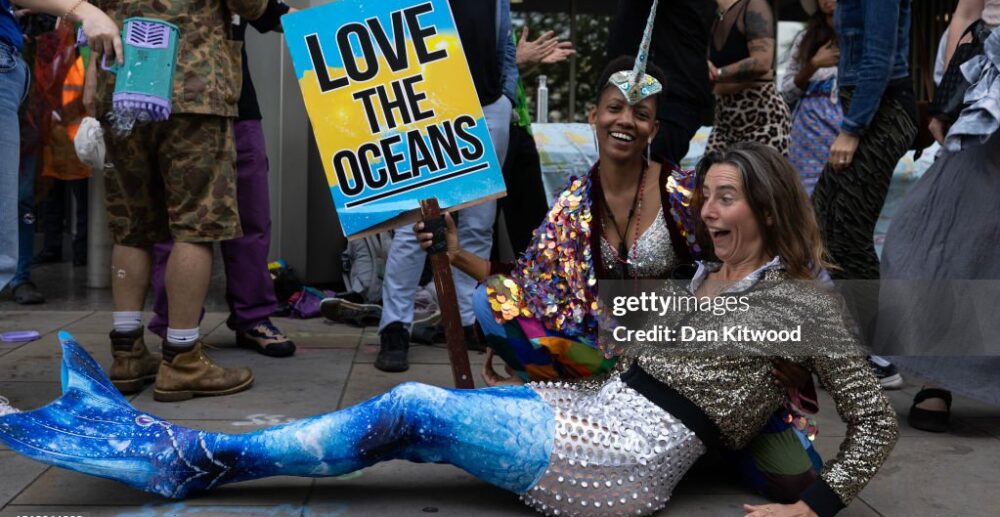
Week 13: African Mermaids and Water Spirits

It was interesting to read about African mermaids and water spirits in comparison to the other Western or European mermaids we’ve read previously. One thing that stood out to me was what the African spirits personify nature or the sources of water that they reside in, rather than personifying human concepts or religion. Aganju and Yemaja, and they’re parents, Odudua and Obatala, personify land, water, air, etc. While mermaids such as Melusine, Undine, and the Little Mermaid personify Christian belief. Such as Undine and the Little Mermaids need for a (Christian) soul.

In Ti Jeanne, Maman Dlo, “mother of the water”, protects the forest and its waters. If “mortal men who commit crimes against the forest… could find themselves married to her for life” (277). While Maman Dlo, protects the forest, she also seems to condemn vanity, though one of her own forms is an elegantly dressed woman. She even is a seductress herself and “not above sleeping with her devotees” (274). Despite this, she condemns Ti Jeannes vanity, turning her into a mermaid to serve her forever after. This story presents moral warnings against harming nature, but also against vanity. Compared to other stories we’ve read, some Western texts warn against vanity and encourages humbleness, but not harming nature, and vice versa.

Week 13: Mami Wata: Hybridity, Sexuality, and Power

The hybridity of Mami Wata in Ti Jeanne creates an element of fear for those who believe in the tale. Not only is she a hybrid beast whose bottom half is a snake, but she also can assume the form of a woman, who is beautiful (unlike her snake form). One would not know that she is Mami Wata when she is in her human form. “In her mermaid form, be it piscine or reptilian, Mami Wata dwells in the waters of the forests she protects, but just as often, she might pass you by in her human form as she walks down the street in high heels, dressed to the nines and wearing stylish sunglasses. She takes seduction to a whole new level, using her beauty and promises of wealth to attract followers, and is not above sleeping with her devotees or taking them as spouses” (p.274). I found this passage to be interesting for many reasons. First off, her hybrid nature, that varies depending on where she is. On one hand, she is a protector, a guardian, but on the other she is a seductress, a symbol of sexuality. Not only does she take part in human activities (such as sex and marriage), but she also indulges in their vanity, by dressing to their standards (and seemingly separating herself from a more classic nature image). This is interesting because later in the story, she critiques Ti Jeanne for her vanity, and uses it as her reason for enchanting Ti Jeanne. I interpret this either as hypocrisy, or a belief that only river spirits are allowed vanity. Another part of the passage I found interesting was the description of Mami Wata’s seductive behavior. When we (those in the US, perhaps California) think of mother nature, we think of a mother figure, a safe place, nature. However, this representation of “mother water” is not a mother figure; rather she is a symbol of sexuality, seduction, and love. By saying she is not above sleeping with her followers, this myth goes against many beliefs of the value of sex, especially for women. Many women are looked down upon for engaging in sexual behavior, but Mami Wata’s choice to sleep with devotees changes power dynamics in female sexuality. I wonder if this reflects the culture or goes against their beliefs. 

African Water Spirits

It has always been fascinating to me how in traditional cultures respect and connect to the environment in such special ways. This has been relevant in many stories, but specifically stood out to me in Ti Jeanne when she says ” Maman Dlo, I didn’t mean to be rude, I didn’t hurt anything.” For the girl knew that punishment awaits the one who offends the forest creatures, the plants or the animals”(p. 276). It is almost as if these are meant to be warning signs for those who follow their generations. Their traditions and practices use natural resources scarcely to ensure that there is enough to consider others and their kind. Their teachings were ignored, just like their existence, and it is sad because they have a mindset that seems more beneficial to the environment that ours currently. These also is relevant in the strange story of Agannju and Yemaja as they are named after water, sky, and air. In these tales it is also evident that the gods are of nature, and should be respected at a higher level. This is another demonstration of the respect and knowledge that they had of the natural world. I am excited to talk more about the other aspects of these stories as I know there is a lot to uncover beyond the environmental points.

Ti Jeanne – Vanity

The story of Ti Jeanne brings us back to the ideas and beliefs around vanity. Ti Jeanne’s story serves as an exploration of the themes surrounding vanity and its consequences. The story revolves around Ti Jeanne, who in a moment of solitude indulges in the seemingly harmless act of admiring her reflection in the water. However, her actions attract the attention of Maman Dlo, who scolds Ti Jeanne for her vanity. “‘Vanity, vanity, my child,’ said Maman Dlo, who was now fully seven feet erect on her snakebody, swaying from side to side. ‘Looking at yourself in the water’s reflection. But beautiful you are, ssssssso beautiful! Mmh, mmh!” (Penguin, 276). Maman Dlo admires Ti Jeanne’s beauty but does not think she has the right to admire it herself. In many stories, mermaids are depicted as creatures obsessed with their beauty, spending amounts of time gazing at themselves in mirrors or water reflections. By transforming Ti Jeanne into a mermaid, the story draws a parallel between her actions and the archetype of the vain mermaid, suggesting that her preoccupation with her appearance aligns her with mermaids. This story also highlights the interconnectedness between human nature and merpeople. The connection of Ti Jeanne’s actions to a characteristic commonly associated with mermaids creates a blur of the boundary between humans and mythical creatures. This idea suggests that human behaviors and traits can take on those of mythical stories. Vanity is a trait that is often seen as a negative. It is often associated with not only mermaids but also women in general. Placing a negative connotation with looking at oneself should not only be told through the tales of women. This creates a negative narrative around women loving themselves and their appearance. Tales of men and mermen admiring themselves are not often told because they do not have the same connotations, similar to how in present-day society women are ridiculed for enjoying their appearance while men are not.

Ti Jeanne

In many of our previous readings about bodily transformations in Western societies, it’s usually the mermaid/aquatic creature that gets transformed into a human not the other way around. In the tale of Ti Jeanne, this assumption gets turned on its head when Ti Jeanne, a human, turns into an aquatic creature and leaves the human world behind. Ti Jeanne’s body adopts more monstrous qualities like a fishtail and serves as Maman Dlo’s servant for eternity as a punishment for her vanity (p.276). Even though she is not outright killed like other people would be for disrespecting the sanctity of the forest, she now can only reside in the aquatic domain, thereby cutting her contact with humanity. Although Ti Jeanne is punished for her vanity, Maman Dlo also acknowledges Ti Jeanne’s beauty which highlights the duality of gendered social expectations when it comes to beauty: it is something to be strived for but it’s also something to be rejected or controlled. As Maman Dlo’s eternal servant, her body and by extension her beauty are also in Maman Dlo’s possession and realm of control. 

week thirteen: african water spirits

we had two different cultures- african and then Afro-caribbean water spirits. while they had their differences, it was very interesting to see how similar they were to one another. Both of the main water spirits were mothers, which I felt could be connected to how water itself is a source of life, and how mothers / the feminine is also connected to life because birth.

and then that leads into a segway about Yemaja being a mother and then giving birth (after being raped) to all sorts of bodies of water, among other things like gods of diseases and iron and war, but also vegetables and lightning. But you could argue that water is necessary for all of these things to thrive (war im not so sure about)… water is necessary for life. water had to be created out of somewhere, much like how women bear children (which one could argue is like making something out of nothing), so there’s that parallel. to be honest (and sorry another tangent) there’s something kinda fucked up about how “woman suffers at the hands of a man and gives birth to a bunch of interesting demigods” because we see a similar parallel with medusa being decapitated and giving birth to pegasus and someone else.

weird how mermaid stories are so quick to go to women suffering for the sake of others… then again i think that’s more tied to how femininity is viewed in the lens of the patriarchy? its a little different because you have maman dlo, who seems to thrive in spite of her femininity (but then also takes pretty young women to become pretty mermaids…) interesting bits of folklore this week.

Week 13: Ti Jeanne and Maman Dlo

One of this week’s reading was the story of Ti Jeanne and I wish the story was longer or that more stories like this would appear. I grew found of Maman Dlo in this story as I can relate her back to Mother Nature in a way, a mythical being who serves a purpose to teach humans lessons. My first read through I didn’t see anything wrong with what Ti Jeanne was doing but taking a moment to process what I was just and then reading it for a second time I can see how what she did was not okay. Maman Dlo was the “mother of the water” in Caribbean island folklore, and I think it is important to tell the story of her as the islands are surrounded by the Ocean so at some point there should be a better teaching for generations to come about the importance of not polluting the water as it is what surrounds the island people. The part I thought was interesting was when Ti Jeanne was realizing that doing laundry in the river pool was bad and is what caused her worry, “For the girl knew that punishment awaits the one who offends the forest creatures, the plants or the animals,..” (pg 275), but yet this was nothing that was thought of before she began washing. This story teaches the importance of smaller actions can and will still do harm to our environment, even if it’s unintentional or intentional but humans need to do better in realizing such. The story of Maman Dlo is one that should be told as it resonates with our current state of global warming and climate change, it advocates for the Ocean and Earth about the punishments that will be given to humans for the deconstruction of the natural environment.

Week 13: Nature is Violent

Good afternoon, everyone. For today’s blog post, I want to discuss a crucial theme I noticed reading Aganju and Yemaja, nature is violent.

Aganju and Yemaja is a perfect example of a creation myth. Aganju and Yemaja are the children of Odudua and Obatala. The story says, “The name Aganju means uninhabited tract of country, wilderness, plain, or forest, and Yemaja, “Mother of fish” (yeye, mother; eja, fish). The offspring of the union of Heaven and Earth, that is, of Obatala and Odudua, may thus be said to represent Land and Water.” (Penguin pg. 168). The siblings marry and have a child named Orungan (Air), who falls in love with Yemaja and assaults her, which causes the creation of 15 new Gods.

This is where I believe the theme that Nature is violent really shines through. After Orungan sexually assaults his mother, she attempts to flee from him. “Orungan, however, rapidly gained upon her and was just stretching out his hand to seize her when she fell backward to the ground. Then her body immediately began to swell in a fearful manner, two streams of water gushed from her breasts, and her abdomen burst open…” (Penguin pg. 168). These two sentences depict truly jarring body-horror. Yemaja explodes after her being savagely taken advantage of – and her annihilation birthed deities representing natural occurrences like vegatables and different African rivers – but also human ideas like wealth and war.

This made me ask myself why, like so many other creation myths I’ve read in the past, the myth of Aganju and Yemaja depicts the creation of the world as we know it as such a disturbing event. I’ve mentioned in blogs of the past that the natural world exists under an equal parts chaotic and serene state. The natural world lacks the order we crave in human civilization; the “wild” isn’t governed. I mean, there’s a reason why we call it “the wild” or “wildlife.”

I apologize because I don’t have a clear enough idea of the relationship between violence and nature to end the post on a clear and concise note, but I do believe that we should ask ourselves to make a distinction between human violence and the violence of the natural world. For centuries, Americans alone have been using terms like “beasts” and “animals” to describe their enemies or people “below” them. The violence that humans commit on other humans is different than the violence that occurs in the natural world – but the comparison has done nothing to help us understand the world better. If anything, this type of language only works to solidify the absurd ego imbalance we are all accustom to.

Close Reading: The Blue Humanities

Art and literature harness a transformative power that shapes perceptions, provokes emotions, and ignites revolutions by standing as catalysts for change. By challenging norms such as the land being the center of human discovery, art and literature shift thoughts and cultural stigmas by offering glimpses of human experiences through visual and vicarious depths to explore alternate possibilities of what we deem to be reality. John Gillis, in “The Blue Humanities”, an article that explores the conceptual emergence of the sea in human lives and sciences, argues that art and literature have inspired the birth of oceanic curiosity and culture in post-eighteenth-century Western society. Through literature and art, oceanic creativity has inspired exploration of sea-oriented thought which has created a shift in the cultural dynamics and attitudes towards the ocean.  

Although discovery surrounding the ocean is limited, art and literature have constructed a reality of the undersea world that has not been explored. The cultural shift from land to sea has influenced various avenues to explore further oceanic curiosities. John Gillis reveals that Archaeology, Anthropology, Maritime history, and environmental history are beginning to focus on the history of the ocean and how it is indistinguishable from historical phenomena on land. To be specific, bodies of water began merging into sciences when scholars examined how life on land and other factors such as the weather is impacted by the sea (par. 3). Considering the ocean in account of various scientific histories, has led to productive discoveries such as “the damage that invasive species of plants and animals could do on small islands…” (par. 3). The scientific shift in focus from land to sea was pioneered through literature and art, and will continue to open the doors to further discoveries. 

Sea stories and art are not new to literature; however, Gillis points out a shift in attitude following the eighteenth century, within artists depicting the sea as a utilitarian source of life to “a space within to imagine modernity” (par. 4). To be more specific, Gillis provides examples from the works of Robinson Crusoe, Moby-Dick, and Jules Verne, who have created modern novels that reached new heights of “metaphysical sophistcation” oriented around the sea (par. 4). Through what is now known as ecoliterature, various scientific angles have been discovered from classic writers such as John Steinbeck. 

Prior to the ocean being a popular topic, early modern science did not explore the depths of the ocean. In fact, as Gillis points out, “The Deep– was thought to be an unfathomable abyss… a dark dead zone… never revealing its secrets” (par. 6). Following the second discovery of the sea, the ocean became entangled with history and geography. The ocean was revealed to have a life of its own. Unexpectedly, when the use of the ocean by different nations was minimized, writers and painters gained a vast interest in creatively exploring the endless depths of the sea. This “spiritual and physical recreation” of the sea created a romanticized oceanic aesthetic amongst Western culture (par. 7). For example, Gillis provides Thomas Cole’s four-part painting The Voyage of Life as an example of how art has influenced and shaped cultural thought around the sea. Gillis expands on this by highlighting that the ocean is a metaphor for hope that people like to use. Cole’s painting inspired people to look at life beyond the limitations of the land. Furthermore, Gillis notes how the Industrial Revolution inspired different aquatic activities to take form– how the water is now being used in ways it never was before. This is significant because it demonstrates how water was once feared and is now used as a means of entertainment. 

Oceanic attitudes have shifted in Western culture following the eighteenth century, and Gillis points out the fascination and excitement centered around the sea by illustrating how people who have no physical touch or access to the sea embrace this oceanic-hype by dressing their children in sailor suits or incorporating sea-oriented details, such as aquariums or wall talismans, in their homes (par. 10). Moreover, the ocean has inspired a shift of fear from the supernatural to the sea considering its endless depths that have not been explored or discovered. Gillis emphasizes that the endless limits of the sea introduce boundless limits of creation, such as supernatural creatures. These endless boundaries in the sea inspire unlimited creations of literature and art. This allows artists and writers to not only explore endless possibilities when it comes to creativity but also allows them to consider the sea as a malleable creative entity to take any form necessary for thought. This became prevalent during the industrialization when sea was projected and intertwined into the lives of people as a result of events occurring during that period. As Gillis notes “the sea became a mirror that landlubbers used to reflect their own condition”; this concept highlights that attitudes towards the ocean not only shifted, but they became a metaphorical escape for struggles during those times. 

Rising interests in the oceans and seas are intertwined within the lives of people who have and have not experienced the endless boundaries of the seas. The vast creative exploration of the ocean has ignited a shift in Western cultural thoughts and discovery. Through the use of art and literature, writers and artists have made it possible to not only impact change, but also lead to discoveries in various scientific avenues. This goes to show the immense impact that literature has on the environment. 

Eywa Is the Way

Eywa is the Way

Sometimes it would seem that the capital, in human capital, has trumped the human and the environment at the cost of all humanity. In the movie Avatar, directed by James Cameron, the Na’vi people reject the human capitalist mindset and instead embrace the way of Eywa. Eywa is a sacred deity that is the collective consciousness of the land of Pandora as well as a representation of the interconnectedness with the Na’vi people and their land. In the film, the world has been run down of our own natural resources so we outsource to a place called Pandora which is being threatened by the Resources Development Administration (RDA), with the use of a United States military group, who wishes to strip the land of a precious material, Unobtanium, which was believed to cost 20 million dollars per kilo. That money paid for the scientific explorations of the RDA and lined the pockets of the higher ups in charge of the operation. Money, a human construct, has become the most important resource on Earth, above all else; even if it means destroying their world, or any other world, to get it. The relationship the Na’vi people have with their land and deity, Ewya, presents a lifestyle, rooted in deep respect and honor for their environment, mirrors the natural mindset and lifestyle humans should have been living all along, acknowledging our inherent connection with nature that has since been forsaken. 

The Na’vi people respect their land and every living creature that inhabits it due to their strong connection to the deity Eywa. This deity seems to be the mother goddess of the entire planet of Pandora; all living things are Eywa and the Na’vi people are caretakers of the land. The Tree of Souls, known as the Vitraya Ramunong, seems to be the most sacred place on Pandora to the Omatikaya clan, as they consider it to be the closest physical connection to Eywa. When you mix culture, religion, and beliefs with nature, it is only natural for people to begin to care about whatever it is that is in the center of that; nature. Nature cannot speak for itself to gain the love and respect of humans nor fend for itself against the humanistic greed for money and power that has taken over the collective consciousness of the human race since the 1760s. The culture of the Na’vi people is the driving force of why they live in harmony with nature; they see everything on their land as living with value and a purpose. The trees, water, animals etc. all have a natural level of respect that they garner just by being a part of the environment. In this ideological thinking, humans, or in this case Na’vi, are not apart from nature but rather a part; they hold no more importance than the animals around them. In one of the early scenes of the movie Jake Sully, a human who is occupying an Avatar to visit Pandora, is surrounded and attacked by animals that are similar to hyenas on Earth. He seems to be moments away from his death until a Na’vi native comes in and kills the pact who threaten Jake and scare away the rest. After absorbing what had just unfolded, Jake tries to thank the woman but she ignores him and walks away. As he follows her he again tries to force his gratitude upon her until she turns around and strikes Jake saying “No thank for this; this is only sad. They did not need to die” Jake is confused by this as he protests that they attacked him so he is not the “bad guy” in this scenario. Ultimately, the woman, who we later know as Neytiri, is trying to convey the message that it was Jake’s fault for being in their environment; because of his ignorance, all of those animals died despite being in their own home. This represents a clear example of how the Na’vi understand that all living things have their own respect and regard on this planet; that they are a part of this harmonious land, not the sole ruler. In human culture, this sort of mentality is not mirrored as  we hunt for sport because we see ourselves as apart from our land and as more important than any other aspect of nature. This sort of thinking is what got the humans in this film in the position of outsourcing in the first place: by not respecting the environment around them it began to revoke its natural offerings. 

While the Na’vi live in harmony with nature, the humans in this film have often disregarded the interconnectedness naturally shared between humans and nature, leading to severe consequences. The Na’vi attempt to teach the Sky People, humans from Earth that inhabit Avatars, their ways but ultimately not every person is convinced leading to the ultimate destruction of their home. The military group goes in and destroys the Tree of Souls, as the Unobtainium recides underneath it. In one fell swoop, not only did they wipe away ample culture, spiritual importance, and people, but they depleted a land that was once full of life, energy, and resources. The tree was destroyed and with it the spirit of the Na’vi people. Throughout the film the entire forest glowed literally and figuratively with light, a light that was representative of the harmonious balance that was cultivated by the Na’vi people. If the humans in this film had an ounce of respect for their environment that the Na’vi had for their land, it would seem that humans and Na’vi could live fruitful lives in harmony with these new peoples and the environment, but instead they chose greed and destruction; destroying a land that has existed for a millennia. All of this destruction and pain for money, a human construct, a piece of paper that will not feed them, that will not give them culture, purpose. The humans in this film are representative of our society today, people who do not care for the environment, but only the parts that are of resource. This sort of thinking is exactly what led the humans to deplete their own world of its resources in the first place. By separating humans from nature, the humanity in humans is also detached; without the connection of being one with the environment, we are sure to one day destroy the world and ourselves with it. 

The humans in this film pose as a clear example of the human-nature conflict, the idea that humans and our advancement are paramount, neglecting the world we live in, or the one the Na’vi inhabit, in order to get there no matter the price. Humans have the capacity to understand the gravity of the decisions made against the environment but because there is such a huge disconnect between people and the environment, it would seem that one day the Earth will have to remind them of how interdependent we are on each other to live. By recognizing the differences between the Na’vi’s harmonious coexistence with nature it begs us as humans to reconnect ourselves with our environment in order to live a better quality of life for ourselves and future generations.